What Do Your Meetings Actually Cost? (Calculator Inside)
Shopify Canceled 12,000 Meetings. Here Is What Happened Next.
In January 2023, Shopify did something most companies only joke about. They canceled 12,000 recurring meetings in one sweep. Every recurring event with three or more people disappeared from calendars overnight.
Then their COO went further. He built a meeting cost calculator that shows the price tag of every meeting in real time, right inside Google Calendar. As you add attendees, the number turns red. The more people you invite, the higher the cost climbs.

The results were hard to ignore. Shopify eliminated 474,000 events, saved 322,000 hours, and saw a 14% drop in meeting time. Teams completed 18% more projects. Wednesdays, now meeting-free again, had 26% fewer events than before.
"Time is money, and it should be spent on helping our merchants succeed and not on unnecessary meetings." - Jeff Hoffmeister, CFO, Shopify
Those numbers came from a company with thousands of employees. But the same math applies at every scale. A 10-person agency burns through meetings just like a 10,000-person enterprise. The difference is that smaller teams feel the impact more, because every hour counts.
Think about it this way. If you run a 12-person team and each person spends two hours per day in meetings, that is 24 hours of collective labor gone before lunch. Over a month, that adds up to a full-time employee's worth of hours, spent talking about work instead of doing it.
So the question is simple: what would your number look like?
Calculate Your Meeting Cost
Meeting Cost Calculator
See what meetings really cost your team. Adjust the numbers below.
The Math Nobody Does
Meetings feel free. There is no line item on your invoice. Nobody sends a bill after a standup. But every meeting has a real cost, and it is usually much higher than people think.
"A one-hour meeting with five people isn't a one-hour meeting. It's a five-hour meeting." - Jason Fried, Co-founder & CEO, 37signals
That framing changes everything. A 30-minute meeting with five people is not half an hour of work. It is 2.5 hours of labor pulled from your team. Five people stopped what they were doing, context-switched, attended, and then needed time to refocus afterward.
And the real cost goes beyond the meeting itself. Research suggests it takes about 23 minutes to fully regain focus after an interruption. So that 30-minute meeting actually blocks closer to 50 minutes of productive time per person. Multiply that by five attendees, and one "quick" meeting eats over four hours of your team's output.

Now add the real cost of an employee. Salary is only about 70% of what someone actually costs. Taxes, health insurance, benefits, equipment, and overhead push the total up by roughly 30%. A team member earning $60,000 per year costs the company closer to $78,000. That changes the hourly rate from $29 to $38.
The numbers get large fast. According to Bain & Company, one weekly executive meeting at a large organization consumed 300,000 hours of support time every year. That single recurring invite triggered prep meetings, pre-meetings, and follow-ups across dozens of teams.
Research from Otter.ai and Dr. Steven Rogelberg found that a 5,000-person organization wastes approximately $101 million per year on unnecessary meetings alone. Not all meetings. Just the ones that did not need to happen.
Scale that down to a 15-person agency where the average salary is $60,000. If each person spends 10 hours per week in meetings, you are looking at roughly $22,000 per month in meeting cost. That is the salary of an additional team member, spent sitting in rooms talking about work instead of doing it.
For smaller teams, the math still stings. A five-person team with an average salary of $45,000, holding six meetings per week at 45 minutes each with all five people attending, spends over $5,000 per month on meetings alone. If a third of those meetings are unnecessary, that is $1,700 per month walking out the door for no reason.
What Shopify Actually Did
Shopify did not just cancel meetings and hope for the best. They ran a structured experiment in two phases, and the way they did it matters more than the headline numbers.
Most companies talk about reducing meetings. Shopify actually built systems to make it happen and keep it that way. The approach was simple but deliberate.
Phase 1 (January 2023): The company deleted all recurring meetings with three or more attendees. They also reinstated No Meeting Wednesdays, giving everyone at least one full day for focused work. If a meeting was truly necessary, someone had to actively recreate it with a clear reason.

Phase 2 (July 2023): Shopify's COO Kaz Nejatian built a cost calculator that plugs directly into Google Calendar. When you schedule a meeting and add attendees, it shows the estimated cost in real time. The number updates as you change the duration or invite list. It makes the invisible visible.
The combined results were significant. Shopify eliminated 474,000 calendar events total. Meeting time dropped 14% company-wide. Wednesdays saw 26% fewer meetings compared to pre-experiment levels. And the business did not slow down. Teams shipped 18% more projects than the previous period.
Shopify was not alone in this approach. Asana ran what they called "Meeting Doomsday," a similar mass cancellation. The result: employees saved an average of 11 hours per month that had previously been locked up in meetings nobody wanted to attend.
The pattern across both companies is the same. When you force people to justify meetings instead of defaulting to them, a large portion simply disappears. Nobody recreates the meeting because nobody actually needed it. The recurring invite was just momentum, not intention.
You do not need to be Shopify-sized to try this. Pick one week, cancel every recurring meeting, and see which ones people ask to bring back. The ones nobody misses were costing you money for nothing.
The One-Third Rule
Not every meeting is a waste. Some meetings genuinely need to happen. The goal is not zero meetings. It is fewer, better ones. The challenge is figuring out which third of your calendar to cut.
Research from Dr. Steven Rogelberg, published through Otter.ai's study, found that roughly one-third of meetings are unnecessary. That is the useful benchmark. You probably do not need to cut everything. But about 33% of what is on your calendar right now likely should not be there.

Here is what usually fills that unnecessary third:
"Meetings are a symptom of bad organization. The fewer meetings the better." - Peter Drucker
For the meetings that do survive the cut, the next question is how long they should be. Our meeting duration guide breaks down recommended lengths for different meeting types. And if you need help actually removing meetings from the calendar without making things awkward, here is how to cancel a meeting professionally.
What to Replace Meetings With
Cutting meetings only works if you replace them with something. Otherwise, information stops flowing and people feel out of the loop. The answer is asynchronous work: sharing updates on your own schedule instead of pulling everyone into a room at the same time.

Here are direct swaps for the most common meeting types. Each one removes a recurring calendar event and replaces it with something faster, cheaper, and usually more inclusive.
Daily standup → Chat thread update. Instead of a 15-minute call where people wait their turn to speak, each person posts a quick update in a shared chat thread. Three lines: what I did yesterday, what I am doing today, any blockers. Takes two minutes to write, 30 seconds to read.
Brainstorm session → Topic thread with a 24-hour window. Open a discussion thread, post the question or challenge, and give the team 24 hours to contribute ideas. This works better than live brainstorming for most people. Introverts get time to think. Everyone contributes on their own schedule.
"Quick sync" → Task comment or voice message. Most "quick syncs" are actually one question that could be a comment on a task. If it needs tone or context, record a 60-second voice message. The other person listens when they are ready, not when your calendar says so.
Weekly review → Shared note updated on Friday. Instead of a 45-minute meeting where someone shares their screen and walks through progress, update a shared document every Friday. Team members read it when they start their week. Questions go in the comments.
Decision meeting → Written proposal with a deadline. Not every decision needs a room. Write up the options, share context, set a 48-hour deadline for input, and make the call. Save meetings for decisions where people need to debate trade-offs in real time.
These swaps are not theoretical. They are how distributed teams already work. The key is choosing the right format for the type of information you need to share. Not everything works async. Conflict resolution, sensitive feedback, and relationship building still deserve face time. But for information sharing and status updates, async wins every time.
If you find your team struggling with inefficient meetings or zoom fatigue, async replacements are the most practical fix. You do not need a company-wide policy change. Start with one meeting this week and see what happens.
What We Do at Rock
We use Rock to replace specific types of meetings, not because meetings are evil, but because most of them have a better format. Here is what that looks like in practice.
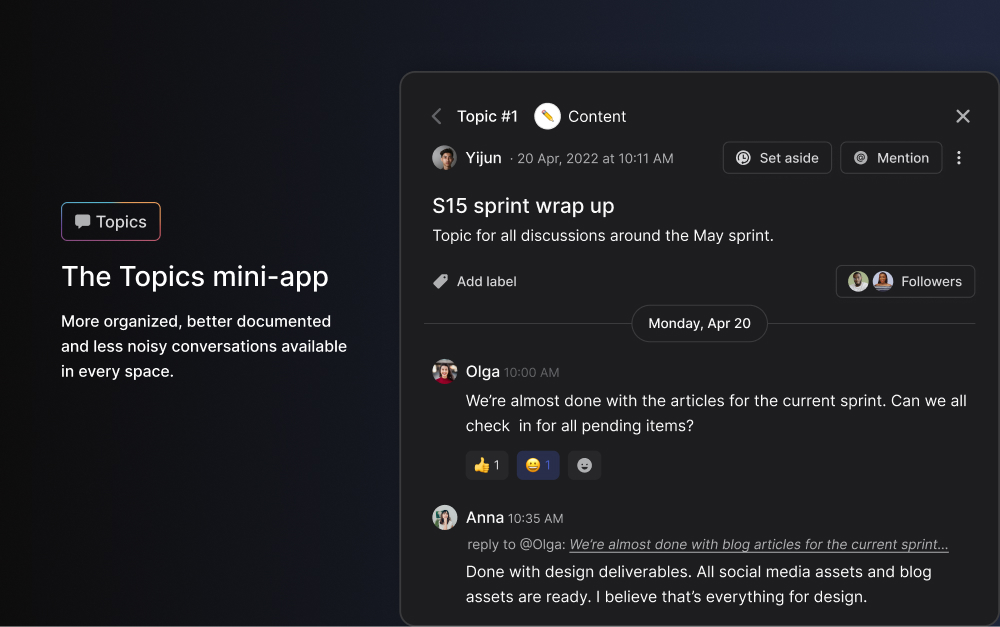
Chat with Topics replaces brainstorm meetings. Topics are threaded discussions inside a chat space. Instead of scheduling a call to "discuss the new campaign," we open a Topic, share the brief, and everyone weighs in over 24 hours. The conversation stays organized and searchable, unlike a call that disappears the moment it ends.
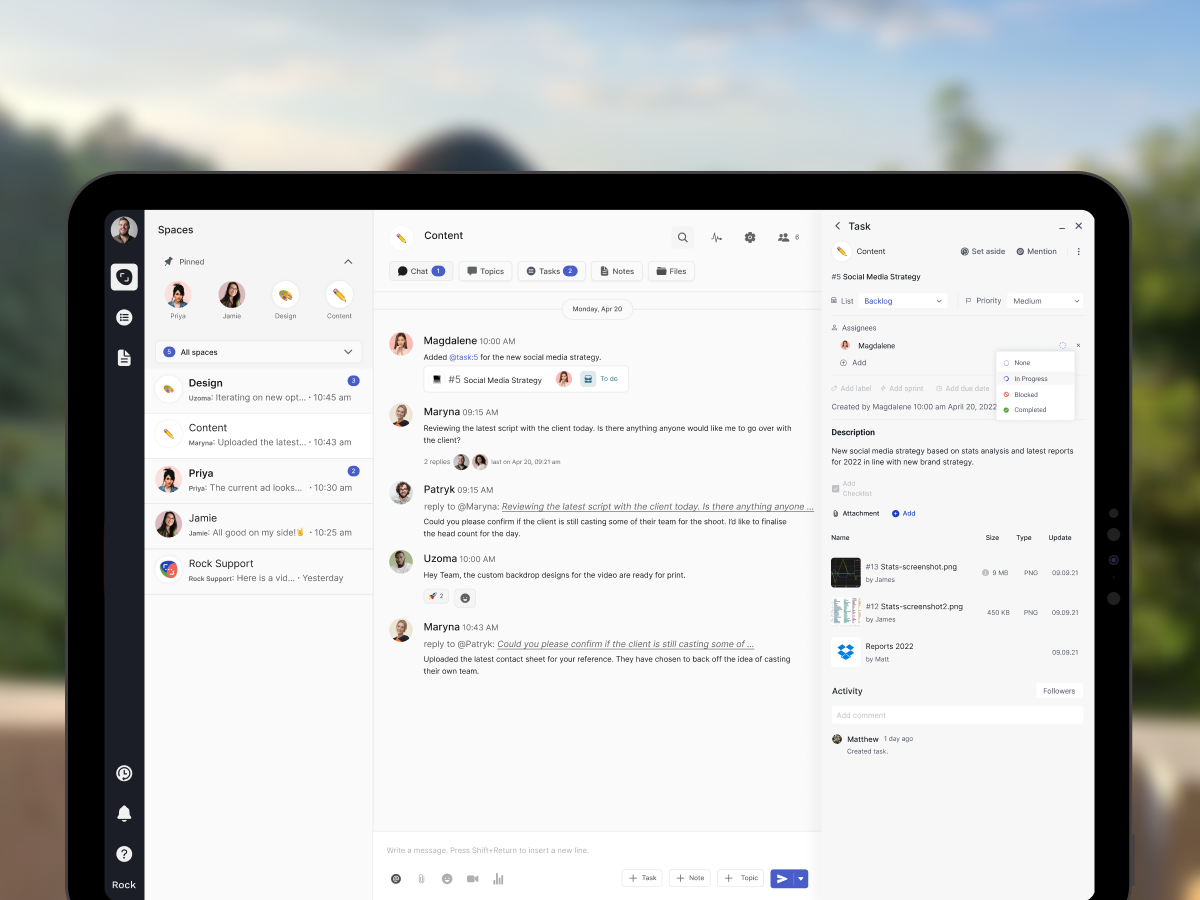
Task boards replace standups. Each person's tasks are visible on a shared board with status columns. You can see who is working on what without asking. No daily standup needed. If something is blocked, it is visible. If a deadline is slipping, you catch it from the board, not from a meeting.
Notes with comments replace follow-up meetings. You know the pattern: someone says "I will send that after the call," and then a follow-up meeting happens because the document never arrived. In Rock, notes live inside the same space as chat and tasks. You write the note, tag the people who need to review it, and they comment directly. No extra meeting required.
Tap-to-organize converts messages into tasks. When someone drops a request in chat, you can turn that message into a task with one tap. It keeps the original context, assigns an owner, and sets a deadline. Discussions become action items without scheduling a "let's align on next steps" call.
To be honest, we still meet. Relationship building, sensitive feedback, and complex decisions are better face-to-face. But those meetings make up maybe 20% of what used to be on our calendars. The other 80% found a better home in async formats. For the calls that stay, our meetings mini-app starts Zoom, Meet, or Jitsi in one click from any space.
The biggest shift was not the tools. It was the habit. Instead of defaulting to "let's schedule a call," the default became "let's put it in a Topic" or "can you update the task?" Meetings became something you choose deliberately, not something that fills your calendar by inertia.
Every time you are about to schedule a call, ask: could this be a message, a task comment, or a shared note? For the calls worth keeping, an AI meeting assistant captures the decisions. If yes, skip the meeting. Your team's time, and your company goals, will thank you.
If you are looking for ways to say no to meetings more often, need better check-in questions, or want ready-made agenda templates for the meetings you do keep, those guides can help too. And our Zoom vs Google Meet comparison covers the video tool you actually pick for those meetings.
The bottom line is this: your meetings have a price tag whether you track it or not. Shopify made the invisible visible, and the results speak for themselves. You do not need a company-wide reset to start. Pick your most expensive recurring meeting, run the numbers, and ask honestly whether that time could be spent better. Most of the time, it can.
Want to replace your costliest meetings with async updates? Rock combines chat, tasks, and notes in one workspace. One flat price, unlimited users. Get started for free.