
The first 90 days set the trajectory for everything that follows. A new hire who feels lost in week two often never catches up. A new hire who ships something real by day 30 builds momentum that compounds for years. Most managers know this. Few have a plan that turns it into a rhythm.
This 30-60-90 day plan template gives you that rhythm out of the box. Three task lists for the three phases, 32 seed milestones, three pinned notes for setup and self-checks. Customize once, run it for every new hire.
What is in this template
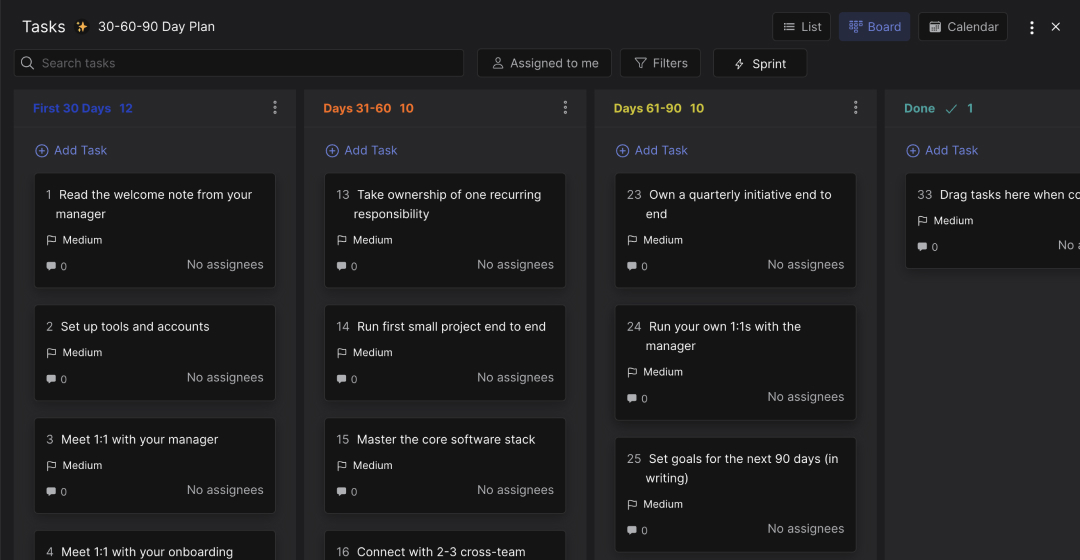
The workspace contains four task lists matching the structure of the 30-60-90 day framework. Each list comes pre-loaded with milestones that move the new hire from learning to contributing to owning their work.
First 30 Days (Learn). 12 tasks covering setup, introductions, training, and one shipped deliverable. The first month is for absorption, not output. Tasks include 1:1 meetings with the manager and buddy, reading internal docs, shadowing a teammate on live work, and ending with a Day 30 self-check and review.
Days 31-60 (Contribute). 10 tasks covering ownership of recurring work, running a project end-to-end, and connecting with cross-team partners. The bar gets higher. Each task is concrete enough that you can tell whether it was met.
Days 61-90 (Own). 10 tasks covering quarterly ownership, setting next-period goals, identifying team gaps, and a full performance check-in. By Day 90 the hire is leading their own 1:1s and proposing improvements, not just executing yours.
Done. A list to drag completed milestones into. The visual progress matters during onboarding, especially in the first 30 days when wins feel small.
Try it: build a 30-60-90 plan
Drag milestones between phases to plan your onboarding rhythm. Add your own.
Meet 1:1 with manager and buddy
Set up tools and access
Read internal docs and SOPs
Shadow a teammate on a live project
Lead first small project
Master the core software stack
Connect with cross-team partners
Own a quarterly initiative
Set goals for the next 90 days
Identify one gap to fill on the team
Drag cards between phases or add your own
Tap a card, then tap a phase
"The actions you take during your first few months in a new role will largely determine whether you succeed or fail." - Michael D. Watkins, Author of The First 90 Days and Professor of Leadership at IMD Business School
Three pinned notes for instant setup
The space includes three notes designed to make the template usable from day one.
How to use this template. A 5-minute setup checklist for the manager: rename the space, edit the welcome message, set due dates, assign tasks, pair the new hire with a buddy.
Welcome message. A copy-paste welcome the manager edits once with role priorities and team rhythm, then sends to the new hire on Day 1. Replaces the generic "welcome to the team" note that says nothing useful.
Self-check questions. Phase-boundary questions for the new hire to run through at end of Day 30, 60, and 90. The plan is the manager's tool. The questions are the new hire's.
Why columns work for onboarding teams
The classic 30-60-90 plan is a document. It works for one-time leadership transitions. For a team running this for every new hire, columns are better.
Columns are visible. The new hire and manager can see at a glance where the rhythm is breaking. If Day 35 arrives with seven tasks still in First 30 Days, that's a signal to talk, not a paper-trail to bury. Gallup found only 12% of employees strongly agree their organization does a great job of onboarding. The pattern most teams fall into is good intentions on Day 1 followed by silence by Week 3. Columns force the conversation.
What we do at Rock: every new hire gets a copy of this space, paired with a recurring weekly 1:1 task between hire and manager. Chat lives in the same workspace as the tasks, so questions and progress show up together. By Day 90, the space becomes the reference for the next-quarter planning conversation, not a discarded checklist.
"Research and conventional wisdom both suggest that employees get about 90 days to prove themselves in a new job. The faster new hires feel welcome and prepared for their jobs, the faster they will be able to successfully contribute to the firm's mission." - Talya Bauer, Cameron Professor of Management at Portland State University, in the SHRM Foundation report Onboarding New Employees
Who this template is for
Best for: Managers onboarding their first or fifth direct hire who want a repeatable rhythm instead of reinventing the plan each time. Agencies that hire freelancers and contractors regularly and need a structured ramp without bespoke documents. Remote and distributed teams where casual context-building does not happen automatically.
Skip this if: Your role has a fully formal HRIS-driven onboarding flow with required compliance steps. The template is operational, not legal. Use it alongside your formal onboarding, not as a replacement.
Tips for getting started
Customize once, then leave it alone. The first time you use the template, spend 15 minutes adjusting tasks for the role and team. After that, treat the structure as fixed. The next hire gets the same rhythm. Consistency is what makes the template valuable.
Set due dates relative to the start date. Open the space, set Day 1 to the actual start date, then propagate due dates across all tasks (Tasks 1-12 in the first 30 days, 13-22 in days 31-60, 23-32 in days 61-90). Dates make the rhythm real.
Resist filling Done with placeholder tasks. The Done list looks better empty on Day 1. Watching it fill up over 90 days is part of the motivation. The first time the new hire drags a task into Done, they realize the plan is theirs.
Use the self-check questions, not just the tasks. Tasks are the what. Self-check questions are the why. At each phase boundary, the new hire should be able to answer most of the questions honestly. If they can't, the plan needs adjusting before moving on.
"In the absence of clear indicators of what it means to be productive and valuable in their jobs, many knowledge workers turn back toward an industrial indicator of productivity: doing lots of stuff in a visible manner." - Cal Newport, Author of Deep Work and Georgetown Professor


