
Most agency pipelines live in a spreadsheet nobody updates, an inbox nobody filters, and the founder's head. See how marketing agencies run their client pipeline on Rock without any of that. By the time a deal closes, the team has lost track of why it came in, how long it took, and what the source actually was. Next quarter's growth conversations are guesses instead of decisions.
This template gives you a live pipeline board for the agency sales process. Five columns from Leads to Won and Lost, with labels that tell you where your pipeline comes from, what size your deals are, and whether you are selling projects or retainers.
What is in this template
5 columns. Leads (untouched or new inbound). Discovery (active conversation, qualifying fit and budget). Proposal (scope and price out, negotiating). Won (signed, hand off to onboarding). Lost (archived, re-engage at 6 months).
3 label dimensions. Source (Referral, Outbound, Inbound, Event, Marketplace) — the most valuable label on the board, because it tells you where deals actually come from when you zoom out. Type (Project, Retainer) — different sales cycles and margin profiles. Deal size (Small under $5K, Medium $5-25K, Large $25K+) — keeps your attention on the cards that move the number.
13 seed tasks. Five instruction tasks that teach the flow, the title convention, and the Monday review cadence. Eight example prospect cards spread across all five columns so the board looks populated on day one. Delete the instructions once your team knows the playbook.
Pinned reference note. Short cheat-sheet with the BANT-lite qualifying checklist for Discovery, copy-paste proposal follow-up emails (day 5 nudge, day 12 final), the 6-month Lost re-engagement script, and the four escalation signals that tell the sales lead when something is off.
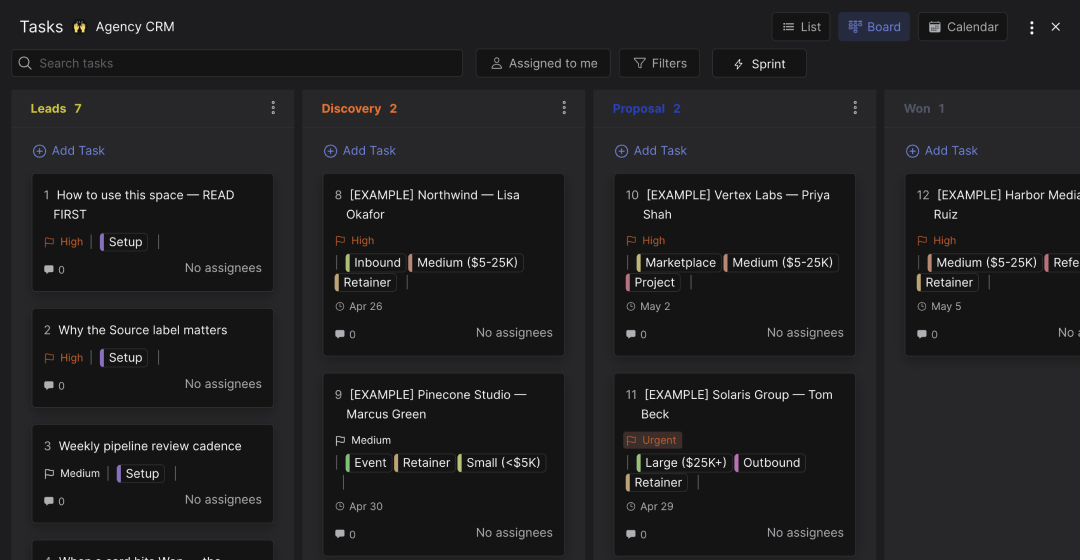
The 5 pipeline stages
Leads. Every new prospect before a real conversation. Cold outbound, inbound from your site, referrals, event follow-ups, marketplace pings. Move out within 14 days or the lead goes stale.
Discovery. First call happened, you are qualifying fit. Before moving to Proposal, confirm Budget, Authority, Need, Timeline. Skip this and you end up writing proposals for unqualified leads.
Proposal. Scope (captured in the scope of work) and pricing are out. Follow up on day 5, final nudge on day 12, then move to Lost with reason "Ghosted." Over 14 days without a reply is the escalation signal.
Won. Signed. Trigger the onboarding handoff: duplicate the Agency Client Onboarding Checklist template, invite the client, start Stage 1. Archive the CRM card after the week.
Lost. Keep Lost cards visible for 1 quarter so the team can spot patterns. Same reason appearing 3+ times in a quarter is a sales-process issue, not a client-fit issue. Archive at 90 days, re-touch promising contacts at 6 months. The warmest re-engagements are contacts whose new agency relationship did not pan out — often because of a poor offboarding from the previous shop.
Try the board
Here is a working preview. Drag cards between columns to see how the pipeline flows, or drop one in Won to close the deal.
Preview: Agency CRM & Pipeline board
Drag cards between columns to see how the pipeline flows. Drop one in Won to close the deal.
Drag cards between columns or add your own
Tap a card, then tap a column header
Why most agency CRMs fail
Generic CRMs like HubSpot, Salesforce, and Pipedrive are built for volume sales teams. Hundreds of leads, SDR workflows, complex deal stages, lead scoring. Most agencies have 10 to 40 active leads at any given time and a team that is part-time on sales. Loading that into a full CRM is like using a cargo ship to move three boxes.
"The agency pipelines that actually close are the ones the team looks at every Monday. A pretty CRM nobody opens is worse than a shared spreadsheet, because you are paying for the illusion of control." - Nicolaas Spijker, Marketing Expert
The spreadsheet does not work either. It rots. People forget to update it, fields go out of sync, and by month two nobody trusts the data. The board in a shared workspace works because it is where the team already works. Chat, files, and tasks on the same card. When a card moves from Proposal to Won, everyone sees it in the channel they already watch.
Who this template is for
Best for: agencies and studios with 10 to 40 active leads at any time. Marketing, design, development, or consulting firms running a mix of projects and retainers. Teams of 5 to 50 where sales is done by the founder, an account lead, or a small BD group, not a dedicated sales org.
Skip this if: you run heavy outbound with more than 100 leads per week and need lead scoring, sequences, and deal automation. That is CRM territory and you should pay for a real one. Also skip if you are a solo freelancer with 2-3 leads a month. A checklist in your notes does the job.
Tips for getting started
Start with 10 real leads. Move your current pipeline into this space and see if the five columns fit your actual flow. Most agencies find that Discovery is where deals silently die. Having a column for it is the point.
Tag Source from day one. This is the one habit that compounds. Three months in, you will filter by Source and see exactly where your best deals come from. That is your growth plan, not a guess.
Invite the rest of the team into the space. On Rock, members join at no extra cost under the flat plan. When your account lead, designer, and project manager all see the pipeline, the handoff from Won to onboarding gets faster.
"Pipeline visibility is not about tracking; it is about accountability. When the team can see what is stuck, the conversation shifts from 'who is doing what' to 'what is blocking us from closing.'" - Nicolaas Spijker, Marketing Expert
Review every Monday, 15 minutes. Check five things: Leads older than 14 days without contact, Discovery stalled more than 10 days, Proposals out more than 14 days with no reply, Won cards not yet handed off, and the Lost pattern of the week.
Related reads. Once you win a deal, run the agency onboarding process. For the 15 questions that build the onboarding file, see our client onboarding questionnaire. For turning past wins into future pipeline, read agency referral strategies. For the role that lives on the Won side of the board, see key account manager skills. Once delivery starts, pair this pipeline with our revision and change request tracker to keep scope honest across every revision round.
Ready to see your pipeline on one board?
Use this template for free. Chat, tasks, and team access in one space.
Use this template


