
Your agency has grown from 3 people to 15. Things that used to "just work" do not anymore. Decisions that were obvious when everyone sat in the same room now require alignment. Client acquisition that happened through referrals now needs a strategy. The team that used to share one vision now has three different ideas about where the company is going.
You need a strategy. But "strategic planning" sounds like something Fortune 500 companies do with consultants and three-day offsites. This template makes it practical for a growing team. Five domains walk you through defining your vision, analyzing your market, structuring your organization, identifying your competitive advantages, and setting goals with concrete objectives. It is not a blank planning document. It is a guided process with workflows, checklists, and examples.
What is in this template
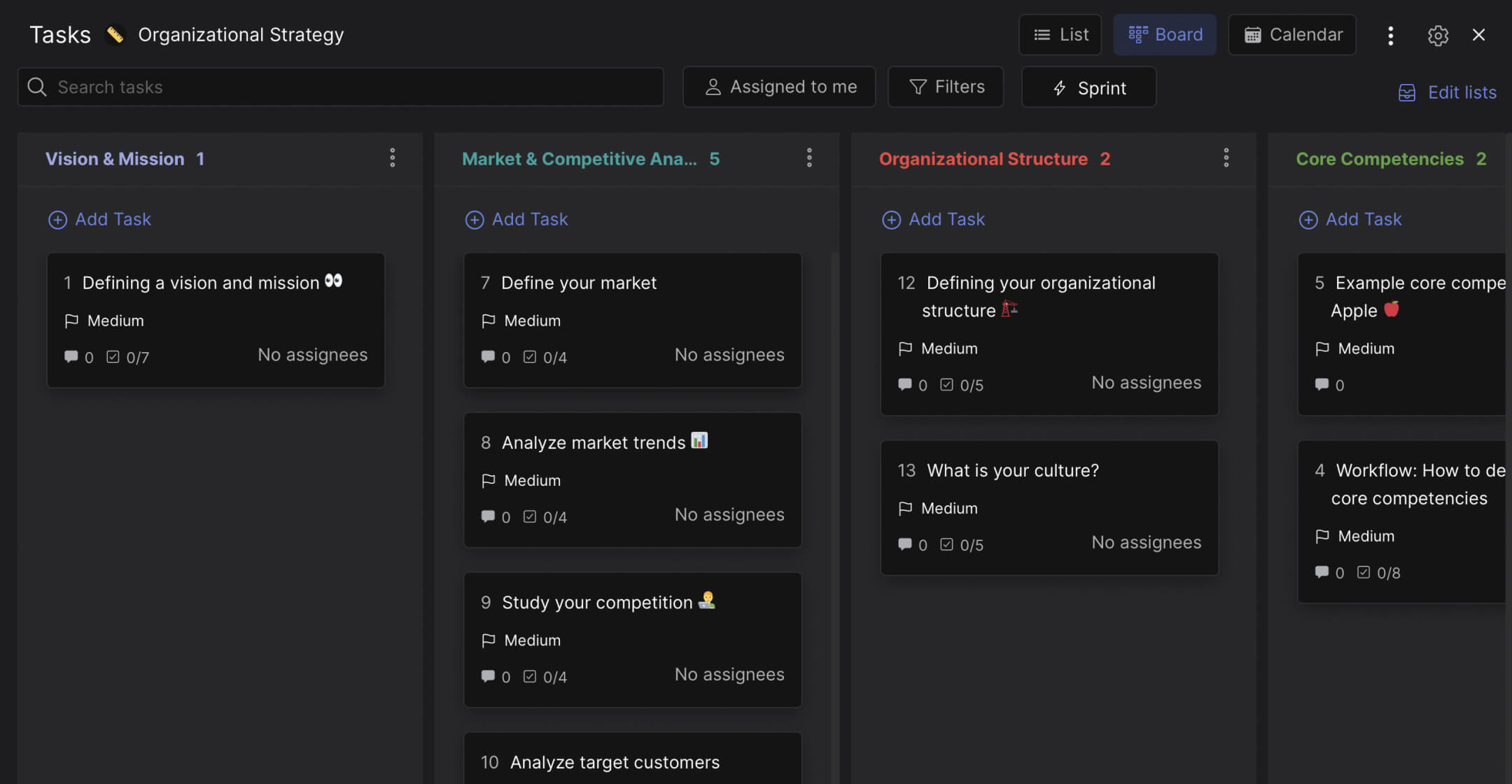
The board covers five strategic domains, each with detailed workflow cards and checklists.
Vision and Mission. A 7-step process: gather input from stakeholders, research your market and competitors, define your organization's purpose, craft a vision statement (ambitious, aspirational), develop a mission statement (specific, actionable), align both with your core values, and communicate them to the entire team. Each step has a checklist item. The result is not a sentence on your website. It is a decision-making filter the team can use every day.
Market and Competitive Analysis. Five analysis tasks: define your market (industry, size, target segments), analyze market trends (growth drivers, PEST factors, emerging shifts), study your competition (direct and indirect competitors, their strategies, their SWOT), analyze target customers (personas, surveys, feedback, reviews), and assess opportunities and threats (new segments, geographic expansion, regulatory changes, Porter's Five Forces). Each task has a 4-item checklist keeping the analysis focused.
Organizational Structure. Two cards: define your structure (choose type, define departments, assign roles, establish reporting, create org chart) and define your culture (values, norms, symbols, leadership style, communication). These are the decisions most small teams skip until a crisis forces them. Documenting them proactively prevents the "who reports to whom?" confusion that slows growing teams.
Core Competencies. A workflow for identifying what makes your organization genuinely different: list capabilities, analyze your value proposition, evaluate competitive advantage, apply the VRIO framework (Value, Rarity, Imitability, Organization), identify patterns, gather feedback, assess sustainability, and prioritize 2-4 core competencies. The template includes an Apple example showing how design integration, brand strength, and supply chain management function as core competencies. For your agency, it might be niche expertise, client retention rate, or speed of delivery.
Goals and Objectives. The SMART framework applied at two levels. A short-term goal example: increase revenue by 20% this fiscal year, with three objectives (improve conversion by 10%, acquire 15% more customers, increase average order value by 5%). A long-term goal example: become an industry leader in 5 years, with three objectives (increase market share by 10%, achieve 95% client satisfaction, introduce 2 new features per year). A workflow card guides you through setting your own: understand customer needs, align with vision, apply SMART criteria, set both timeframes, develop initiatives, allocate resources, define KPIs, implement, and review.
"Culture eats strategy for breakfast. But you still need the breakfast. A team without strategy is just a group of talented people pulling in different directions." - Peter Drucker
Why most small teams skip strategy
When your team is 5 people, strategy is a conversation over lunch. Everyone knows the goals because everyone was in the room when they were set. But somewhere between 10 and 20 people, informal alignment breaks. New hires do not have the context. Decisions that used to be instant now require meetings. The founder's vision lives in their head, not in a document anyone can reference.
According to Harvard Business Review, only 29% of employees can correctly identify their company's strategy. In a 15-person agency, that means 10 of your people do not know where the company is going. They are making daily decisions based on assumptions, not shared organizational strategy.
What we do at Rock: the strategic planning board lives in a shared space where the entire leadership team collaborates. When the vision statement gets refined, everyone sees the update. When a new competitive threat is identified, it goes on the board and gets discussed in the same workspace. Strategy is not a document that lives in a Google Drive folder. It is a living board that evolves as the business evolves.
"Plans are worthless, but planning is everything. The act of working through strategy together aligns the team more than the document itself." - Dwight D. Eisenhower (adapted)
Who this template is for
Best for: Agencies and small businesses with 10-50 people that have outgrown informal strategy. Founders who know they need a plan but have never done formal strategic planning. Teams preparing for a major decision: entering a new market, offering a new service, hiring a new leadership role, or raising investment.
Skip this if: You are a solo freelancer or a 3-person team where everyone is already aligned. At that size, a simple goals and objectives conversation is enough. This template is for when informal alignment stops working.
Tips for running strategic planning
Do not try to complete all five domains in one session. Spread it across a week: Vision on Monday, Market Analysis on Tuesday, Structure on Wednesday, Competencies on Thursday, Goals on Friday. Each domain takes 1-2 hours of focused discussion. Trying to do it all in one day leads to fatigue and shallow thinking.
Involve people beyond the leadership team. The Market Analysis and Core Competencies domains benefit from input from people who talk to customers daily. Account managers know competitive threats. Developers know technical gaps. Designers know where the brand resonates. Their perspective makes the strategy more grounded.
"The best strategies I have seen were not created in boardrooms. They were created by teams who combined leadership vision with frontline reality." - Jim Collins, Author, Good to Great
Review and update quarterly. Strategy is not a one-time document. Markets shift, team capabilities change, client needs evolve. Set a quarterly review where the team walks through the board: is the vision still right? Have new competitors emerged? Are the goals still realistic? Define the scope of each quarterly review so it stays focused and does not become another all-day offsite.


