
Client revisions live in email threads. Change requests get absorbed into existing work without anyone noticing. By month-end, your agency has done 20% more work than the scope covered and the client's last invoice still looks the same.
This template fixes that. A four-column Kanban board that tracks every revision and change request in one place, with labels that make the contractual revision cap visible at a glance. Built for agencies that run retainer or project work with real revision cycles.
What is in this template
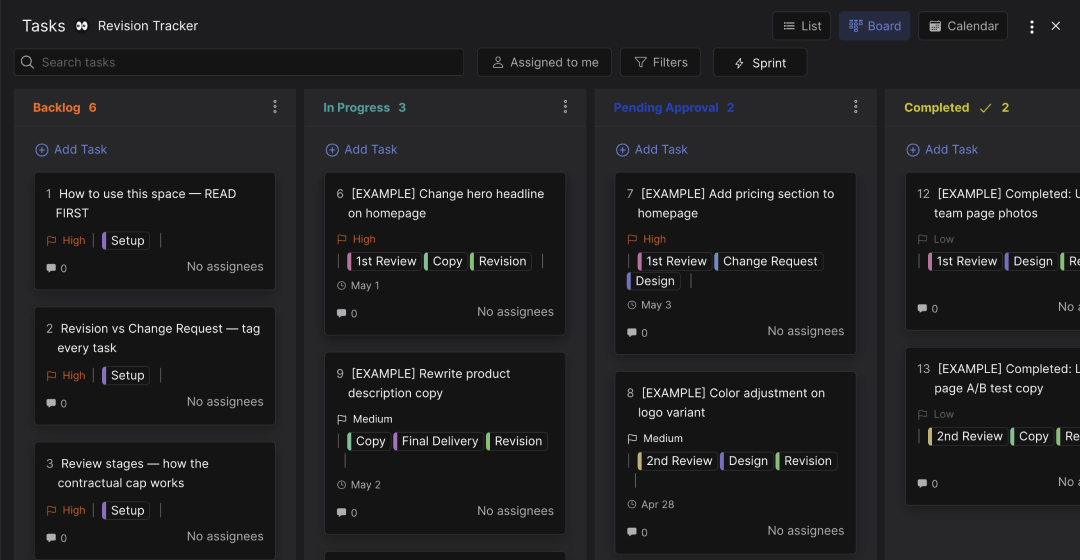
4 columns. Backlog (new, triaged, or rejected-with-major-changes). In Progress (team is actively working). Pending Approval (delivered, waiting on client sign-off). Completed (signed off, done). When the client rejects a delivery, small tweaks send the card back to In Progress. Major rework sends it back to Backlog.
3 label dimensions. Type (Revision vs Change Request), Review round (1st, 2nd, or Final Delivery), and Deliverable category (Design, Copy, Dev, Strategy). The Review label is the most important signal on the board. When a task hits Final Delivery, you know the contractual cap is reached and the next pass goes straight to Completed.
13 seed tasks. Five instruction tasks that teach your team the flow. Eight example revision and change-request cards spread across the columns so the board is populated on day one. Delete the instructions once your team knows the playbook.
Pinned reference note. Short cheat-sheet with the revision-vs-change-request decision test, a copy-paste change order email, and the four escalation signals that tell the account lead when something is about to go wrong.
The one distinction that changes everything
Most agencies lose money not because clients are unreasonable, but because the team silently absorbs work that should have been a change order. The revision vs change request distinction is the whole game.
Revision: the deliverable exists, the client wants it adjusted, and the change fits inside the original scope. Tweak-level work. Usually covered.
Change request: a new deliverable, a materially changed direction, or revision count past the contractual cap. This needs a change order before work starts.
Tagging every card with Revision or Change Request at the moment it enters the board is a 10-second decision that prevents most scope disputes. If you cannot decide, default to Change Request. It is easier to downgrade after a conversation than to backfill later.
Try the board
Here is a working preview of the template. Drag cards between columns to see how the flow moves, or drop one in Completed to close it out.
Preview: Revision & Change Request board
Drag cards between columns to see how the flow works. Drop one in Completed to close it out.
Drag cards between columns or add your own
Tap a card, then tap a column header
Why most revision trackers fail
Revision trackers live in a Google Sheet or Notion page that nobody updates. The team handles the work in Figma, Slack, and a project management tool. The tracker gets filled in after the fact, or not at all, and by the time anyone looks at it the numbers no longer match what actually shipped.
"Most agencies lose money not on the work itself, but on the work they silently agreed to do for free. A visible revision board is the difference between catching scope creep on Monday morning and catching it in the next P and L review." - Nicolaas Spijker, Marketing Expert
What we see on Rock: the tracker lives in the same space as the work. When a designer finishes a revision, the card moves to Pending Approval in the same workspace where the design file sits, the client chat happens, and the handover doc is written. Nothing gets double-entered, nothing goes stale, and the client can be invited into the space at no extra cost to see progress live.
Who this template is for
Best for: marketing, design, and development agencies with 2 or more revision-heavy clients. Retainers in the $2K-25K per month range. Creative or dev deliverables where revisions are normal and change requests happen monthly. See our New Aesthetics case study for a working example from a design studio. Freelancers running multiple clients who need a clearer scope boundary.
Skip this if: your work is one-off projects with no revision cycle (a single deliverable, signed off, done). Or your revisions are strictly internal with no client review step. Or you use a dedicated creative review tool like Ziflow or Filestage for file-level markups. This template covers the workflow layer, not the pixel-level annotation layer.
Tips for getting started
Start with one client. Duplicate the template, rename it for one specific client, and run it for two weeks. Do not roll it out across every account on day one. Two weeks is enough to see whether the four columns match your actual flow.
Tag the round the moment a task is created. The Review label is what surfaces scope creep. A board full of untagged cards tells you nothing. A board with 60% "1st Review", 30% "2nd Review", and 10% "Final Delivery" tells you the client is on the edge of their revision budget and the next three weeks need a change-order conversation.
"The quality of your revision tracking decides whether scope creep becomes a conversation with the client or a surprise in your own margin." - Nicolaas Spijker, Marketing Expert
Invite the client into the space. On Rock this costs nothing; clients join free. When the client can see the board, they self-regulate on the Change Request side because the cost of a new ask is visible, not hidden in email back-and-forth.
Review weekly. Every Monday, 15 minutes. Check what is stuck in Pending Approval (the column where engagements stall), what hit Final Delivery last week (the cap-reached signal), and what is aging in Backlog (the stuff nobody wants to pick up).
Related reads. For the creative direction that sets expectations before revisions begin, see our creative brief template. For the scope language that makes this board enforceable, see our client working agreement template and scope of work template. For the upstream brief that defines what counts as in-scope, see the client brief. For the longer take on scope creep, read never-ending client revisions. For the pipeline board that feeds this one (lead to signed deal), see our agency CRM and client pipeline template.
Ready to bring order to your revision cycle?
Use this template for free. Chat, tasks, and client access in one space.
Use this template


