How Agencies Get Client Referrals: 5 Strategies and a Readiness Score
Cold outreach, paid ads, and sales teams eat through agency budgets fast. The most reliable source of new business costs almost nothing, and most agencies still do not have a plan for it.
A client referral is not a happy accident. It is the result of three things: a relationship that earned the right to ask, a simple system that makes the ask easy, and a thank-you that makes the referrer glad they did it. Get those right and referrals become a channel, not a side effect.
This guide covers the three-part program, five strategies that actually work, three email templates, and the honest cases where referrals will not fill the pipeline. Run the scorecard below first.

Score Your Referral Readiness
Before the strategies, a quick self-check. Five questions, one score, and a next step that fits where your agency actually is today.
Referral readiness scorecard
Five questions. See how ready your agency is to turn clients into a growth channel.
Quick answer. An agency referral strategy combines a written program with rewards, process, and tracking, a habit of asking at the right moments, and a consistent thank-you loop. Get all three right and happy clients become an agency's biggest single source of new business. Referred B2B leads convert at three to five times the rate of cold leads and rarely negotiate the proposal down. The honest caveat: referrals are a quality channel, not a volume one. They will not fill a pipeline fast on their own. Pair them with at least one other channel, then ask directly after every clear client win.
The Referral Math (And the Honest Caveat)
The case for taking referrals seriously is already strong, and it has been for years. Nielsen's Global Trust in Advertising study found that 83 percent of consumers trust recommendations from people they know, making it the highest-trust form of advertising by a clear margin. Frederick Reichheld's research in Harvard Business Review showed that willingness to recommend is the single strongest predictor of sustainable growth across industries.
For B2B specifically, the numbers are even stronger. Referred leads typically convert at three to five times the rate of cold leads, and they usually pay more because the trust is already built. A referred client rarely negotiates the proposal down the way a cold lead does.
The honest caveat. Referrals do not fill a pipeline fast enough on their own. Most agencies cannot control the volume or timing, which means a referral-only strategy leaves you exposed to slow months. Treat referrals as a quality top-up, not your primary growth engine. Pair them with at least one other channel (outbound, content, or partnerships) and you have a pipeline that holds up. Our agency CRM and pipeline template tracks leads by source so you can see which channel is actually paying out.
"The willingness of customers to recommend a company to a friend is the single most reliable indicator of sustainable growth." - Frederick F. Reichheld, Founder of Bain & Company's Loyalty Practice
The Three-Part Referral Program
Before you ask for referrals, you need a program. Three building blocks do most of the work.
Reward both sides. The best referral programs reward the referrer and the new client. Give your existing client a service credit or bonus. Give the new client a welcome offer or faster onboarding. Two-sided rewards feel fair. One-sided rewards feel transactional.
Make the process take two minutes or less. A short email, a shareable link, or a pinned note in the client space. Remove every step that is not strictly needed. If it takes a client longer to refer than it takes to write a LinkedIn DM, they will not bother. Time the ask after project milestones so the momentum is already there, and our client communication habits do most of the work for you.
Keep the reward easy to understand. A service credit, a gift card, a free strategy session, or a discount on next month. Pick one. Complicated tier systems confuse clients and reduce participation. When the value is obvious, more people take part.
5 Strategies That Actually Work
A program gives you the structure. These five strategies give you the flow. Each row in the table below shows the effort required, the realistic timeline to a first referral, and the agency profile it fits best.
| Strategy | Effort | Timeline to first referral | Best for |
|---|---|---|---|
| 1. Ask directly after a win | Low | Days | Agencies with strong client relationships who just need the habit |
| 2. Two-sided referral program | Medium | Weeks | Agencies with 10+ active clients who want a repeatable system |
| 3. Strategic partnerships | High | Months | Agencies with a clear ICP who can find complementary (not competing) partners |
| 4. Case studies and testimonials | Medium | Months | Agencies with impressive results they can publish |
| 5. Past-client reactivation | Low | Weeks | Agencies with 30+ former clients who went quiet after the project ended |
The two strategies with the fastest payoff are asking directly after a win and reactivating past clients. Both lean on a clean offboarding: the thank-you note on day 1 and the check-in at day 30 keep the door open for the referral ask at day 60. Both require low effort and lean on relationships you already have. Strategic partnerships take the longest to pay off but become the most durable source of referrals when they work.
The past-client reactivation play is the most underused of the five. Most agencies have 30 to 100 past clients who went quiet after the project ended. A short check-in email six or twelve months later ("how has the site held up since launch?" or "did the team end up using the playbook?") opens a door without asking for anything. AgencyAnalytics research on high-growth agencies finds that most of their new-client pipeline traces back to relationships that were already in the database, not cold acquisition. Reach out, genuinely, then see where the conversation goes.
Referral Email Templates
Most agencies never ask because they are not sure how to phrase it. Three templates below, each tied to a specific moment when the ask is natural. Copy them, adjust one line per client, send.
| When to send | Template |
|---|---|
| After a project milestone | "Glad we got [milestone] across the line last week. If anyone in your network is thinking about [service area], I would love an introduction. In return, we can offer them a free [audit / strategy call / discount] and you a [service credit / gift card / 10% off next month]." |
| After a clear win (new result, hit goal) | "Really happy with the [specific result: traffic lift, feature shipped, signed deal]. Most of our new clients come from introductions like this one. If you know one person who could use the same outcome, would you be willing to connect us?" |
| Quarterly, as part of a review | "Quick request as part of our quarterly check-in: is there anyone in your network who might benefit from what we do for you? Referrals from [client name] are our best new clients, so I want to ask properly instead of hoping. No pressure either way." |
The common thread across all three: acknowledge the specific result, be clear about the ask, and offer something in return. Vague asks like "know anyone who might need us?" do not work because they put all the effort on the client. Specific asks like "Do you know one [job title] at a [company stage] who is dealing with [problem we solved]?" convert because the client can actually picture one person.
Timing matters as much as wording. An ask right after a delivered milestone lands differently than an ask during a rough patch of the project. Watch for the moments when the client is proud of what you built together. Those are the natural openings. If the project has been bumpy, skip the ask and focus on fixing the work first. A referral earned on rocky ground rarely holds.
Partner Referrals: The Untapped Channel
Client referrals get most of the attention. Partner referrals are quieter but often bigger. A partner is a complementary service provider who talks to the same clients you do but does different work. A web design agency partners with an SEO agency. A content studio partners with a PR firm. A brand studio partners with a packaging designer.
The math is straightforward. One partner with 30 active clients can drive more referrals than 30 clients each trying to introduce one person. Partners also refer differently, without needing a reward structure as rich, because they get the reciprocity back in kind.
How to structure a partner referral relationship. Start with one or two partners, not ten. Agree on a specific commission (10 to 20 percent of first-project value is standard) or a mutual referral cadence (one warm intro per quarter). Document the process in writing so nobody has to remember the deal. Our account manager skills guide covers how to maintain these relationships once they are running.
The mistake most agencies make with partners is treating the relationship as transactional. A partner who only hears from you when you want a referral will refer less, not more. Share leads you cannot serve. Send useful context their way. Introduce them to clients who could benefit from their work. The partners who send you the most business are the ones who genuinely like working with you, not the ones with the highest commission.
When Referrals Will Not Fill the Pipeline
Three cases where referrals alone are the wrong bet, and what to do instead.
You are a new agency with under ten completed projects. The referral base does not exist yet. Clients cannot refer what they have not experienced. In year one, cold outreach and content are cheaper paths to pipeline. Revisit referrals seriously at the 15-to-20-client mark.
You are growing faster than your referral engine can keep up. Growing from five to twenty clients in a year means your referral volume is capped by how many referrers exist. Referrals are a flywheel, not a rocket. Pair them with a faster-ramping channel (outbound, paid, partnerships) for the acceleration.
Your work is too narrow for natural word of mouth. If your clients rarely meet other people in the same situation (a niche regulatory agency, a highly specialized technical service), referrals are structurally slower. Lean into content and SEO so the specific people searching for your service can find you.
Your clients are competitors with each other. Some service categories create natural friction. Two direct competitors will not refer each other, and most clients will hesitate to introduce a rival. If your book is concentrated in a single industry vertical, map the competitive dynamics before leaning on referrals. Cross-industry relationships (B2B SaaS meets fintech meets healthcare) tend to refer more freely than same-vertical ones.
Referrals are a quality channel, not a volume channel. The agencies that treat them that way get the most out of them, without over-relying on them when the math does not work.
What We Do at Rock
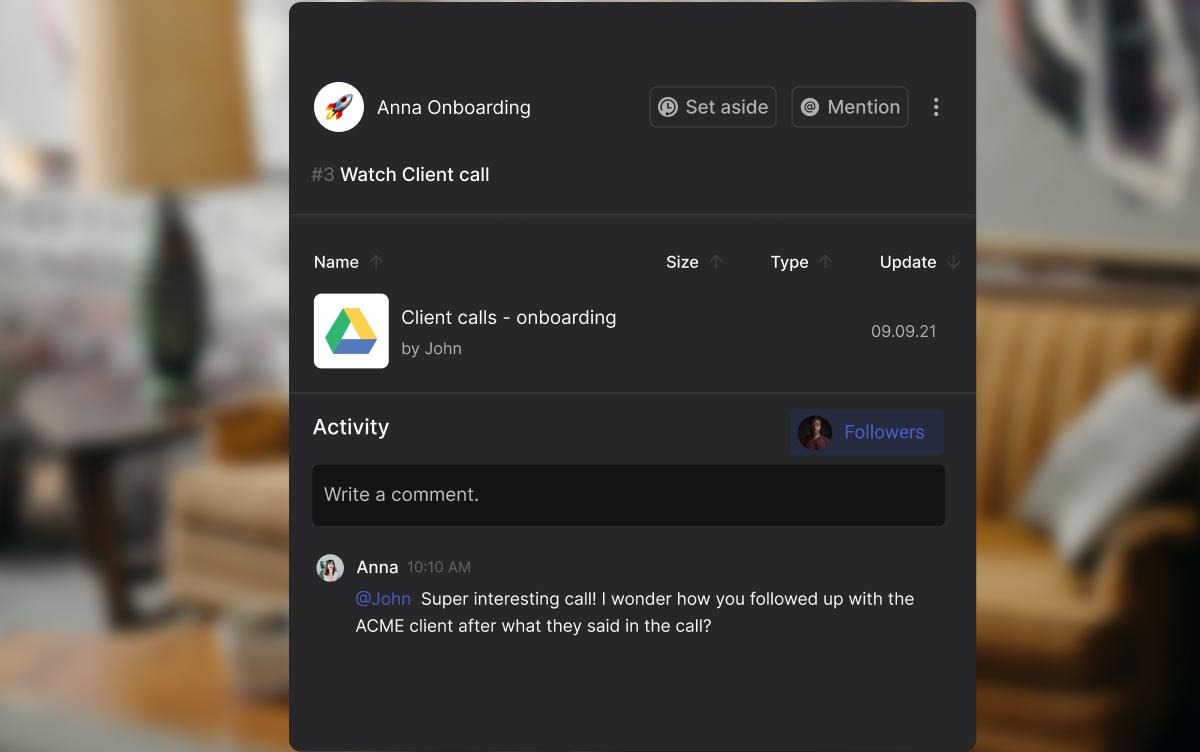
Our own agency and freelancer users get a specific benefit out of running client work inside Rock: the referral ask happens in the same place the work lives. No separate CRM, no awkward tool switch, no "let me find your email" moment. The weekly update, the project celebration, and the referral ask all land in the shared client space.
The pattern we see from users who turn referrals into a channel: they pin a short referral note in each client space after a major milestone. They set a recurring task at the 90-day mark to ask again in the quarterly review. They track referral source as a custom field on the task when a new client lands. None of this requires new tooling. It requires the habit, and the habit lives where the work already is.
What makes this work is less about the software and more about what the software encourages. An agency running clients across five tools (email, WhatsApp, Trello, Drive, and a separate CRM) has no natural moment to ask. The client relationship is fragmented across tools, and so is the ask. An agency running one space per client has a weekly pinned update, a project celebration, and a quarterly review all in one place. The ask sits alongside the work, so it feels like part of the relationship, not a separate sales conversation.
For the broader client relationship side, see our guides on client management for freelancers, the full client management playbook, and client onboarding. Referrals are the last step of a relationship that started on day one.
Referral programs work when the ask lives where the work lives. For the bigger picture of how marketing agencies run client work on Rock, see the use case page. Rock combines chat, tasks, and notes in one workspace so the ask feels natural. One flat price, clients join free. Get started for free.