Client Onboarding Questionnaire: 15 Questions + Template
A good client onboarding questionnaire saves you weeks of realignment later. A bad one wastes everyone's time and sets the tone for a sloppy engagement. The difference is usually not the number of questions. It is whether each question actually needs an answer you do not already have.
This guide covers 15 questions every agency should ask during onboarding and add-ons for marketing, design, dev, social, and SEO. Three ways to actually send the questionnaire, plus the mistakes to avoid. Run the widget first for a starter tailored to your service.
Build Your Questionnaire
Before the 15 questions, a tailored starter. Three quick answers and the widget outputs a customized questionnaire (10 to 15 questions) built around your service type and client complexity.
Build your questionnaire in 30 seconds
Three questions. Get a tailored starter questionnaire you can copy into your onboarding flow.
Quick answer. A client onboarding questionnaire is a short written survey sent to new clients before the kickoff meeting. It captures the context your team needs to deliver (goals, stakeholders, brand, access) without using the kickoff itself for basic information gathering. Good ones stay under 15 questions. Great ones only ask what the sales process did not already answer. If you are not yet capturing sales context per lead, our agency CRM and pipeline template gives you the board to hold that context before it turns into an onboarding call.
The 15 Essential Questions
These 15 questions cover contact, business context, goals, access, preferences, and risk. Each one earned its place because the answer directly changes how you start the engagement. Group them in the questionnaire (do not present them as one long list) so the client can answer in focused batches.
| Category | Question | Why it matters |
|---|---|---|
| Contact | 1. Who is your primary contact, and what is the best way to reach them? | Defines the default communication channel from day one. |
| Contact | 2. Beyond the primary contact, who makes final decisions on this work? | Prevents the "approver surprise" in week three. |
| Contact | 3. Who else on your team needs to be kept informed, even if not deciding? | Catches stakeholders who will review the work later. |
| Business | 4. In 2-3 sentences, what does your business do and who are your main customers? | Forces the client to articulate their own positioning, which often surfaces mismatch. |
| Business | 5. Who are your top 3 competitors and what do you do differently? | Positions the work against the landscape the client actually operates in. |
| Business | 6. What is the one business outcome this engagement most directly affects? | Forces alignment on the one number that matters. |
| Goals | 7. What does success look like at 30, 60, and 90 days? | Defines the milestones you will be reviewed against. |
| Goals | 8. What specific metric will you use to measure whether this worked? | Turns a feeling into something you can both track. |
| Goals | 9. Is there an external event or deadline we should be working back from? | Surfaces hard dates that change how you sequence the work. |
| Access | 10. What accounts, tools, or systems will we need access to? | Prevents the week-three discovery that you never got analytics access. |
| Access | 11. What brand assets, guidelines, or existing materials can you share? | Saves the team from rebuilding what already exists. |
| Access | 12. What existing documentation or processes should we review first? | Surfaces knowledge the client assumes you have. |
| Preferences | 13. What communication cadence do you prefer (daily, weekly, only when needed)? | Sets the rhythm before they have a chance to expect something different. |
| Preferences | 14. What was your last agency experience? What worked, what did not? | Gives you the unspoken rules of engagement in one answer. |
| Risk | 15. What is the biggest risk or concern you have about this engagement? | Surfaces the real blocker early enough to address it. |
Question 14 ("what was your last agency experience, what worked, what did not") is the one most agencies skip and most clients appreciate. It surfaces the unspoken rules in the relationship and gives you the shortest path to understanding how they already think about working with an agency. Question 15 (biggest risk or concern) is the early warning system. If their answer is "honestly, I'm nervous about scope creep," you know to build the scope agreement carefully in week one.
Why 15 Questions Beats 37
Most onboarding questionnaire templates online run between 20 and 40 questions. AgencyAnalytics publishes a 37-question version. They are not wrong about the value of each individual question. They are wrong about what a real client will answer.
The response rate on a 15-question questionnaire is dramatically higher than on a 37-question one. This is not a nuance. It is the difference between a filled-out questionnaire and one that sits in the client's inbox for three weeks while you chase them. The goal is not to ask everything you might want to know. The goal is to get clean answers to the questions that change how you deliver.
Three rules for choosing which questions survive the cut. First, cut anything sales already asked. If the sales rep captured it, document it, do not ask again. Second, cut anything you can research (company size, industry vertical, current website stack). Third, cut anything that would not change your approach no matter what the answer is.
The third rule is the one most agencies skip. If the answer "we use HubSpot" versus "we use Salesforce" would not change your proposal, your timeline, or your week-one plan, the question is a vanity question. It makes the questionnaire feel thorough without making your work better. Cut it.
"The quality of your questions is more important than the quantity. Asking fewer but better questions forces clients to engage, and their answers are more honest when they know you respect their time." - Nicolaas Spijker, Marketing Expert
Service-Specific Add-Ons
The 15 above are the baseline for any agency. Add three to four service-specific questions on top, depending on what you are actually delivering. The table below covers the six most common agency service categories.
| Service type | Add these questions on top of the 15 |
|---|---|
| Marketing and content | Current funnel performance (leads, conversion, cost per acquisition). Existing creative library or content bank. Paid channel spend and attribution setup. |
| Design and brand | Existing brand system we are working within or replacing. Moodboard or visual references. Font licenses and design tool preferences. |
| Development and engineering | Current tech stack and deployment process. Admin access holders for repos and infrastructure. API docs or architecture notes. |
| Social media management | Platform priorities and platforms explicitly not a focus. Tone, voice, and content library. Competitor handles to benchmark against. |
| SEO | Current rankings and target keywords. Site CMS and technical SEO state. Link profile and past penalty history. |
| Virtual assistant or ops | Tools the client expects you to master. Daily or weekly recurring tasks. Approval workflow for anything sent externally. |
Keep these additions tight. Adding five extra questions per service is tempting but pushes you past the response-rate threshold. If you run multiple service lines at once, prioritize the add-ons that matter for week-one delivery, and leave deeper questions for the 30-day review. ContentSnare's research on onboarding questionnaires reaches a similar conclusion: focus on the questions whose answers change your immediate delivery plan.
How to Actually Send It
The format matters almost as much as the questions. Three options, each with a clear best-fit.
Shared document. The most flexible format. Google Doc or shared note that the client fills in asynchronously, with room for long answers and follow-up comments. Best for retainer-style engagements where the questionnaire becomes a living reference throughout the project.
Form. Typeform, Jotform, or a built-in form tool. Best for one-off projects where you need clean, structured answers and do not need discussion. Faster for the client, less flexible for follow-up.
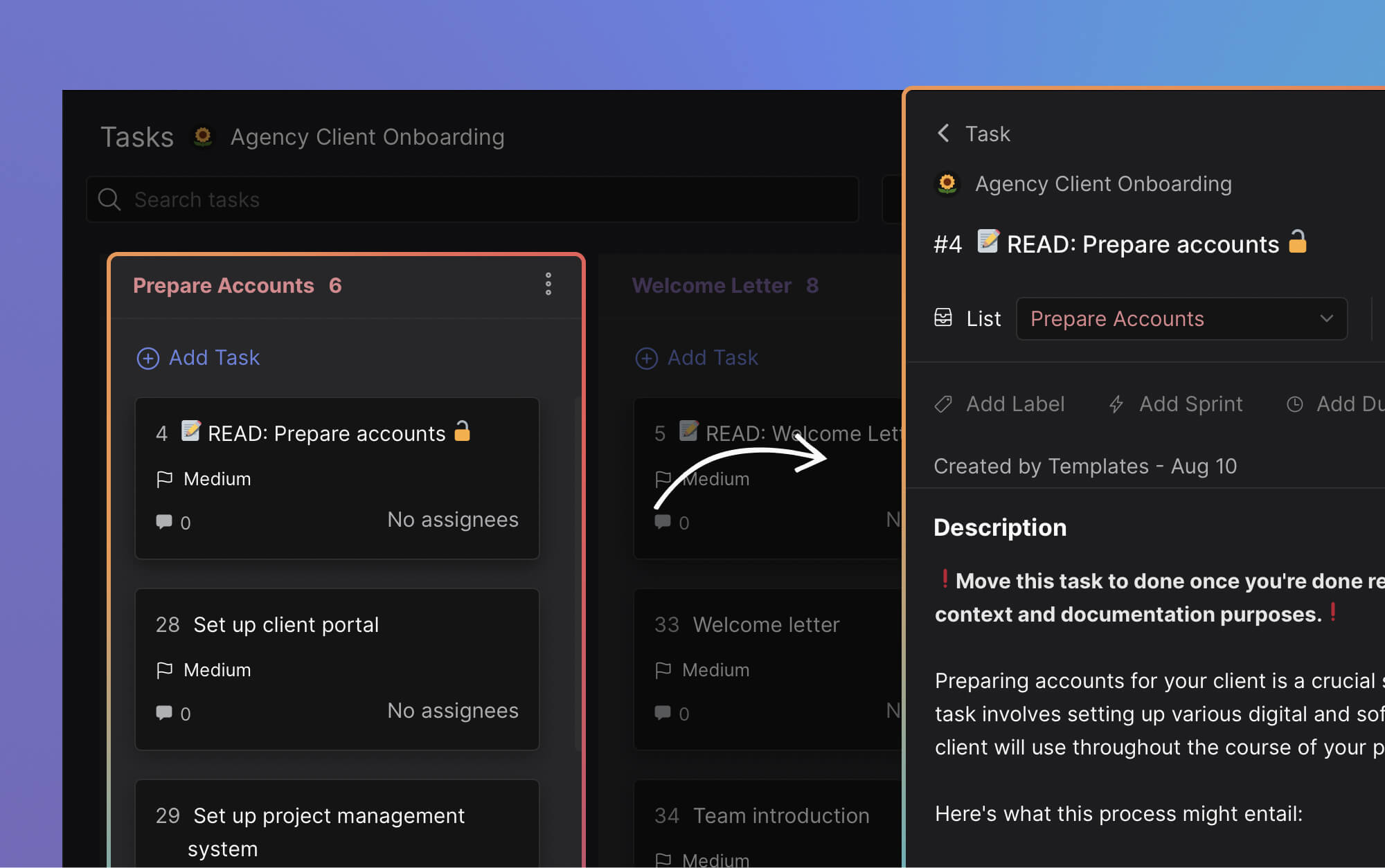
Pinned task in a shared client space. The questionnaire sits inside your shared client workspace with comments, attachments, and the rest of the engagement context in one place. Best for agencies running client work in a collaborative tool rather than email. Sets the tone that the workspace is where everything lives, starting day one.
Avoid sending a questionnaire by email attachment. PDFs that need to be printed, filled, scanned, and emailed back are the most reliable way to kill your response rate. For the communication pattern that supports this, see our guide on communicating with clients.
When to Send It and What to Do If They Ghost
The timing of the questionnaire matters almost as much as the questions. Send it within 48 hours of the contract being signed, while the client is still in onboarding mode. Wait longer and the project has already started in their head, which makes the questionnaire feel like backtracking.
Pair the send with a short message, not a cold email. Two or three lines explaining why you are asking, how long it will take (be honest, usually 20 to 30 minutes), and when you need the answers by. Give a specific deadline: "before our kickoff call next Wednesday" works better than "whenever works for you."
If the client goes quiet, send one follow-up at day three with a reminder and an offer: "Happy to jump on a 15-minute call and go through these live if that is easier." Most late responders take you up on this, and the call itself becomes a soft kickoff.
If the client still has not responded by day seven, the questionnaire is probably not the real problem. Something else in the relationship needs attention first. Use the meeting agenda templates for a structured check-in call to surface what is actually going on.
Common Mistakes
Four patterns that sink otherwise good questionnaires.
Asking for information sales already captured. If the sales rep knew the client's industry and revenue tier, do not ask again. Pre-fill what you know before sending. Tony Gambill writing in Forbes makes this clear: good questions show you have already done your homework, not that you need the client to do it for you.
Treating the questionnaire as discovery. The questionnaire captures context the client already knows about themselves. It is not a research tool for you to understand their industry. Research their industry first, then send a questionnaire that asks only about the specifics of their situation.
Not following up on vague answers. "We want to grow" is not an answer. "We want to double Q3 bookings over Q3 last year" is. If a client's answer is generic, send a one-line follow-up that weekend (not two weeks later) asking for a specific number. Silent gaps become assumption gaps.
Skipping the questionnaire entirely for repeat or familiar clients. Even clients you know well have non-obvious expectations for a new engagement. The questionnaire is the forcing function. A five-minute version (five questions, not fifteen) is still better than skipping it and hoping for the best in week one.
Writing questions in your language, not theirs. "What is your target ARR trajectory?" reads fine to an agency, but a non-SaaS client might not know what ARR means. Run the questionnaire past someone outside your bubble before sending. If a question needs to be translated for the reader, it will either get a vague answer or get skipped. Plain language always wins response rates over technical precision.
What We See on Rock
Rock is a product, not an agency, so we do not run onboarding questionnaires ourselves. What we do see, every day, is how the agencies that use Rock handle this stage of onboarding. The pattern among agencies with the highest client retention is consistent.
They create one shared space per new client on the day the contract is signed. The questionnaire lives as a pinned task at the top of that space, with questions grouped by category and the client able to leave answers as task comments. The team sees responses come in during the week, asks follow-ups in the same task, and has clean context by the kickoff meeting. The next step after collecting answers is writing them up into a team-facing client brief. When the kickoff happens, it is alignment on a plan, not basic information gathering. See our client kickoff meeting agenda and script for how to structure that alignment in 60 to 120 minutes.
The agencies that struggle tend to run the questionnaire in email or a separate form tool, then manually copy answers into their PM tool after. Every client ends up with their own reconstruction process, and the context is incomplete by month two. For the full 7-stage onboarding flow that this questionnaire sits inside, see our onboarding process walkthrough.
One concrete habit worth stealing from the best performers: they revisit the questionnaire at the 30-day review. Answers that were slightly wrong in week one (because the client did not fully know the answer themselves) can be corrected in week four, when the real dynamics are clearer. This also gives the client a built-in moment to raise anything that is not working, without making it feel like a complaint. A 15-minute conversation around the questionnaire at day 30 is worth more than a formal retrospective at day 90.
Harvard Business Review research on client retention makes the economics plain: a 5 percent lift in retention can raise profits by 25 to 95 percent. The questionnaire is the first moment you earn that lift, or do not. Clients who feel heard in week one renew far more often than clients who feel processed.
For related reading in the onboarding cluster, see our client onboarding checklist for the tier-based framework. Our 7-stage onboarding process covers the full flow. And our scope of work template is the document that follows the questionnaire. For a working example of a solo-operator running client work in one space, see our Fosca freelance case study. For the freelancer version of the same process, see client management for freelancers.
A good questionnaire sets the tone for the whole engagement. For the freelancer angle on running a questionnaire-driven intake, see how freelancers and solo operators use Rock. Rock combines chat, tasks, and notes in one workspace so the questionnaire, the answers, and the project all live together. One flat price, clients join free. Get started for free.