10 Best Messenger Alternatives for Business (2026)
Facebook Messenger is fine for quick personal chats, but it was never built to run a business. No task management, no project structure, and your work threads tangled up with personal ones. As a team grows, those gaps start costing real time.
This guide covers 10 Messenger alternatives built for professional teams, grouped by what you are trying to solve: chat plus tasks, customer messaging, budget, privacy, or self-hosting. Each includes real pricing, who it is best for, and when to skip it.
Quick disclosure: we are the team behind Rock, one of the alternatives below. We build in this space and run these tools next to Rock, so we know where each is strong and where it is not. This is the honest landscape, not a pitch.
Messenger Alternatives: Quick Comparison
Here is a side-by-side overview of all 10 tools before the details.
| Tool | Best For | Free Plan | Paid From |
|---|---|---|---|
| Rock | Chat + tasks, flat pricing | 3 spaces, 5 members | $89/mo flat |
| Slack | Integrations, threading | 90-day history | $7.25/user/mo |
| Microsoft Teams | Office 365 teams | Unlimited chat | $4/user/mo |
| Google Chat | Google Workspace | Personal Gmail | $7/user/mo |
| WhatsApp Business | Customer messaging | Free app | API per-conversation |
| Pumble | Free Slack alternative | Unlimited history | $2.49/user/mo |
| Discord | Communities and voice | Unlimited members | Free (Nitro $9.99/mo) |
| Signal | Privacy-first messaging | All features free | Free (nonprofit) |
| Telegram | Free channels and groups | All features free | Premium $4.99/mo |
| Rocket.Chat | Self-hosting | 50 users (self-hosted) | $8/user/mo |
Why Look for Messenger Alternatives?
Facebook Messenger is fast, free, and everyone on your team already has it. In parts of the world where a business is really a WhatsApp and Facebook page, Messenger is how clients reach you and how your team talks all day. More than 947 million people use it monthly, and for many small businesses it is the default channel.
The problem is that Messenger was built for personal chat, not work. There is no task management, no separation between your sister's vacation photos and a client brief, no admin controls, no audit trail when an employee leaves. End-to-end encryption only became the default for personal chats in late 2023, and even then, business messaging through Meta's API still goes through Meta's servers in plain form.
If your business runs on Messenger today and you are starting to feel the cracks, these 10 alternatives cover the realistic options for team communication, customer messaging, and privacy-first setups in 2026.
Short on time? Take the 30-second quiz to get a personalized recommendation.
Which Messenger alternative fits your business?
Answer 4 questions. Takes 30 seconds.
1. What matters most to you?
Select all that apply
2. How many people will use it?
3. Do clients or external people need access?
4. What's your budget?
Start over

More than a chat app
Rock pairs messaging with tasks and notes for client and team work. Flat price, unlimited users.
Best Messenger Alternatives for Professional Teams
1. Rock - Best for Teams That Need Chat and Tasks Together
Unlimited: $89/month flat or $74.92/month annual
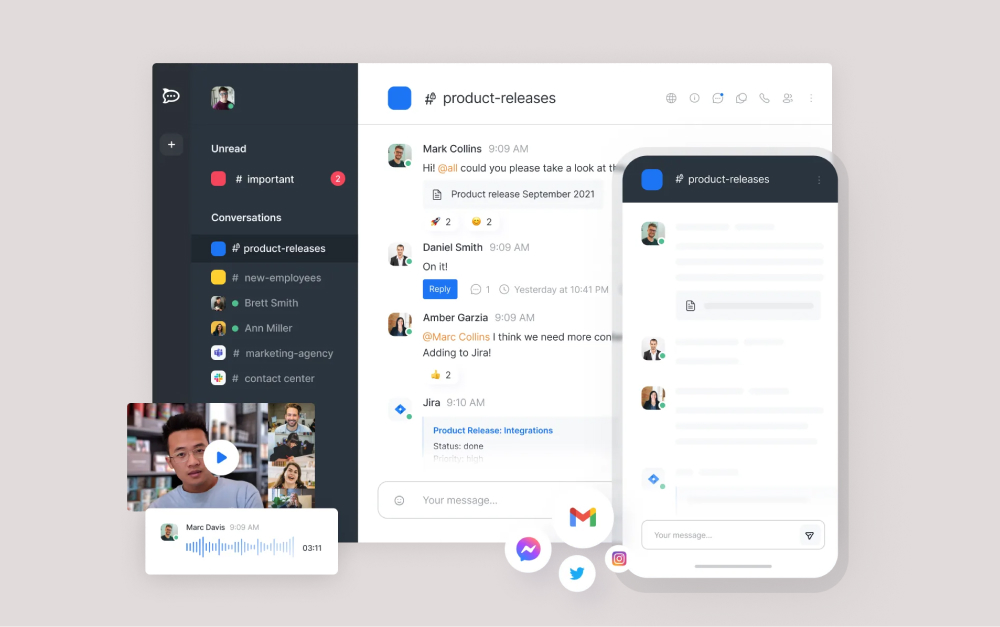
Rock combines team messaging with task management, notes, and file sharing in one workspace. Each project lives in its own space with chat next to a task board, so conversations and work sit in the same place instead of in Messenger and a spreadsheet.
For small businesses and agencies, the standout feature is cross-organization collaboration. Clients, freelancers, and contractors join your spaces at no extra cost. There is no guest limit and no per-seat pricing. The flat $89 a month covers unlimited users, which matters when your team size swings between projects.
Rock is simpler than enterprise tools like ClickUp or Monday.com. You will not find Gantt charts or advanced automations. But if your main problem is "we talk in Messenger and track everything else in our heads," putting both in one place solves a very specific kind of chaos.
What we do at Rock: each client project has its own space with chat, tasks, and files in one view. When a client sends a request, we turn the message into a task with one click. No searching Messenger threads for what was agreed three weeks ago.

Rock also ships a native MCP server, so AI assistants like Claude, Cursor, and ChatGPT can operate your workspace directly: read messages, create tasks, and search across spaces. It is available on the free plan, not gated behind an enterprise tier.
2. Slack - Best for Teams That Live on Integrations
Pro: $7.25/user/month (annual)
Business+: $12.50/user/month
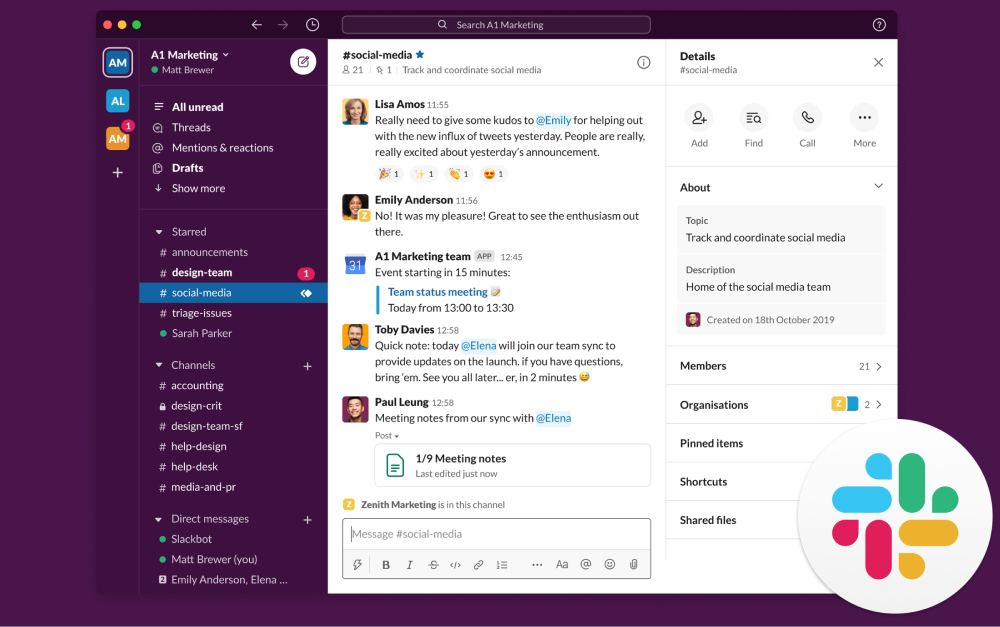
Slack is the professional standard for internal team messaging. Channels, threads, and search make it easy to keep conversations organized by client, project, or topic. The real strength is the ecosystem: more than 2,600 integrations connect Slack to nearly every tool your team already uses.
Compared to Messenger, Slack gives you real admin controls, SSO on higher tiers, audit logs, and data retention policies. Threads are far more structured than Messenger's reply system, and Workflow Builder automates routine tasks without code.
The trade-off is cost. Slack's free plan limits message history to 90 days, which is painful for client work. Pro starts at $7.25 per user per month. For a 15-person team that is over $100 a month, a real jump from the free Messenger habit.
3. Microsoft Teams - Best for Office 365 Organizations
Essentials: $4/user/month
M365 Business Basic: $6/user/month
Microsoft Teams bundles chat, video meetings, and deep integration with Word, Excel, SharePoint, and OneDrive. If your business already pays for Microsoft 365, Teams comes included.
Teams covers enterprise needs that Messenger cannot: SSO, compliance reporting, audit logs, data loss prevention, and retention policies. The meeting experience is more robust than Messenger's video calls, with screen sharing, breakout rooms, recording, and live transcription.
The downside is that Teams is built for large organizations, and it shows. The interface can feel heavy for small teams and the mobile app is slower than Messenger. If you are not already inside the Microsoft ecosystem, the setup cost is hard to justify.

4. Google Chat - Best for Google Workspace Teams
Business Starter: $7/user/month (30 GB)
Business Standard: $14/user/month
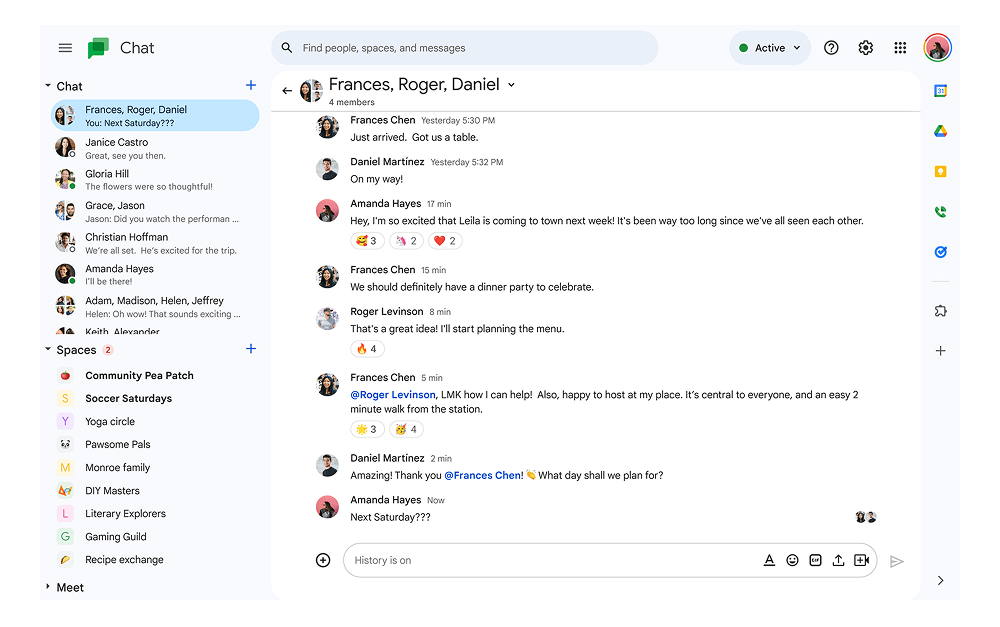
Google Chat connects directly to Docs, Sheets, Calendar, Drive, and Meet. You can create or edit documents inside a chat thread without opening a new tab. Gemini AI summaries are built in on higher tiers.
For businesses where Google Workspace is already the default, Chat is the natural messaging layer. The interface is clean. Spaces, which are group conversations, support threads and file sharing. Admin controls and data retention are handled through the Workspace admin console.
Google Chat is not sold on its own. It is part of Google Workspace, which starts at $7 per user per month. As a chat tool by itself, it is basic compared to Slack: no workflow builder, limited bot ecosystem, less granular notifications.
The practical impact is that the vast majority of one-on-one Telegram conversations, and literally every single group chat, are probably visible on Telegram's servers.
Best Messenger Alternatives for Customer Communication
5. WhatsApp Business - Best for Customer-Facing Messaging in Key Markets
API: per-conversation pricing, varies by country and category
WhatsApp Business is the most direct upgrade from Messenger for one specific reason: it is where your customers already are. In Brazil, India, Indonesia, and most of Latin America and Southeast Asia, WhatsApp is the default business communication channel, with over two billion monthly active users worldwide.
Compared to Facebook Messenger, WhatsApp Business offers a cleaner separation between business and personal profiles, a catalog for products and services, labels to organize conversations, automated greetings and away messages, and a business profile with hours, website, and address. The free app works for small operations. The API, billed per 24-hour conversation, scales to agency and enterprise use cases.
Keep in mind that WhatsApp Business is also owned by Meta, so the data privacy concerns that push people away from Messenger do not fully disappear here. Messages are end-to-end encrypted by default, but metadata still flows to Meta.

Budget-Friendly Messenger Alternatives
6. Pumble - Best Free Slack-Style Alternative
Pro: $2.49/user/month
Business: $3.99/user/month
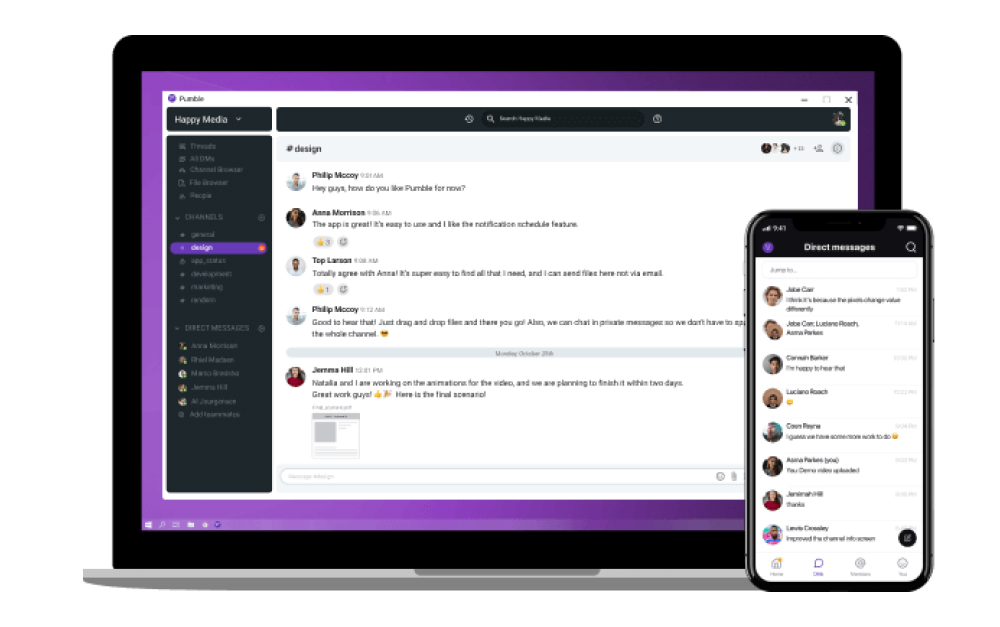
Pumble is a free Slack clone with one real advantage over Slack: unlimited message history on the free plan. Messenger does not search work chats well, and Slack charges for history beyond 90 days. Pumble gives you channels, threads, direct messages, and voice or video calls without paying anything.
The free plan supports unlimited users with 10 GB of total workspace storage. Paid plans start at $2.49 per user per month and add screen sharing, guest access, and integrations with Clockify for time tracking and Plaky for project management.
7. Discord - Best for Large Communities and Voice
Nitro Basic: $2.99/month (individual)
Nitro: $9.99/month
Discord is the closest Messenger alternative for community-style conversations. Servers, channels, roles, and always-on voice rooms let you organize hundreds or thousands of people with better moderation than a Messenger group chat could ever manage.
The free tier is generous: unlimited members, unlimited text channels, and voice channels for up to 25 participants. Discord is not built for professional work though. There is no task management, no client workspaces, and no enterprise admin features like SSO or audit logs on the free plan.
For businesses running public communities, customer forums, or large volunteer groups, Discord is a solid fit. For confidential work with clients, look at Rock, Slack, or the privacy tools below instead.

Privacy-Focused Messenger Alternatives
8. Signal - Best for Privacy-First Messaging
Signal is what Messenger's security branding wishes it was. Every message, call, group chat, and file is end-to-end encrypted by default, not as an opt-in. The Signal Protocol is open source and actually powers the encryption behind WhatsApp and several others.
Signal Foundation is a nonprofit. No ads, no trackers, no shareholders. The app is free and funded by donations. For journalists, lawyers, activists, or any business where client confidentiality is non-negotiable, it is the default recommendation from security researchers.
The trade-off is that Signal is a messenger, not a workspace. There are no channels in the business sense, no task management, no file versioning, no admin console. For a team that needs private communication but still uses other tools for work, Signal sits alongside them rather than replacing them all.
9. Telegram - Best for Free Channels and Large Groups
Telegram Premium: $4.99/month (individual)
Telegram is free, fast, and handles groups that would cripple Messenger. Supergroups hold hundreds of thousands of members and channels broadcast to millions. The bot API is solid, and Telegram Premium adds extras like larger file uploads and custom emoji for under $5 a month.
The privacy reputation is misleading though. Default Telegram chats are not end-to-end encrypted. Only Secret Chats are, and you have to enable them manually for every one-on-one conversation. Group chats are never end-to-end encrypted. For a business looking to escape Messenger's data practices, Telegram is not actually an upgrade on privacy.
Telegram works well as a broadcast or community tool, and it runs without requiring each user to have an account tied to Facebook. That alone is why many teams switch.

We cannot share data in response to valid legal requests that we never had in the first place.
Self-Hosted Messenger Alternatives
10. Rocket.Chat - Best for Self-Hosting and Data Control
Pro: $8/user/month (51-500 users)
Enterprise: custom
Rocket.Chat is open source and self-hosted, giving you full control over your data. For businesses handling sensitive client information or operating under data residency rules, this matters more than any marketing claim Meta could make about Messenger. You can run it on your own servers or use their managed cloud.
Features include channels, threads, end-to-end encryption, omnichannel support (live chat, WhatsApp, SMS), and white-labeling. The free self-hosted plan supports up to 50 users, which covers most small business teams.
Tools We Did Not Include (and Why)
Workplace from Meta: Meta's own business messaging product was shut down in 2024 and is no longer accepting new customers. Existing customers had to migrate by mid-2025, so it is not a forward-looking option.
Intercom, Zendesk Messaging, HubSpot Chat: Strong for customer support but priced and scoped as help-desk platforms, not team messaging. Different buyer, different budget. Worth looking at if your only goal is replacing Messenger for customer service, not team communication.
Viber, Line, WeChat: Dominant in specific regional markets but not built for team workflows or cross-border business use outside those regions.
Wire, Threema, Element: Solid privacy-first options, but pricing and enterprise fit are aimed at specific niches (EU compliance, Swiss jurisdiction, government). For most small businesses, Signal or Rocket.Chat cover the same ground at a lower price.
Run client work in one place
Rock keeps chat, tasks, and files together per project. Built for teams and agencies.
How to Choose the Right Messenger Alternative
If your main use is customer messaging in WhatsApp-heavy markets: WhatsApp Business is the like-for-like upgrade. Your customers are already there.
If you need internal team chat plus tasks in one tool: Rock keeps conversations and work in the same space at a flat price. Clients join for free.
If integrations are your priority: Slack has the largest ecosystem. Almost every tool your business uses connects to it.
If you already use Microsoft 365 or Google Workspace: Teams or Google Chat is the path of least resistance. Messaging is bundled with productivity.
If budget is the top priority: Pumble offers a genuinely free Slack-style experience with unlimited history. Discord works for large communities at no cost.
If privacy is the main reason you are leaving Messenger: Signal is the consumer default. Rocket.Chat covers self-hosted team messaging.
The lens that actually matters here is simple. Chat apps are where conversations happen, and a workspace is where decisions turn into work. For a small business the question is not which app is most popular. It is which one keeps the conversations and the work in the same place.
Want to see how other messaging apps compare? Browse Slack alternatives, Telegram alternatives, and Discord alternatives for more options.
The right communication tool keeps your business focused without adding complexity. Rock combines chat, tasks, and notes in one workspace. One flat price, unlimited users. Get started for free.