Power-Interest Grid: Mendelow's Matrix Explained
The Power-Interest Grid is the stakeholder-mapping framework most project teams reach for when they need a fast answer to "who do we engage how?" It plots every stakeholder on a 2x2 grid: power on one axis, interest on the other. The resulting quadrant tells you whether to manage them closely, keep them satisfied, keep them informed, or just monitor.
This guide covers what the Power-Interest Grid is and the two dimensions that drive placement. It walks through the four quadrants and their recommended strategies, how to apply the grid in five steps, and the mistakes that turn a useful framework into a slide nobody opens. Use the Power-Interest Builder widget below to map your own project's stakeholders.
Quick Answer: What Is the Power-Interest Grid?
The Power-Interest Grid is a 2x2 stakeholder mapping tool that classifies stakeholders by their power to influence outcomes and their interest in the project. The four quadrants are Manage Closely (high power, high interest), Keep Satisfied (high power, low interest), Keep Informed (low power, high interest), and Monitor (low power, low interest). The framework was introduced by Aubrey Mendelow in 1991 and is often called Mendelow's matrix.
"Stakeholder mapping is a planning concept emphasizing organizational responsiveness to those who hold power over and interest in the project's outcome." - Aubrey Mendelow, Environmental Scanning: The Impact of the Stakeholder Concept (1991)
Run it at project kickoff and re-run it at every phase gate, then set an engagement cadence for each quadrant.
Origin and Why It Works
Mendelow developed the framework while working at Kent State University in the late 1980s, and presented it at the Second International Conference on Information Systems in Cambridge, MA in 1991. He was responding to the same gap that R. Edward Freeman's 1984 stakeholder theory had identified: organizations had stakeholder lists but no way to prioritize. Freeman defined stakeholders as broadly relevant; Mendelow gave practitioners a tool to decide who deserved attention this quarter.
"A stakeholder is any group or individual who is affected by or can affect the achievement of an organization's objectives." - R. Edward Freeman, Strategic Management: A Stakeholder Approach (1984)
Freeman's definition is the upstream theory; Mendelow's grid is the downstream practical tool. Most stakeholder analysis today uses both. Freeman's broad definition identifies everyone. Mendelow's grid prioritizes. PMI's Project Management Institute curriculum, MBA programs, and corporate change management all teach the pair together.
The framework's persistence is mostly about its simplicity. Two binary scores produce four cells with clear engagement strategies. You can run it in 20 minutes with sticky notes. The trade-off is loss of nuance: the Salience Model's three attributes capture stakeholder dynamics the 2x2 cannot. Use the Power-Interest Grid as the first-pass filter and a more granular framework for high-stakes work.
When to Use the Power-Interest Grid
The grid earns its place in three specific moments. First, at project kickoff, to set engagement strategy before the team commits to a stakeholder communication plan. Second, before any major scope or contract change, when the stakeholder landscape may have shifted. Third, when a project hits a politically tense moment and the team needs a defensible map of who matters.
It is less useful in three other situations. Solo or two-person projects do not have enough stakeholders to justify the grid; the prioritization is obvious. Highly regulated work (pharmaceutical trials, public-sector tenders, financial audits) needs the Salience Model's urgency dimension because regulatory deadlines drive priority more than power or interest alone. And projects with complex coalition dynamics need a relationship-focused framework like Aaltonen and Kujala's multilateral salience extension; the 2x2 cannot capture how stakeholders interact with each other.
For most agency, marketing, product, and IT projects in the 5 to 50-person team range, the Power-Interest Grid is the right first-pass tool. Run it at kickoff, re-run at every phase gate, and add a more granular framework only when the stakes warrant the extra detail. The cost of skipping the exercise is rarely visible at kickoff and almost always visible at month three, when an unmanaged stakeholder surprises the project.
The 2 Dimensions: Power and Interest
The whole framework rests on two binary dimensions. Get either definition wrong and the placements drift; get both right and the quadrants almost place themselves.
Power. The stakeholder's ability to influence the project's outcome. Power can be formal (org-chart authority, budget control, regulatory authority, contract signoff) or informal (coalition leadership, media reach, technical veto). A stakeholder has power if they can make the project change direction, slow down, or stop.
Interest. How much the stakeholder cares about the project's outcome. Distinct from power: a CEO has high power across every project but high interest only in some. A frontline operator has low formal power but high interest if the project changes their daily work. Interest measures attention and emotional stake, not authority.
The most common conceptual mistake is collapsing interest into influence. A stakeholder can be highly interested without being able to influence the outcome, and the framework only works if you keep the two dimensions independent.
Power-Interest Grid Builder
Type each stakeholder, then click the quadrant where they belong: Manage Closely (high power, high interest), Keep Satisfied (high power, low interest), Keep Informed (low power, high interest), Monitor (low power, low interest). The grid below updates as you click.
The widget above is the version we hand to project teams running this exercise live. Add stakeholder names, click the quadrant where each belongs, and the grid populates as you go. The pre-filled "Project sponsor" example demonstrates the Manage Closely quadrant; the empty row below it is where you start your own.
The 4 Quadrants and Recommended Strategy
Each quadrant maps to a specific engagement strategy. Mendelow's original framing assumed organizations would respond differently to stakeholders by quadrant; the strategies below are the modern, project-management formulation refined across thirty years of practice.
| Quadrant | Profile | Strategy | Examples |
|---|---|---|---|
| Manage Closely | High power, high interest | Top priority. Engage actively, involve in decisions, communicate frequently. These stakeholders can make or break the project. | Project sponsor, executive committee, key client decision-maker, regulator with active jurisdiction |
| Keep Satisfied | High power, low interest | Keep informed but do not overwhelm. Maintain confidence; activate them when key decisions need their backing. | Senior executives outside the project, board members, parent-company finance, major shareholders |
| Keep Informed | Low power, high interest | Keep them in the loop with regular updates. They lack authority but care deeply; can become advocates if engaged well. | End users, dedicated team members, community groups, niche customer cohorts |
| Monitor | Low power, low interest | Minimum effort. Periodic check-ins. Watch for any change in their power or interest that would push them up the grid. | Adjacent teams not directly affected, general public, media not actively covering the project |
The most under-managed quadrant is Keep Satisfied. High-power-low-interest stakeholders feel safe to ignore until they suddenly care, at which point they have the power to disrupt and no relationship history with the team. A monthly executive briefing is cheap insurance.
The most over-managed quadrant is Keep Informed. Project teams default to high-touch engagement with anyone who shows interest, even when the stakeholder has no power. The right move is regular updates (newsletters, digests, dashboards) without consuming the team's bandwidth. Save the high-touch engagement for Manage Closely.
How to Apply the Power-Interest Grid in 5 Steps
The mechanics are straightforward; the discipline is in scoring power and interest independently and re-running the grid as the project changes. Five steps separate teams that get value from teams that produce a static slide.
- List the stakeholders Pull names from the project charter, the org chart, contracts, regulators with jurisdiction, end-users, vendors. Aim for 10 to 25 names. The grid will sort them; the job at this stage is exhaustive identification.
- Score each stakeholder on power Power is the ability to influence the project's outcome, formally or informally. Use a binary high/low decision unless you have rich data; binary forces a clearer conversation than 1-to-10 scoring.
- Score each stakeholder on interest Interest is how much the stakeholder cares about the outcome. Distinct from power: a CEO has high power across every project but high interest only in some. Be specific to this project; the same person can sit in different quadrants on different work.
- Place each in one of the four quadrants Manage Closely (high power, high interest), Keep Satisfied (high power, low interest), Keep Informed (low power, high interest), Monitor (low power, low interest). The Power-Interest Builder above does this directly: type the name, click the quadrant, see the grid populate.
- Set engagement cadence per quadrant Manage Closely gets weekly touchpoints and decision-involvement. Keep Satisfied gets monthly executive updates. Keep Informed gets weekly newsletters or digests. Monitor gets quarterly check-ins plus a trigger to escalate if power or interest changes.
The fifth step (engagement cadence per quadrant) is where most failures happen. Identifying who is in Manage Closely is easy; defining what weekly engagement actually means (a 30-minute call? a written update? a co-decision in the steering committee?) is the work. Pin the cadence to the calendar with named owners.
Free resource: Stakeholder Engagement Plan template
Power-Interest Grid vs Other Stakeholder Frameworks
The Power-Interest Grid is one of several stakeholder frameworks, each answering a different question. The table below shows where each fits in your stakeholder toolkit.
| Framework | Dimensions | Best for |
|---|---|---|
| Power-Interest Grid | Power x Interest (2x2, 4 quadrants) | Quick segmentation by attention level; setting engagement strategy by quadrant |
| Salience Model | Power, Legitimacy, Urgency (3 attributes, 7 types) | Identifying which stakeholders deserve priority right now, especially when claims compete |
| Stakeholder Map | Visual map (often Influence x Interest, free-form) | Plotting all stakeholders at a glance, including informal relationships and coalitions |
| RACI Matrix | Responsible / Accountable / Consulted / Informed (per task) | Defining who does what on a project; clarifying decision rights, not stakeholder priority |
| Stakeholder Onion (or Circle) | Concentric rings: core team, project, organization, external | Mapping proximity to the work; useful for communication frequency planning |
The pragmatic stack we recommend works in layers. Use the Stakeholder Map first to identify everyone visually. Run the Power-Interest Grid for fast 2x2 prioritization. Layer on the Salience Model when you need finer-grained prioritization (especially for the Manage Closely quadrant). Use the RACI matrix separately for decision rights on the engagement plan.
Common Mistakes
The patterns below show up across teams that adopt the Power-Interest Grid and lose the value within one or two project phases. Most are about treating the framework as a static slide rather than a live operating exercise.
- Confusing interest with influence Interest is "how much do they care about this outcome?" Influence is part of power: "can they affect the outcome?" Many articles collapse the two and end up with a Power-Influence grid, which is meaningless. Mendelow's distinction is the whole point; keep them separate.
- Scoring the person, not the situation A CEO has high power across every project but high interest only in some. Score each stakeholder against this specific project, not their general organizational role. The same person sits in different quadrants on different work.
- Treating placement as static Power and interest both shift. A regulator with no current claim is a Monitor; the same regulator after a public incident is Manage Closely overnight. Re-run the grid quarterly and after any significant change in scope, regulation, or context.
- Ignoring the Keep Satisfied quadrant until it is too late High-power-low-interest stakeholders feel safe to ignore, right up until they suddenly care. Then they have the power to disrupt and no relationship history with the team. A monthly briefing is cheap insurance against this exact failure mode.
- Treating Monitor as "do nothing" Monitor is the lightest engagement, not zero engagement. Quarterly check-in plus a trigger condition (what would push them to a higher quadrant) keeps the watch list useful. Without that trigger, low-power-low-interest stakeholders escalate before anyone notices.
- Building the grid alone, not with the team Power-Interest scoring works better with three or four perspectives in the room. The PMs who run this exercise solo consistently misjudge interest levels, especially for technical or operational stakeholders. Run it as a 30-minute team session, not as homework.
The biggest is the static placement trap. The whole point of the framework is that placement can change as the project unfolds. A regulator who is currently in Monitor can move to Manage Closely overnight after a public incident. Run the exercise quarterly at minimum, plus after every material context change.
What We Recommend
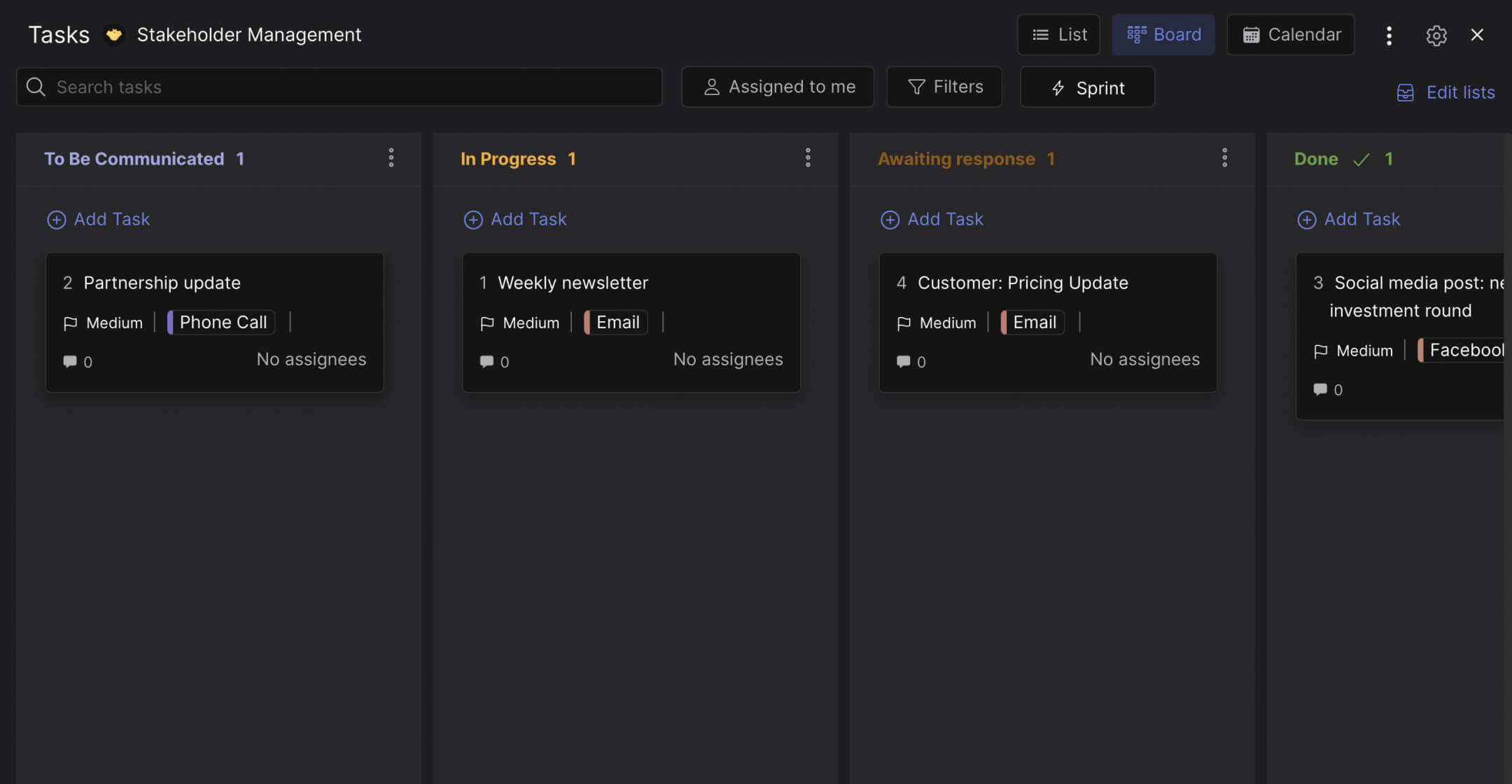
At Rock we run the Power-Interest Grid as a 30-minute team exercise pinned inside the project workspace. The output is a note with the four-quadrant placement, named owners per Manage Closely and Keep Satisfied stakeholder, and an engagement cadence written next to each name. The placement updates at every phase gate; tasks for each engagement live in the same workspace as the project work.
The reason for keeping the grid inside the project workspace is the failure mode otherwise. Stakeholder maps that live in slide decks become decoration; they get reviewed at kickoff and forgotten when the team is heads-down. A pinned note with the current grid plus tracked tasks for each engagement keeps the model alive when the project actually needs it.
Pair this with the broader stakeholder toolkit. The Stakeholder Map handles visual planning. The Salience Model handles finer-grained 7-type prioritization. The RACI matrix handles decision rights. Our stakeholder communication guide covers the cadence of how you engage each priority tier.
Pin the Power-Interest Grid inside the project workspace. Rock combines chat, tasks, and notes in one workspace. One flat price, unlimited users. Get started for free.