What Is a Communication Plan? 5 Elements + 6 Steps + Templates
Communication failure is the most expensive project risk on the table. The Project Management Institute estimates 29% of projects fail from poor communication. PMI also reports that $75 million of every $1 billion spent on projects is at risk from it. The PMBOK Guide puts the share of a project manager's time spent communicating at 75 to 90 percent.
A communication plan is the cheapest insurance against all of that. This guide covers what one is and the five essential elements. It also walks through six steps to build one, five template types, a worked example, and the pitfalls that quietly drain plans.
Quick answer. A communication plan is a written document that defines who needs what information, when, through which channel, and who delivers it. It turns ad-hoc updates into a predictable system instead of stakeholders chasing the team. The five essential elements are goals and objectives, stakeholders and audiences, key messages, channels and frequency, and roles and owners. A plan is the operational layer, not a strategy, a project schedule, or a stakeholder map. Most teams need one for any project running longer than two weeks, involving more than three stakeholders, or crossing time zones. Build it in six steps and review it at each milestone.
What is a communication plan
A communication plan is a written document that defines who needs what information, when, through which channel, and who delivers it. It turns ad-hoc updates into a predictable system. Stakeholders stop chasing the team, and the team stops over-explaining the same thing five times.

It is not the same as a communication strategy. A strategy is the why and the long view (what voice we use, what we stand for, what brand of communicator we want to be). A plan is the operational layer (what we will send next Tuesday, to whom, in which channel). Strategies are written once a year. Plans get written per project, per launch, or per quarter.
Teams need a communication plan whenever the work runs longer than two weeks, involves more than three stakeholders, or crosses time zones. Distributed teams, agency-client work, product launches, and anything regulated all qualify. Most informal teams skip the plan and find out the hard way which decisions never reached the people who needed them.
What a plan is not: a project schedule, a status report template, or a stakeholder map. The plan touches all three but replaces none of them. It sits above them as the agreement on how the project communicates with itself and the world. It is the document everyone refers back to when something goes off the rails.
"On average, a project manager spends about 90% of their time communicating." - Project Management Institute, PMBOK Guide
The 5 essential elements of a communication plan
Every working communication plan answers the same five questions. Skip one and the plan starts leaking value within a week.
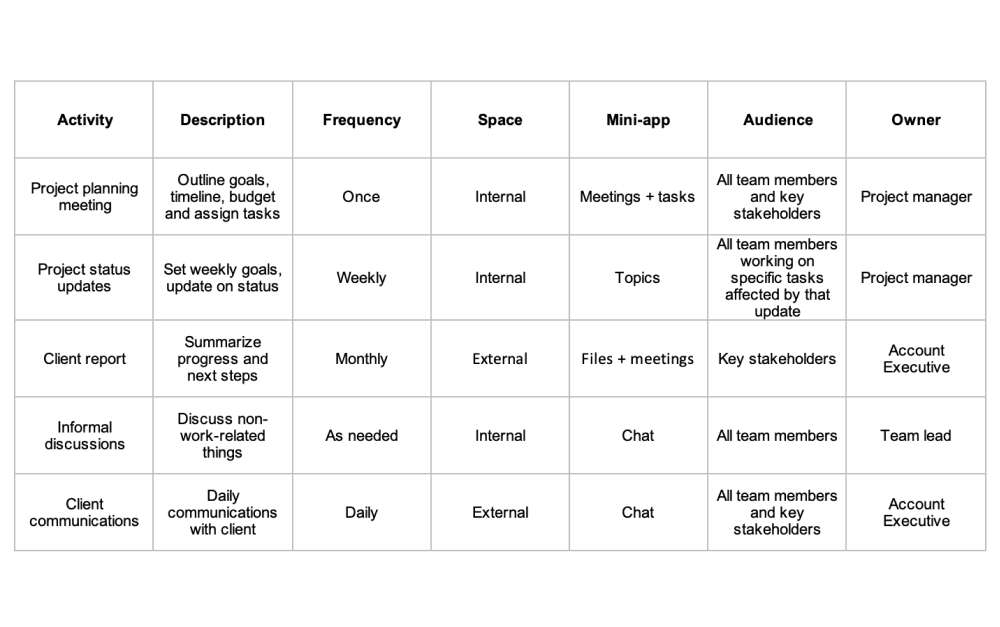
| Element | What it answers | Example |
|---|---|---|
| Goals and objectives | What outcome should this communication produce? | "Keep the client aligned on weekly progress so scope changes are caught in week one." |
| Stakeholders and audiences | Who needs to know, and what is their level of detail? | Client lead (weekly summary), client exec (monthly), internal team (daily standup). |
| Key messages | What is the substance of each update? | Status, blockers, decisions needed, next milestones, risks. |
| Channels and frequency | How and how often does it land? | Async written summary every Friday, 30-min sync on milestone weeks, escalation by phone only. |
| Roles and owners | Who writes it and who signs off? | Account lead writes, project lead reviews, account lead sends. |
The biggest mistake is treating these as separate documents. They are five columns of one plan, and they only work when they are seen together. A goal without a channel never reaches anyone. A channel without an owner gets skipped the first busy week.
The columns matter in this order too. Goals constrain the audience list (who actually needs this information?). The audience list constrains the messages (what do those people care about?). The messages constrain the channel choice (which medium fits what is being said?). Skipping ahead to channels (the most fun column to fill in) is how plans end up with weekly all-hands emails nobody reads.
How to create a communication plan in 6 steps
Six steps is the working baseline. A 30-minute session is enough to draft a plan that covers a quarter, longer for plans that cross multiple workstreams.
- Define the communication goals5 min Write 2 to 3 sentences on what this communication should produce. "Keep client aligned weekly" is a goal. "Communicate the project" is not. Goals decide everything downstream, so spend the time here before moving on.
- Map stakeholders and audiences10 min List everyone who needs project information and group them by role: deciders, doers, influencers, observers. Each group gets a different cadence and a different level of detail. The stakeholder communication guide covers this in depth.
- Pick channels by message type8 min Match the channel to the message. Status updates: async written. Decisions needed: short sync call. Crisis: phone. Routine FYI: shared workspace. Document what goes where so the team is not guessing in real time.
- Set the cadence and assign owners5 min Lock the frequency for each audience group. "Weekly Friday by 5pm" is a cadence. "Periodic updates" is not. Name an owner for each thread. Without an owner, the meeting is everyone's responsibility, which means nobody's.
- Document the plan where the work lives5 min Pin the plan to the project space, not a separate Confluence page nobody visits. If team chat is in one app and the plan in another, the plan loses every week. Keep it next to the work.
- Review at each milestone10 min A plan that never gets reviewed is a document, not a plan. At each milestone or monthly, take 10 minutes to ask what worked, what stakeholders complained about, and what should change. Update in writing.

Run your communication plan where the work happens.
Rock pairs team messaging with a task board, notes, and files so plans live next to the project, not in a separate doc. Flat $89/month, unlimited users.
5 communication plan templates by use case
Templates exist for the same reason recipes do: they keep you from reinventing the basics each time. Five types cover most projects. Pick the one that matches your situation and adapt.
| Template type | Use case | Key fields | Default cadence |
|---|---|---|---|
| Project communication plan | Any project with a start, end, and multiple stakeholders. | Audience, message type, channel, owner, milestone trigger. | Weekly + per milestone |
| Internal communication plan | Company-wide changes, policy updates, all-hands cadence. | Topic, audience segment, leader voice, format, escalation path. | Quarterly + ad-hoc |
| External communication plan | Client work, partner updates, regulatory reporting. | Stakeholder, contractual cadence, format, sign-off, archive. | Per contract terms |
| Crisis communication plan | Incident response, security breach, PR event, outage. | Trigger, decision tree, spokesperson, channels, hold statement. | Pre-built, activated on trigger |
| Strategic communication plan | Long-horizon brand or change initiatives. | Narrative, audience map, milestones, channel mix, KPIs. | Quarterly review |
Most teams need the first one. Agency teams running multiple clients usually run the first and third in parallel, with one shared template each stakeholder relationship adapts. Crisis plans are often skipped and most urgently missed exactly when needed, so pre-build them for the foreseeable situations.
A note on channel choice. Channel decides what gets read and what gets ignored, so match it to the message. Status updates and FYIs belong in async written form where they can be skimmed in seconds. Decisions needed belong in a short sync or a tagged thread with a clear deadline. Crises belong on the phone, no exceptions. Routine cadence belongs in a pinned doc inside the team's working space, not in an email thread that buries itself within a week.
Cadence is the other half. Once-a-week works for most project communication. Daily standups make sense for active sprint weeks but burn the team's attention if they run year-round. Monthly works for executive updates where the audience does not need granular detail. The right rule of thumb: cadence should match how fast the underlying work changes, not how visible the team wants to feel.
Communication plan example: agency client project
Here is a real-shape example for an 8-week brand redesign with a mid-size client. Three audiences: the client lead, the client exec, and the internal delivery team. The plan fits on one page.

Goal: Keep the client aligned on weekly progress and catch scope changes within the same week they happen.
Audiences and cadence: Client lead gets a written Friday summary with status, decisions needed, and risks. Client exec gets a one-paragraph monthly highlight at milestone weeks (2, 4, 6, 8). Internal team gets daily async standups and a 30-minute live sync on Mondays.
Channels: Friday summary in the shared client space as a pinned message. Monthly exec note over email. Decision-needed items go in a tagged thread in chat. Anything urgent goes by phone, no exceptions.
Owners: Account lead writes and sends the Friday summary. Project lead reviews before send. Account lead drafts the monthly exec note and the partner reviews. Each team member owns their own daily standup.
Review: At the week-4 milestone, the account lead asks the client lead what is working in the cadence and what they would change. Anything that comes up gets updated in the plan within 24 hours.
"Effective communications to all stakeholders is the most crucial success factor in project management." - PMI Pulse of the Profession, The Essential Role of Communications
Common pitfalls to avoid
Most communication plans fail in predictable ways. Spot the pattern early and the fix is a paragraph; let it compound and you are rewriting the plan halfway through the project.
- Over-engineering the plan A 12-page plan with 8 audiences and 14 channels is a plan that nobody reads. One page is the working size. If it does not fit on a page, the plan is not the document, the document is the artifact of someone wanting to look thorough.
- No named owners "The team will share weekly updates" is not a plan. The team is everyone, which means nobody. Every line in the plan needs a single name attached. If you cannot name an owner, the line is not ready to ship.
- A static document nobody reads A plan written once in week one and never touched again is decoration. Plans need a review at each milestone (10 minutes is enough). If review keeps slipping, kill the plan and write a simpler one.
- Wrong channel for the message Sending a decision needed in a public chat is how decisions get lost. Sending a status update over phone is how status reports get exaggerated. The channel decides what gets read and what gets ignored.
- Plan lives separately from the work A plan in a Confluence page nobody opens does not survive. Keep it in the project space next to the chat and tasks. People should see it while they are doing the work, not only when they are hunting for it.
What we recommend at Rock
Most agency teams we see on Rock keep the communication plan as a pinned note inside the client space. It lives next to the project chat and the task board, which is the single change with the biggest payoff. Plans that live with the work get reviewed; plans that live in a separate doc get forgotten by week three.

The other shift we see work is treating the plan as five columns, not paragraphs. Audience, message, channel, frequency, owner. Five columns fits on a page. Paragraphs sprawl. The constraint forces decisions instead of hedging.
That said, the tool is downstream of the plan. The five elements and the six steps work in any stack, including a shared spreadsheet. If your team already has a system that fits on one page and gets reviewed at each milestone, the platform change is optional. If your plan currently lives in three different docs and nobody can find the latest version, consolidation is the cheaper move.
Three other patterns we see work on agency teams. First, a standing 10-minute communication review at every milestone (read out loud what the plan currently says, ask what to keep and what to change). Second, a single owner per audience group, named by name, not by title. Third, a written meeting agenda for any sync over 15 minutes, sent 24 hours ahead, with decisions needed listed at the top.
Frequently asked questions
What are the 5 elements of a communication plan?
Goals and objectives, stakeholders and audiences, key messages, channels and frequency, and roles and owners. Skip any one of these and the plan starts leaking value within a week. Most working plans fit all five on a single page.
How do you write a communication plan?
Six steps: define goals, map stakeholders, pick channels by message type, set cadence and owners, document where the work lives, and review at each milestone. A first draft takes about 30 minutes for a quarter-long project.
What is the difference between a communication plan and a communication strategy?
A strategy is the long-view why (voice, brand, audience principles). A plan is the operational layer (what gets sent next Tuesday, to whom, in which channel). Strategies are written once a year; plans get written per project or per quarter.
Which stakeholders should be involved in communications planning?
Every stakeholder with a role, decision authority, or material interest in the project should appear in the plan. Per PMBOK, inputs include the stakeholder register, the project plan, organizational process assets, and enterprise environmental factors. In practice: deciders, doers, influencers, and observers should all be mapped.
How often should you update a communication plan?
At each project milestone or once a month, whichever comes first. The review takes 10 minutes. Ask three questions: what worked in the last cadence, what stakeholders complained about, and what should change. Update in writing the same day, not "later."