
Most marketing plan templates are a Word doc your team forgets in a folder. They look good at kickoff. A month later they live in version 4 of plan_FINAL_v2.docx and nobody opens them between quarterly reviews. The strategy stays in the doc; the team improvises against the inbox.
This template is built differently. The Rock space holds your strategy, the plan, the annual roadmap, and the day-to-day execution in one place. Strategy lives as four short notes you actually re-read. Execution lives on a task board with the work that ships this month. Together they keep the plan in motion instead of sitting in a shared drive. For the full step-by-step guide on how to write a marketing plan, see our marketing plan guide.
What is in this template
Four notes hold the strategic content. One task board holds the execution. Files holds the budget sheet and any market research.
Note 00. How to use this template. Orientation: read order, cadence, who edits what, how notes and tasks split. Read this first.
Note 01. Strategy. The slowest-moving layer. Situation analysis, two or three personas, positioning, and an explicit list of what you are NOT doing this year. Refreshed annually, sanity-checked quarterly.
Note 02. The Plan. The operational layer. Three SMART goals with baselines and owners, three to five KPIs with sources and targets, the channel mix, and the budget headline. Updated quarterly at the retro.
Note 03. Annual Roadmap. The time-layered artifact. Q1, Q2, Q3, Q4 with theme, major campaigns, channel priorities, milestones, and what is out of scope per quarter. Plus a parking lot and quarterly retrospective questions. The differentiator from a Word-doc plan: the roadmap stays alive because it gets reviewed every quarter.
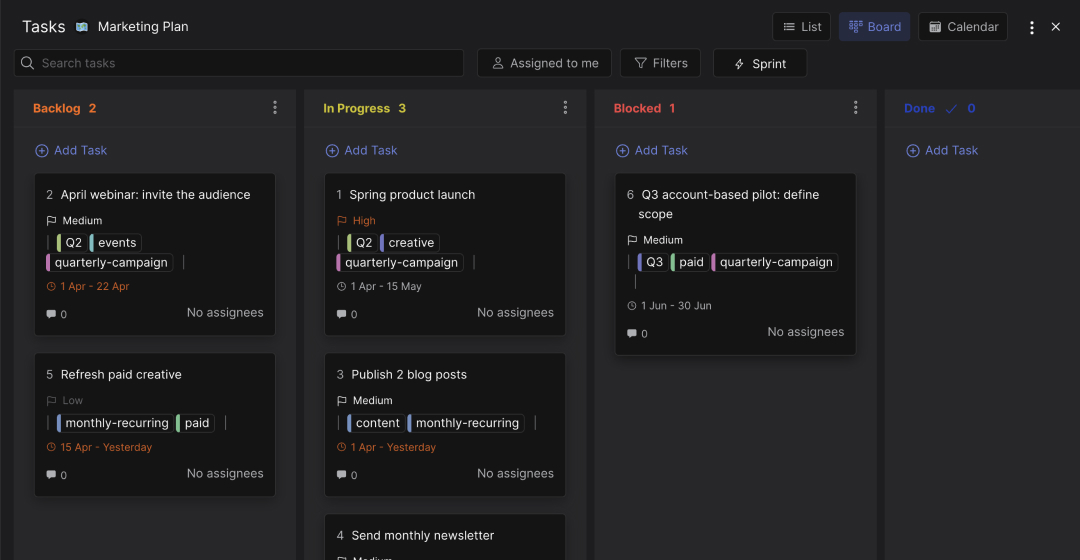
Task board. Backlog, In Progress, Blocked, Done. Tasks are labeled by type (quarterly-campaign or monthly-recurring), quarter (Q1 through Q4), and channel (creative, paid, content, events). Drag the demo below to see the structure.
Files. A budget spreadsheet stub and a market research folder. The note holds the headline numbers; the math lives in the sheet.
The 3-layer marketing plan, in one space
Most marketing plan templates ship as a single annual artifact. The plan gets written, signed off, and then drifts away from how the team actually works. The three-layer structure keeps the plan connected to weekly execution.
Annual roadmap. Lives in the Annual Roadmap note. Quarter-by-quarter sequence, themes, milestones. Reviewed at the quarterly retrospective and rebuilt once a year.
Quarterly campaigns. Live as cards on the task board, labeled by quarter (Q1 through Q4) and type (quarterly-campaign). Move from Backlog to In Progress at the start of each quarter; close out in Done with a wrap-and-learn note in the card.
Monthly retainer plan. Lives as recurring cards on the same task board, labeled monthly-recurring. The cards capture work that repeats every month: publish two blog posts, send the newsletter, refresh paid creative. Different label, same board, so capacity is visible across both layers at once.
The reason this matters: the annual roadmap moves too slowly to guide weekly decisions, and the monthly task list moves too fast to hold the strategic line. Run all three layers as one family and the plan stays in motion. Drift between layers is the warning sign that the strategy needs an update, not the execution.
"Plans are worthless, but planning is everything." - Dwight D. Eisenhower, 1957 speech to the National Defense Executive Reserve Conference
Who this template is for
Best for: Marketing leads at agencies running multiple client accounts, in-house marketing managers at 10 to 100-person companies, founders running marketing themselves before the first hire. Teams that have written a marketing plan before and watched it die in a Word doc. Anyone who wants strategy, the plan, and the work in the same place.
Skip this if: You need a one-page plan for a single campaign. The campaign management template fits better. This template is built for the broader marketing function: strategy, the year's plan, and recurring execution.
Why marketing plans usually die in a Word doc
The failure pattern is consistent. The plan gets written at kickoff or at the start of the year. It is comprehensive, well-formatted, and signed off. Then it goes into a shared drive. The team improvises against weekly demands. Three months later the plan and the work no longer match each other; six months later, the plan is wallpaper.
According to the CoSchedule 2022 Trend Report on Marketing Strategy, only 17% of marketers have documented the majority of their strategy. Even fewer keep the document up to date. The gap between writing the plan and using it is wider than most teams admit.
This template addresses the gap directly. The plan lives where the team already works: the same chat, the same task board, the same files. The Annual Roadmap note is on the side panel; opening the space puts the plan in front of the team. The cadence note explicitly schedules the weekly check, monthly readout, and quarterly retro before the plan gets signed off. Without the cadence, the plan drifts. With it, the plan stays a working document.
Tips for getting started
Fill the notes top-to-bottom before adding tasks to the board. Note 00 first to understand the structure, then 01 (Strategy), then 02 (The Plan), then 03 (Annual Roadmap). The notes are designed to inherit from each other; the goals in The Plan should reflect the diagnosis from Strategy.
Do not pre-fill the board with too many tasks. Start with the next 30 days of work plus the 3-5 quarterly campaigns for the current quarter. Add monthly-recurring cards for repeating work. The board should feel current, not exhaustive; an overflowing board is harder to use than a tight one.
Schedule the cadence on the calendar before you sign off on the plan. Weekly status check (15 minutes), monthly readout (30 minutes), quarterly retrospective (60 minutes). Plans without a defined cadence have a half-life of about three months, after which the team is improvising and the plan is wallpaper.
Bring clients into the space if the plan is for a client. Rock allows external users in any space at no extra cost. The client gets visibility into the plan, the campaigns, and the monthly deliverables. The team gets one source of truth instead of separate internal and client-facing versions.
Review and update the Annual Roadmap at every quarterly retro. The retro questions in note 03 are the prompt: what shipped, what slipped, what we learned, what changes for next quarter. Update the note, then update the labels on the board. The discipline of changing the plan is what keeps it alive.


