How to Write a Marketing Plan (With Template and Examples)
Most marketing plans get opened twice: once at kickoff and once at the quarterly business review. The rest of the year the plan sits in a shared drive, while the team improvises against whatever the inbox demands that week. This is not a planning problem. It is a working-document problem.
This guide covers what a marketing plan actually is, the seven sections every good one needs, and the seven-step process for writing one. It also walks through the three layers (annual, quarterly, monthly) that keep the plan alive past kickoff. Run the completeness check below first to see which sections of your current plan are ready and which still need work.
Marketing Plan Completeness Check
Tick every section your current plan has documented. Eight checks, one minute. Score below shows which sections are ready and which still need work.
Tick the items above to see where your plan sits.
What is a marketing plan?
A marketing plan is a written document that says what a business will do to reach its marketing objectives, when, and by whom. It translates a marketing strategy into concrete work that gets shipped. The pieces are target audiences, goals with numbers, channel mix, budget, calendar, and named owners. A plan without those pieces is a wishlist; a plan with all of them but no review cadence is a binder.
The function is often confused with two adjacent disciplines. Strategy sits upstream of the plan and answers why the audience should pick this brand. Marketing operations sits underneath the plan and runs the work day to day. The plan itself is the artifact in the middle: the document that turns a strategy into the specific work the team ships this year.
| Dimension | Marketing Strategy | Marketing Plan | Marketing Operations |
|---|---|---|---|
| What it is | The choice of where to play and how to win | The document that says what to do, when, and by whom | The system that runs the work day to day |
| Question it answers | Why should this audience pick us? | What will we do this year to win them? | How does this team ship the work without chaos? |
| Time horizon | Multi-year | Annual, with quarterly and monthly layers | Daily and weekly |
| Output | Positioning, segmentation, value prop | Goals, channels, budget, KPIs, owners, calendar | SOPs, capacity plans, retainer rhythm |
| Owner | CMO or agency partner | Marketing lead or account director | Operations lead |
| Lives in | Strategy doc, refreshed annually | Working document, updated monthly | The team workspace, every day |
"A marketing plan is a written document that summarizes what the marketer has learned about the marketplace and indicates how the firm plans to reach its marketing objectives." - Philip Kotler, Principles of Marketing
Kotler's definition is the textbook one for a reason. The two halves matter equally: the diagnosis of what the marketer has learned, and the explicit how-we-will-reach. A document with only the second half is a tactical to-do list; a document with only the first is a research deck. Both are common; neither is a marketing plan.
The 7 sections every marketing plan needs
Strong plans are not long. They are complete on the seven sections below, each one short enough to be read in a meeting. The table summarises the structure, what each section answers, and the mistake most plans make at that step.
| Section | What it answers | Common mistake |
|---|---|---|
| 1. Situation analysis | What is happening in the market and our share of it? | SWOT slide that no one updates after Q1 |
| 2. Audience and segments | Who exactly are we trying to reach? | "Everyone with a budget" passes for a segment |
| 3. Positioning and message | Why should this audience pick us? | Inside-out copy that names features, not outcomes |
| 4. Goals and KPIs | What does success look like, with numbers? | Vanity metrics: impressions, followers, traffic |
| 5. Channel mix and tactics | How do we reach the audience and convert them? | Doing every channel because the team has heard of all of them |
| 6. Budget and capacity | What is this going to cost, in money and hours? | Budget without capacity, or capacity without budget |
| 7. Calendar and owners | When does each thing happen, and who is responsible? | Calendar with no owners; owners with no calendar |
The most common failure is treating goals and KPIs as the same thing. The goal is the outcome the business wants, like growing qualified pipeline by 25 percent. For the diagnostic lens that maps which stage of the buyer journey is leaking, see the marketing funnel guide. The KPI is the number the team watches to know if the goal is on track, like marketing-qualified leads per channel per month. Lump them together and the plan loses its measurement layer. Our deep dive on marketing KPIs covers which numbers matter and which are vanity.

How to write a marketing plan in 7 steps
The seven steps below are the canonical sequence, and the order matters. Skipping the audience step turns goal-setting into guesswork. Jumping to channels before goals turns the plan into a tactics list with no judge for whether the tactics are right.
- Analyze the situation Look honestly at the market, the competition, and where the brand sits today. A SWOT or PESTEL is fine if it produces a real read; a SWOT slide that lists generic strengths and threats is filler. The output is a one-paragraph diagnosis a stranger could read and understand the business.
- Define the audience Pick the segments worth winning and describe them in enough detail that the team knows when to say no. "Mid-market B2B SaaS marketing leaders, 200 to 1000 employees, replacing a legacy stack" beats "B2B decision makers." Most weak plans skip this step and try to talk to everyone.
- Set the goals Three to five SMART goals at most. Tie each to a number, a deadline, and a baseline. Generic goals like "grow brand awareness" do not survive contact with a budget conversation; "lift brand-search volume from 2,400 to 4,000 per month by Q4" does.
- Choose the channel mix Pick the two or three channels where the audience actually pays attention. Add a fourth as an experiment. Plans that list eight channels at 12 percent each are wishlist plans. Concentration beats breadth at 5 to 50-person scale.
- Allocate the budget Split the budget by channel with a contingency line of at least 10 percent. Match it to capacity in hours, not just dollars. A plan that funds a channel the team has no capacity to run is a plan that will be quietly missed by month three.
- Build the calendar Lay the work out across the year with one named owner per workstream. The calendar lives in the same workspace as the work; if it lives in a doc nobody opens, the plan dies in the second month. Quarterly milestones, monthly check-ins, weekly status.
- Define the review cadence Set the review rhythm before the plan is signed off, not after. Weekly status check, monthly readout, quarterly retrospective. The cadence is what turns a plan into a working document. Plans without a defined cadence end up in the binder.
"Start with diagnosis. Then make choices. And remember to ignore the tactics while the strategy decisions are being made." - Mark Ritson, Marketing Week
Ritson's three-phase frame (diagnose, then choose, then plan tactics) is the cleanest discipline for getting through the seven steps without short-circuiting. Most weak plans short-circuit at step three (goals) by jumping to step four (channels) before the goals are clear. The cost shows up in month four, when the team is shipping channels nobody can connect to a goal.
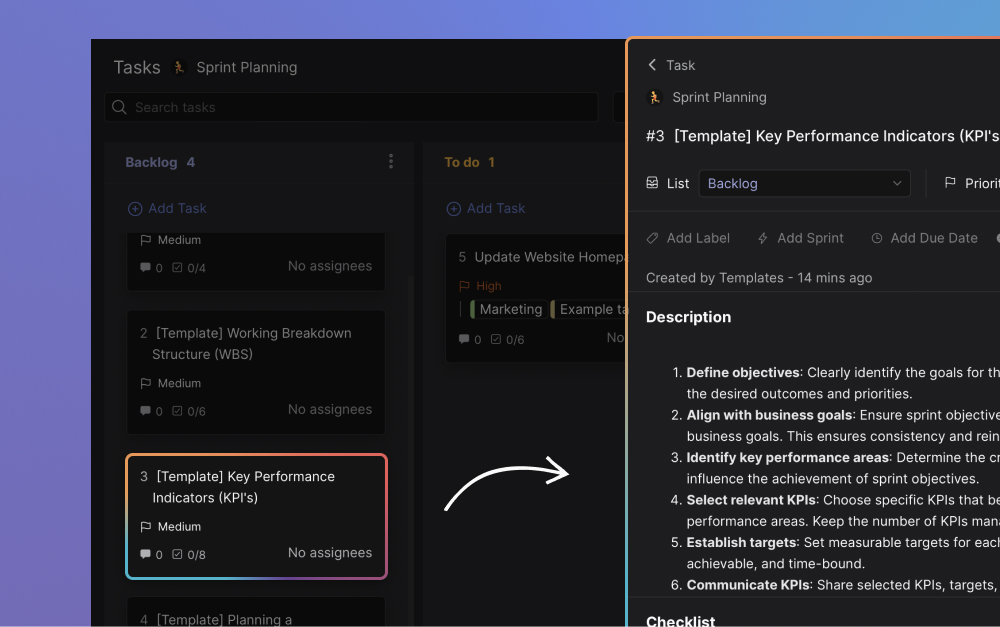
Marketing plan example
The example below is a small B2B agency running a year of marketing for a mid-market SaaS client. The point of the worked example is not the specific numbers; it is to show how each section connects to the next.
Situation analysis. The client is a mid-market HR-tech SaaS, $8M ARR, 110 employees, growing 15 percent year over year. SERP and ad spend are dominated by three larger competitors. Brand search volume is 2,400 per month and flat. Content output is sporadic; the marketing function is one in-house generalist plus the agency on retainer.
Audience. Two segments. Segment A: HR leaders at 200 to 1,000-employee companies replacing legacy HRIS, willing to consider a smaller vendor for better support. Segment B: People-ops practitioners (the buyer-influencer) who use peer communities and tactical content. Segment A is the buyer; segment B influences the shortlist.
Goals. Three SMART goals. Lift brand-search volume from 2,400 to 4,000 per month by Q4. Generate 480 marketing-qualified leads (40 per month average) with 12 percent of those becoming sales-qualified opportunities. Close $1.6M in net new ARR with marketing-attributed pipeline.
Channel mix. Three channels at meaningful spend. SEO and content (45 percent of budget): topical authority on three clusters that match buyer pain. Paid search (30 percent): defensive on brand plus selective non-brand on three head terms. Industry community and events (20 percent): two practitioner communities, four virtual events, two in-person events. The remaining 5 percent is contingency.
Budget and capacity. $360K annual budget. Capacity in agency hours: 80 hours per month from the agency, 25 percent of one in-house FTE. The plan is reviewed against capacity before sign-off; one of the planned content clusters is descoped because the team cannot ship at the planned cadence.
Calendar. Quarterly milestones for each channel. Q1 launches the topical authority push and brand defence. Q2 layers community and the first in-person event. Q3 expands non-brand paid and runs the second event. Q4 protects pipeline through year-end and prepares the renewal push. Owners are named for each workstream, with a weekly status check, monthly readout, and quarterly retrospective.
The plan is two pages plus an appendix. It lives in the same workspace as the work; the team opens it weekly, not annually.
Annual, quarterly, monthly: the three layers
One document does not solve the working-document problem. The annual roadmap moves too slowly to guide weekly decisions; the monthly task list moves too fast to hold the strategic line. Strong agencies run all three layers as one family, not as separate artifacts that drift apart.

| Layer | Annual roadmap | Quarterly campaign plan | Monthly retainer plan |
|---|---|---|---|
| Time horizon | 12 months | 1 quarter | 1 month |
| What it sets | Goals, segments, budget, channel mix | Campaigns, themes, milestones | Deliverables, owners, weekly cadence |
| Audience | Leadership and finance | Marketing team and account leads | Production team and the client |
| Updated | Annually, soft refresh quarterly | At quarter open and close | Every Monday |
| Format | Slide deck or doc | Plan note plus task board | Task list with deadlines |
| Key risk if missed | Plan drifts from strategy | Campaigns slip or compete with each other | Retainer scope creeps quietly |
The trick that makes the three layers work is using the same definitions across them. The annual roadmap names the audience, the goals, and the channel mix. The quarterly campaign plan inherits those and adds specific campaigns and milestones. The monthly retainer plan inherits those and adds specific deliverables and owners. If the quarterly plan invents a new goal that does not appear in the annual roadmap, that is the signal the strategy has drifted.
"Plans are worthless, but planning is everything." - Dwight D. Eisenhower, 1957 speech to the National Defense Executive Reserve Conference
Eisenhower's point applies directly. The plan as a document is worth almost nothing once execution starts. The discipline of planning, the conversations and tradeoffs that produce it, gives the team a shared mental model when reality changes. The three-layer structure is what keeps the planning alive past the document.
Channel-specific plans (when to spin them out)
The seven sections cover a marketing plan at the level of the whole function. When a channel is large enough or technical enough to deserve its own document, that document inherits from the main plan and goes deep on the channel-specific tradeoffs.
SEO marketing plan. When SEO is more than 20 percent of the budget or the business depends on organic search, write a dedicated SEO marketing plan. It covers keyword strategy, content gap analysis, technical health, link acquisition, and the measurement layer that ladders up to the main plan.
Content marketing plan. When content is the engine that feeds multiple channels (SEO, social, sales enablement), a separate content marketing plan handles the editorial calendar, production pipeline, distribution, and repurposing. Without it, content gets briefed on a project-by-project basis and the cumulative compounding effect is lost.
Social media marketing plan. When social is a primary channel for either reach or community, a social media marketing plan covers content pillars, posting cadence, community management, and platform-specific reality. The big mistake is treating social as one channel when in practice each platform is its own.
Other channels (paid search, email, partnerships, events) follow the same logic. If your plan covers multiple digital channels and you need the layer above them all, the digital marketing plan guide covers the integration logic. Spin out a dedicated plan when the channel is structurally distinct or large enough that the main plan cannot do it justice.
What we recommend
At Rock we run marketing teams inside the same workspace where the work happens. The annual roadmap lives as a pinned note in the marketing space. The quarterly campaign plan is a board where each campaign is a card with owner, dates, and links to the brief. The monthly retainer plan is a task list with weekly review check-ins on the calendar. One workspace, three layers, no rebuilding the file every Monday.
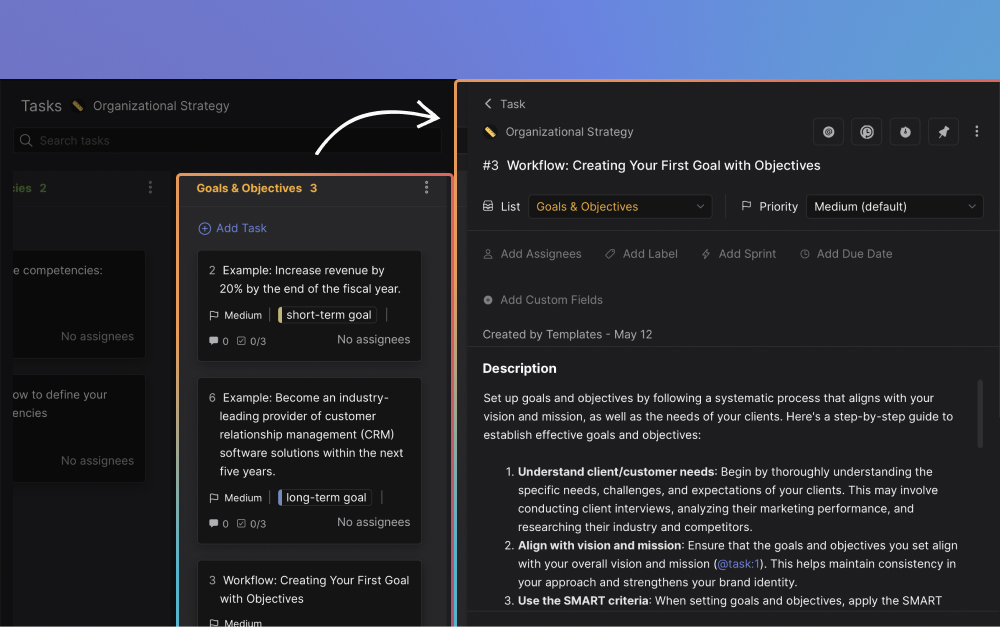
This is honest about what Rock does and does not do. Rock is the place the plan lives and gets used; it is not a strategy-generation tool. The strategy work happens upstream in conversations and decision frameworks like SWOT, Porter's Five Forces, and the Strategic Choice Cascade. The plan is what comes out the other end.
The broader system fits together with adjacent disciplines. Marketing operations runs the day-to-day execution. Marketing project management tracks the work. Campaign management handles the one-campaign-at-a-time view. Marketing KPIs and agency KPIs close the measurement loop. Capacity planning and billable hours tie the plan to delivery economics. The plan is the artifact at the center; the rest is what makes it real.
Once the plan is written, the next move is keeping it alive. The annual roadmap, the quarterly campaign plan, and the monthly retainer plan all need a home that the team opens daily, not the shared drive that nobody opens at all. That is the difference between a plan that compounds and a plan that decorates.
Free resource: download our marketing plan template to get the strategy notes, annual roadmap, and task board structure ready to copy into your workspace.
Common pitfalls
The mistakes below show up across teams that intend to build a real plan and slowly drift into improvisation. Most are pattern recognition failures, not analytical ones.
- Confusing the plan with the strategy A plan without a strategy is a list of tactics. If the document jumps straight into channels and campaigns without naming the audience and the position, the team is doing tactics with no judge for whether they are right. Strategy first; the plan picks up after.
- A plan with no review cadence The plan is signed off, the binder closes, and nothing is scheduled to revisit it. Three months later the team is improvising. The fix is simple: a recurring weekly check, a monthly readout, a quarterly retro, scheduled before the plan is approved. Cadence is what keeps the plan alive.
- Goals without a baseline or owner "Grow leads by 20 percent" without a starting number, a deadline, or a named owner is not a goal. It is a wish. Every goal needs a baseline (where we are today), a target (where we want to be), a deadline, and one person whose name is next to it.
- Eight channels at 12 percent each A plan that funds eight channels at the same level is a plan with no opinion. At 5 to 50-person scale, two or three channels at meaningful spend beat eight channels at token spend every time. Concentration beats breadth; pick the channels where the audience actually is.
- One document for everyone The client-facing plan and the internal working plan are not the same artifact. The client plan shows outcomes and milestones; the internal plan shows tasks, owners, and risk notes the client should not see. Trying to serve both audiences with one document leaves both audiences underserved.
The biggest of the five is the second one. Plans without a review cadence have a half-life of about three months; after that the team is improvising and the plan is wallpaper. Setting the cadence (weekly status, monthly readout, quarterly retro) before the plan is signed off is what turns the document into a working artifact instead of a binder.
The CoSchedule 2022 Trend Report on Marketing Strategy surveyed 515 marketers. Those who proactively plan their marketing were 331 percent more likely to report success than peers; only 17 percent had documented the majority of their strategy. The gap between knowing the plan matters and writing it down is wider than most teams admit.
How to start writing your marketing plan this week
If your current plan is missing two or more of the seven sections from the scorecard at the top, do not try to rebuild the whole document this quarter. The fastest path to a usable plan is to fill the three highest-leverage sections this week and add the rest over the next month.
Start with goals and KPIs. Three SMART goals at most, each with a baseline, a target, a deadline, and a named owner. If the goals already exist but live in someone's head, write them down. The team cannot follow what is not written.
Then nail the audience. One paragraph per segment, specific enough that the team can say no to the wrong work. "Mid-market HR leaders replacing legacy HRIS" beats "B2B decision makers" by a wide margin. Specificity is what makes the plan useful.
Last, set the cadence. Weekly status check, monthly readout, quarterly retro, scheduled before the plan goes to anyone for sign-off. The cadence is what keeps the document alive. Without it, the plan dies in the second month and the team goes back to improvising.
The other four sections matter, but they fill in over the first 30 days. The three above (goals, audience, cadence) are what separate a plan from a wishlist. Once the three are in place, the plan is ready to be used; the rest is detail.
Run the plan inside the same workspace as the work. Rock combines chat, tasks, and notes in one workspace. One flat price, unlimited users. Get started for free.