Porter's Five Forces: Examples, Template, and Free Builder
Porter's Five Forces is the industry-level companion to SWOT. Where SWOT looks at one firm and asks where you are strong or exposed, Porter's looks at the industry around you and asks whether the industry itself is worth competing in. The framework breaks competitive pressure into five separate forces and rates each one. The combined intensity tells you how much profit the industry can sustain over time.
This guide covers the five forces, how to apply them in 5 steps, a worked example, and when to use Porter's instead of SWOT or PEST. It also covers the limitations the framework was already showing in 1979. Analyze your own industry with the interactive widget below, copy the result, take it into your strategy conversation.
Contents
Build Your Five Forces Analysis
Type the industry you are analyzing, then rate each of the five forces as Low, Medium, or High. The summary panel reads the combined intensity and gives you the industry attractiveness verdict. The widget seeds an example so you can see the shape; reset to clear and run yours.
Analyze your industry with Porter's Five Forces
Type the industry you are analyzing, then rate the intensity of each force. The summary below reads the overall industry attractiveness.
Want to act on these findings? Continue to a SWOT analysis → to translate industry signals into strengths, weaknesses, opportunities, and threats for your firm.
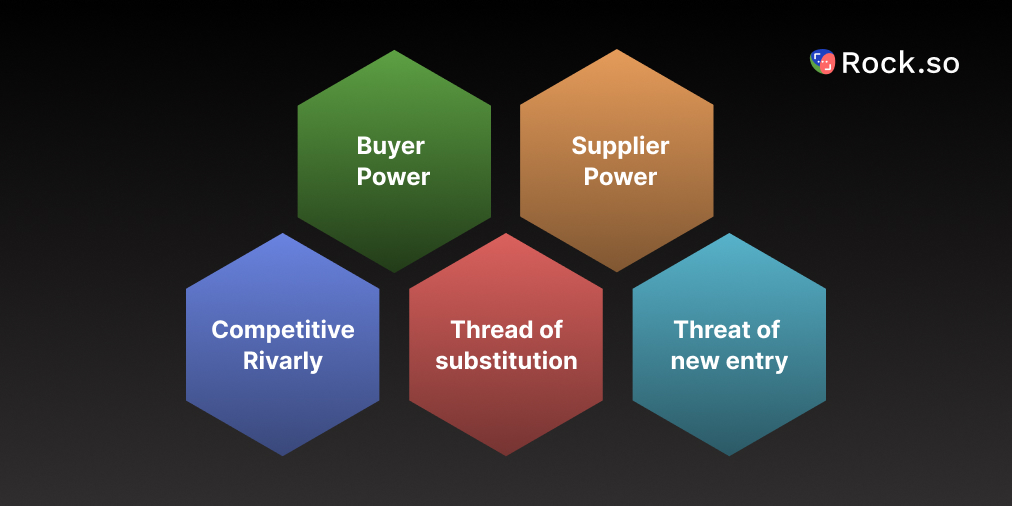
Quick answer. Porter's Five Forces is a strategic framework that analyzes the structural attractiveness of an industry. It rates five competitive forces: rivalry among existing competitors, threat of new entrants, threat of substitutes, bargaining power of suppliers, and bargaining power of buyers. It was introduced by Michael Porter in Harvard Business Review in 1979 and remains the dominant framework for industry analysis.
"Competition for profits goes beyond established industry rivals to include four other competitive forces." - Michael Porter, Harvard Business School (HBR, 2008)
The Five Forces Explained
Each force is independent but they interact. A high-rivalry industry with high buyer power gives buyers most of the surplus. A low-rivalry industry with high entrant threat looks attractive today but may not be in 18 months. The shape of the five forces, not any single one, decides industry profitability.
| Force | What raises intensity | What lowers intensity |
|---|---|---|
| 1Competitive rivalry | Many similar competitors, slow industry growth, high exit barriers, weak product differentiation, price-based competition. | Few players with clear positioning, growing market, strong brand differentiation, high switching costs. |
| 2Threat of new entrants | Low capital required, easy access to distribution, weak brand loyalty, no regulatory barriers, scalable technology. | High capital requirements, regulated industry, established network effects, patents, strong customer lock-in. |
| 3Threat of substitutes | Cheap or free alternatives exist, low switching cost, substitute solves the same job differently, customer trends favor the substitute. | No clear alternatives, switching cost is high, your product solves a job nothing else solves well. |
| 4Bargaining power of suppliers | Few suppliers control critical inputs, switching suppliers is costly or risky, suppliers can integrate forward into your industry. | Many interchangeable suppliers, easy to switch, you are a major share of supplier revenue, you can integrate backward. |
| 5Bargaining power of buyers | Few large buyers, buyers are price-sensitive and informed, low switching cost for buyers, buyers can integrate backward. | Many small buyers, low price sensitivity, high switching cost, your offering is mission-critical or differentiated. |
Porter's original numbering is conventional, not strict. Some treatments lead with rivalry, others with entrants. The order does not matter; coverage of all five does. Skipping the supplier side because your inputs feel commoditized is the most common analysis miss; commoditized inputs sometimes consolidate suddenly (semiconductor shortages, AI compute capacity) and supplier power flips overnight.
Worked Example: Agency PM Software
Industry analyzed: SaaS project management software targeted at marketing and creative agencies in the 5-50 employee range.
1. Competitive rivalry: High. Dozens of established players (Asana, ClickUp, Monday, Trello, Notion, Basecamp, Wrike) plus newer entrants. Most compete on similar feature sets, with periodic price wars on annual seat plans. Differentiation tends to fade as competitors copy features within 6 to 12 months.
2. Threat of new entrants: Medium. Software is cheap to build initially, especially with AI-assisted development, but distribution is hard. Most new entrants struggle to acquire customers cost-effectively in a category dominated by incumbents with large content libraries and established sales teams.
3. Threat of substitutes: High. Email plus spreadsheets is the persistent substitute, especially for small teams. AI copilots that orchestrate work across existing tools are an emerging substitute that could reframe the category. Buyers often default to "free with Gmail" rather than buy specialist software.
4. Bargaining power of suppliers: Low. Cloud infrastructure (AWS, GCP, Azure) is largely fungible at the size most PM tools operate at. Talent is the main supplier; tight market for product engineers but not concentrated enough to compress margins industry-wide.
5. Bargaining power of buyers: Medium. Buyers have many alternatives and are price-aware, but switching costs are real (data migration, team retraining). Larger agencies negotiate harder; smaller agencies often pay list price. Annual contracts soften some buyer power.
Verdict: mixed industry leaning unattractive. High rivalry plus high substitution pressure compress margins, while medium-low pressure on supplier and entrant sides keeps the industry from collapsing. The strategic implication: succeed by picking a narrow niche where switching costs and differentiation can be defended, rather than trying to outcompete on broad horizontal features. Generalist players will get squeezed; deep-niche players (e.g., agency-specific PM with billing built in) have room.
When to Run Porter's (vs SWOT or PEST)
Porter's answers a specific question: how much profit can this industry support? Reach for it when that question is the bottleneck.
Before entering a new industry or vertical. If you are weighing whether to launch into adjacent space, Porter's tells you whether the structural economics work before you invest. An attractive industry with weak forces is a tailwind. An unattractive one is a headwind that even great execution may not overcome.
Before strategic acquisitions. When evaluating an acquisition target in a new industry, Porter's surfaces the structural reasons that target's profits may be sustainable or temporary.
When margins are compressing and the cause is unclear. If profits are eroding industry-wide, Porter's helps locate which force is doing the damage. A pricing problem caused by buyer power is fixed differently from one caused by new entrants flooding the market.
As input to a SWOT analysis. Porter's covers the External half of SWOT (Opportunities and Threats) at the industry level. Run Porter's first, use the findings to populate the external columns of your SWOT, then proceed to the firm-level analysis.
Skip Porter's when the industry is already understood. If your team has been operating in this industry for years and the structural picture is clear, Porter's may just confirm what you already know. Use the time on TOWS or VRIO instead.
"Success breeds complacency. Complacency breeds failure. Only the paranoid survive." - Andy Grove, former CEO, Intel
How to Run Porter's in 5 Steps
- Define the industry precisely The single biggest source of bad Porter's analyses is a fuzzy industry definition. "Software" is not an industry. "Project management software for mid-market marketing agencies in North America" is. Tighten until two reasonable strategists would draw the same boundaries.
- Map the players for each force Name actual competitors, suppliers, buyer segments, and substitutes. Forces in the abstract are weak analysis. Forces with specific named players are strategic information you can act on.
- Rate each force Low, Medium, or High Use the intensity drivers in the forces table above. Avoid the temptation to rate every force Medium because it feels safe. A Porter's analysis where every force scores Medium is usually a Porter's analysis the team did not push hard enough.
- Read the combined verdict If most forces are High, the industry compresses profits and only specialists or scale players survive. If most are Low, profits are sustainable and the strategic question is how to defend the position. Mixed verdicts (the most common outcome) require you to identify which forces are most intense and design around them.
- Translate into strategy Porter's by itself produces a diagnosis, not a strategy. Feed the verdict into a SWOT (using the force ratings as the External column) or directly into a TOWS matrix to generate strategic moves. Without this translation step, the analysis stops being useful at the document stage.
Reading the Industry Attractiveness Verdict
The combined force ratings produce one of three broad verdicts. The strategic response differs sharply for each.
Attractive industry (most forces low). Profits are sustainable, competition is mild, structural barriers protect incumbents. Strategic priority: defend the position. Build switching costs, deepen differentiation, lock in distribution. The risk is complacency: industries do not stay attractive forever.
Mixed industry (force ratings vary). Some forces compress margins, others give breathing room. Strategy depends on which forces are most intense. If buyer power is the killer, build differentiation and switching cost. If new entrants are the killer, build moats. If substitutes are the killer, expand the category boundary or move to where substitutes do not threaten.
Unattractive industry (most forces high). Profits are structurally compressed. Three options: pick a defensible niche where the forces are weaker, change the rules through innovation, or exit and redeploy capital to a more attractive industry.
Porter's Five Forces vs Other Frameworks
Porter's is one of several strategic analysis tools, each answering a different question. Running Porter's when you need SWOT (or vice versa) gives you a correct answer to the wrong question.
| Framework | Level of analysis | Question it answers | When to reach for it |
|---|---|---|---|
| Porter's Five Forces | Industry | How attractive is this industry, and where is the profit pressure coming from? | Choosing where to compete, evaluating a new vertical, sizing the prize before SWOT. |
| PEST / PESTLE | Macro environment | What political, economic, social, technological forces are reshaping the landscape? | 3-5 year horizon planning, geographic expansion, anticipating regulatory shifts. |
| SWOT | Firm | Where are we strong, weak, exposed, or positioned to win? | Annual planning, new initiative scoping, situational diagnosis after Porter's. |
| VRIO | Internal resource | Which of our resources can produce sustained competitive advantage? | After SWOT, on each strength worth investing in. |
| TOWS | Strategic options | What concrete moves should we make given our SWOT? | Right after SWOT, to convert findings into named strategies. |
The common chain in practice: PEST (or PESTLE) for the macro environment, Porter's for the industry structure, SWOT for the firm-level diagnosis using Porter's findings as the external view, VRIO on the strengths column to verify which are durable, and TOWS to convert it all into named strategic moves. No single framework does the whole job; the workflow does.
Common Mistakes and Limitations
Five patterns that produce a Porter's analysis that looks complete but does not inform strategy, plus the broader limitation Porter's has had since 1979.
- Defining the industry too broadly "We are in the SaaS industry" produces a useless analysis because SaaS contains hundreds of structurally different sub-industries. Tighten the definition until the named players in each force are specific.
- Rating every force Medium Safe-middle ratings are usually unanalyzed ratings. Push the team to commit to High or Low on each force; if the genuine answer is Medium, articulate why.
- Treating substitutes too narrowly The most dangerous substitutes come from outside the obvious category. Spreadsheets substitute for PM software; Whatsapp substitutes for Slack; the iPad substituted for many laptop categories. Look for the job the buyer is hiring your category to do, then list every alternative way to get that job done.
- Ignoring the supplier side because inputs feel commoditized Most analyses underweight supplier power until a supply shock arrives. Cloud infrastructure was a non-issue until 2020-2022 when capacity got tight; AI compute is the current example. Rate supplier power based on the next 24 months, not just today.
- Treating the analysis as final Industry forces shift continuously. A Porter's analysis from 18 months ago is a historical artifact, not a current strategy input. Rerun annually at minimum, or whenever a major industry event (consolidation, regulation, technology shift) changes the picture.
"Disruption is what happens when the incumbents are so focused on pleasing their most profitable customers that they neglect or misjudge the needs of their other segments." - Clayton Christensen, Harvard Business School
The broader limitation. Christensen's disruption theory shows that even in attractive industries, incumbents can be displaced by entrants who target segments the incumbents are happy to ignore. Porter's measures industry attractiveness today; it does not predict which entrants will reshape the category from below. Use Porter's for the structural snapshot; use disruption analysis as the complementary lens for what the snapshot misses.
What We Recommend
Run Porter's as the opening move in any planning cycle that involves a competitive question. Put the analysis in the same place where the strategy decisions and follow-up tasks will live, so the verdict on each force can be revisited as conditions change. In practice: the Porter's analysis lives as a note in the shared planning space, with a quarterly review trigger on each force (suppliers, buyers, substitutes especially) so the team catches shifts before they show up in the margin report. The teams that run Porter's once and never revisit end up with a strategy built on industry conditions that no longer exist.
For the integrative top-of-stack framework where Porter's findings get committed into a strategy, see our strategic choice cascade guide. For the growth-direction choice (existing or new product, existing or new market), see our Ansoff matrix guide. For the integrative top-of-stack framework where Porter's findings get committed into a strategy, see our strategic choice cascade guide. For the broader strategic framing that Porter's findings feed into, see our organizational strategy guide.
A Porter's Five Forces analysis is only as useful as the strategy it informs. Rock combines chat, tasks, notes, and files in one workspace so the analysis, the resulting strategic moves, and the work to deliver them all live together. One flat price, unlimited users. Get started for free.