SWOT Analysis: Step-by-Step Guide with Interactive Builder
A SWOT analysis takes a strategic question and breaks it into four quadrants. What is working for you, what is holding you back, what is changing outside that you could act on, and what could damage you if you do not respond. Used well, it turns a 60-minute team conversation into a prioritized set of strategic moves. Used badly, it becomes a four-box post-it exercise that nobody ever looks at again.
This guide covers the four components of SWOT, when to run one, how to run it in 6 steps, and the TOWS matrix step most teams skip. Build your own SWOT with the interactive widget below, copy the result, and take it to your next planning meeting.
Build Your SWOT Analysis
Type your objective at the top, add items to each of the four quadrants, and copy the result when you are done. The widget seeds an example agency SWOT to show the shape. Click any item to edit, press the × to remove.
Build your SWOT analysis
Add items to each quadrant. Click an item to edit, press × to remove. Copy the result when you are done.
Have your items locked in? Continue to the TOWS matrix → to convert this analysis into four strategic moves.
Quick answer. A SWOT analysis is a strategic planning framework that sorts factors affecting a decision into four categories: Strengths and Weaknesses (internal to the organization) and Opportunities and Threats (external to the organization). It was developed by Albert Humphrey and colleagues at the Stanford Research Institute in the 1960s, originally under the name SOFT. The modern SWOT label stuck because the letters are easier to say.
"What is good in the present is Satisfactory, good in the future is an Opportunity; bad in the present is a Fault, and bad in the future is a Threat." - Albert S. Humphrey, SRI International
The 4 Components of SWOT
Each letter sits at a specific intersection of two axes: internal versus external, and helpful versus harmful. Getting the quadrant right matters because the strategic response differs: you can invest in strengths, fix weaknesses, pursue opportunities, and defend against threats. Putting an external factor in an internal bucket leads to strategies you cannot execute.
| Component | Nature | What it answers | Example (SaaS agency) |
|---|---|---|---|
| Strengths | Internal, helpful | What do we do better than anyone else? | Deep niche expertise, 40-client retainer base, proprietary audit framework. |
| Weaknesses | Internal, harmful | Where are we behind, under-resourced, or inconsistent? | No productized offer, thin sales bench, undefined pricing for new services. |
| Opportunities | External, helpful | What is changing outside that we could act on? | Inbound demand spike, competitor hourly-only pricing, partner referral channels opening. |
| Threats | External, harmful | What outside shift could damage us if we do not respond? | AI answer engines displacing search, marketplace price pressure, 2026 client budget cuts. |
The most common mistake is putting competitor moves or market shifts in the Weaknesses column. A competitor price drop is not a weakness of your business. It is a threat. Your cost structure is a weakness. Confusing the two leads teams to pressure internal teams for something they cannot change, instead of defending the market position.
When to Run a SWOT
SWOT is broad by design, which is its strength and its weakness. It fits many moments, which is why it gets overused as a default whenever a team has a meeting. Run it when you have a real decision to make, not as ritual analysis.
Annual planning or quarterly review. The highest-frequency use. SWOT gives the leadership team a shared view of where the business stands before it commits to next-cycle priorities. One session, 60 to 90 minutes, done before the budget conversation starts.
New service or product launch. Before committing resources to a new line, a SWOT on the offering surfaces capability gaps (weaknesses) and category shifts (opportunities and threats) that change the launch plan.
Retainer or major project pitch. Agencies often run a SWOT on a prospective client's business as part of the proposal. It signals strategic thinking beyond deliverables and gives the client something to react to.
Market entry or geographic expansion. Especially useful when paired with a PEST analysis (macro external forces). SWOT tells you how your specific organization matches up; PEST tells you what the broader environment looks like.
Partnership or acquisition decision. Run SWOT on both parties independently, then compare. Strengths that match are redundant. Strengths that complement are the case for the deal.
Skip SWOT when the decision is already made and you are just looking for validation. The whole point is that the output can surprise you. If the team walks in knowing the answer, the session produces a grid that matches the pre-existing view, and nothing changes.
How to Run a SWOT in 6 Steps
The gap between a useful SWOT and a wasted one is process. Below is the 6-step flow that reliably produces actionable output, adapted from strategy practice at SRI and strategic planning conventions since.
- Set the objective Before any brainstorming, write a single sentence that states what this SWOT is analyzing. "SWOT on the business" is not specific enough. "SWOT on launching a productized SEO service for B2B SaaS agencies" is. The objective filters every item that follows: is this strength relevant to THIS decision? Without the filter, the grid fills with everything the team has ever thought about the company.
- Assemble the right team Four to eight people from the functions affected by the decision. Product, sales, marketing, operations, finance if the decision is financial. Include someone who works directly with customers, because the opportunities and threats columns are where customer-facing teams contribute most. Avoid stacking the room with executives who share the same view.
- Gather data before brainstorming Pull the metrics, market data, and customer feedback relevant to the objective into a one-page pre-read. Send it 48 hours before the session. A SWOT run on gut feel alone produces a grid that reflects the loudest voice in the room. A SWOT run on data produces a grid the team can defend.
- Brainstorm per quadrant Start with external factors (opportunities and threats) first, as Minsky and Aron argue. The instinct is to start with internal strengths because it feels safer, but beginning with the outside forces the team to anchor the analysis in the real environment. Otherwise you end up listing strengths that matter only to you, not to the market. Give each quadrant 10 to 15 minutes and cap at 10 raw items per box before filtering.
- Prioritize the top 3 to 5 per quadrant Dot-voting works well here. Each participant gets three votes per quadrant; they place them on the items that matter most to the objective. The top items are your working SWOT. A SWOT with 40 items total is a list, not a strategy. A SWOT with 12 to 20 prioritized items is a decision tool.
- Convert to TOWS for strategy This is the step most teams skip, and skipping it is why most SWOTs die in a shared drive. The TOWS matrix, developed by Heinz Weihrich in 1982, pairs internal and external factors to generate concrete strategic moves. Without this conversion step, a SWOT is just a diagnosis; TOWS is the prescription.
Worked Example: Agency Service Line Expansion
Scenario: a 15-person B2B SaaS marketing agency is considering launching a productized SEO service (fixed scope, fixed price, monthly retainer) alongside its current custom-project model. Leadership runs a SWOT before committing.
Strengths. Deep niche expertise in B2B SaaS SEO (5 years, 40+ clients). Reusable audit and content-brief templates built over the last 18 months. Existing retainer base of 40 accounts creates a warm intro list for upsell. Team of 4 SEO specialists with documented processes.
Weaknesses. No prior productized-offering experience (every project so far has been custom scope). Small delivery team means limited capacity for new service intake. Pricing anchor unclear: team has always billed hourly, not by deliverable. Sales process is founder-led and cannot scale into a productized funnel as currently structured.
Opportunities. Eight inbound requests in the past quarter asking if the agency offers a "starter" package. Competitor analysis shows all direct competitors are either custom-hourly or DIY SaaS tools: no middle-tier productized offer in the market. Partner network of 12 complementary agencies could refer 5 leads per quarter.
Threats. Google's AI Overview rollout changes organic search economics in ways that make SEO harder to sell. Freelance marketplaces continue to undercut agency rates for entry-level SEO work. 2026 client budget signals point to flat or reduced marketing spend, compressing the willingness to add a new line item.
Filled in this way, the grid already suggests a strategy, though the TOWS step below makes the moves explicit. The strengths and opportunities pair cleanly. The weaknesses and threats frame the risks the launch plan must address.
Turn SWOT into Strategy with TOWS
A finished SWOT is a list. TOWS converts the list into moves. The matrix pairs each internal factor with each external factor to generate four strategic modes: SO (use strengths to pursue opportunities), WO (overcome weaknesses to pursue opportunities), ST (use strengths to defend against threats), and WT (minimize weaknesses and avoid threats). This is the step most teams skip. For the full guide with an interactive builder, worked agency example, and the 5-step process, see our TOWS matrix guide.
"The very essence of strategy is explicit, purposeful choice." - Roger Martin, Rotman School of Management, former dean
Without TOWS, a SWOT is a list. With TOWS, it is a set of choices the team can commit to, assign owners, and ship.
Common Mistakes
Five patterns that turn a SWOT session into a document nobody opens again.
- Vague items that no one can act on "Strong brand" is not a strength. "Recognized by 62% of target-segment buyers in our category, up from 48% two years ago" is. Specific, data-backed claims filter into strategies. Vague adjectives evaporate in review.
- Listing without prioritizing A SWOT with 50 items across four quadrants is scanning, not strategy. Cap each quadrant at 3 to 5 prioritized items. If the team cannot agree on which 5 matter most, the objective probably is not sharp enough.
- Confusing internal and external Competitor moves in the Weaknesses column. Market trends in the Strengths column. These misclassifications lead to strategies aimed at the wrong target. Internal factors are things your organization can directly change; external factors are things it can only respond to.
- Skipping TOWS The single biggest reason SWOTs end up unused. A grid without a matching strategic conversion is a diagnosis without a prescription. The grid goes in a slide deck; the team returns to business as usual.
- One-person SWOT A single founder or planner filling in a SWOT alone is not a SWOT; it is a structured form of confirmation bias. The framework's value comes from the disagreements between team members that surface during brainstorming. Skip the team session and the value goes with it.
SWOT vs Other Strategic Frameworks
SWOT is one of several strategic analysis tools, and knowing when to reach for which one matters. Running SWOT when you really needed Porter's Five Forces gives you the wrong answer, politely formatted.
| Framework | Scope | Best for | When to reach for it |
|---|---|---|---|
| SWOT | Overall situation (internal + external) | Quick strategy check on any unit of analysis: company, product, team, campaign. | Kickoff of a planning cycle, new initiative scoping, quarterly review. |
| TOWS | SWOT findings matched into action pairs | Turning a completed SWOT into concrete strategic moves. | Right after SWOT, before you close the planning doc. |
| PEST | External macro forces (Political, Economic, Social, Technological) | Market entry decisions, long-horizon forecasting. | Entering a new geography or anticipating a 3-to-5 year shift. |
| Porter's Five Forces | Industry structure and competitive pressure | Assessing profitability ceiling of an industry or segment. | Choosing where to compete, or sizing a new vertical. |
| VRIO | Internal resources and their competitive value | Testing whether a strength is actually a durable advantage. | Auditing capabilities, M&A diligence, investment decisions. |
In practice, these are often chained. Start with SWOT for the situational view, then TOWS for strategy. Run PEST in parallel if the external macro matters. Layer VRIO on any strength the team thinks might be a durable competitive advantage. No single framework does the whole job.
What We Recommend
Run your SWOT as a living workspace, not a slide deck. Put the analysis in the same place where the team actually works so the strategic moves turn into operational commitments. In practice: the SWOT itself lives as a note in the shared planning space. The TOWS strategic pairings get pulled out as tasks with owners and due dates on the same board. Each strategic move becomes an operational item the team reviews in the Monday huddle, not a grid that sits in a slide deck.
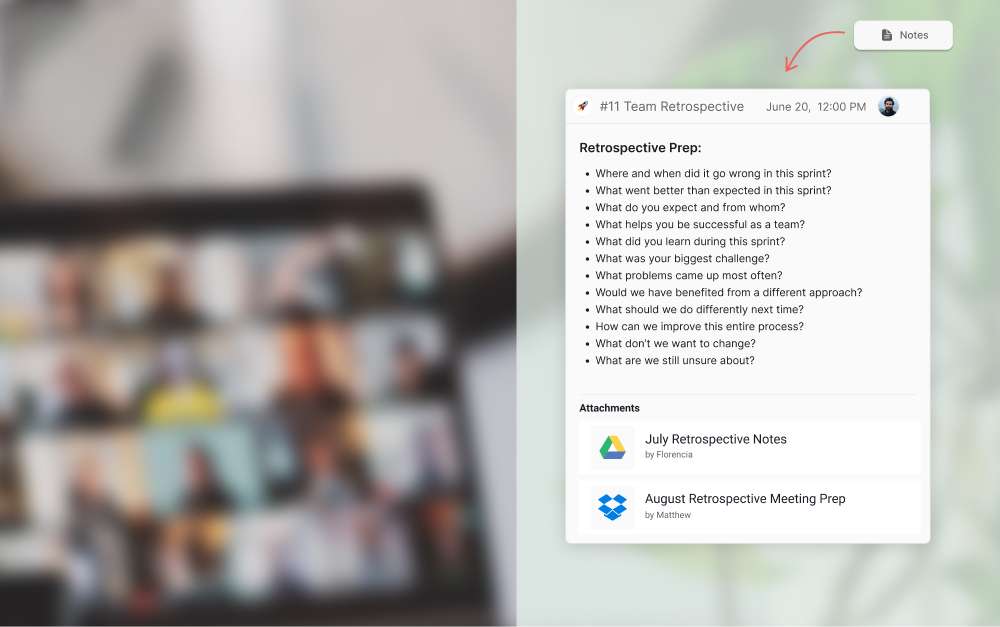
The agencies and teams that struggle run SWOT in a one-off slide deck. The grid gets polished, presented, filed, and forgotten. By the next planning cycle, nobody remembers which threats they decided to defend against, which opportunities they committed to pursue, or who owned what. Consolidating the SWOT, the TOWS strategies, and the tasks in one space closes the loop.
Free resource: use our SWOT analysis template to run your next analysis as a living workspace instead of a static document.
For the prioritization framework often paired with SWOT, see our MoSCoW method guide. To turn the SWOT and other analytical inputs into a connected set of strategic choices, see our strategic choice cascade guide. To map opportunities into a clean growth direction (existing or new product, existing or new market), see our Ansoff matrix guide. For the decision framework that pairs with SWOT in quarterly planning, see our Eisenhower matrix template. For the operational measurement layer that tracks whether SWOT-derived strategies are actually working, see our KPI framework guide; agency KPIs covers the function-specific cut for service businesses. For the strategic brief that often triggers a SWOT in agency work, see our client brief template.
A SWOT you actually act on beats a SWOT you file. Rock combines chat, tasks, notes, and files in one workspace so the SWOT, the TOWS strategies, and the work to deliver them all live together. One flat price, unlimited users. Get started for free.