How to Build a Social Media Marketing Plan (With Template and Examples)
A social media marketing plan is the social-specific layer of your broader marketing plan. It says which platforms you will show up on, what you will post, and how often. It also names who runs the conversation when the post lands and how you will measure whether any of it is moving the business. Most plans cover the first three and skip the rest.
This guide covers what goes into a social media marketing plan and how to pick the channels worth your time. It walks through the production pipeline that keeps the calendar honest and the community management discipline that decides whether posts compound or disappear. Read on if your team is publishing but cannot tell you whether anything is landing.
What is a social media marketing plan?
A social media marketing plan is the document that says who you are reaching on social, what you will post, where you will post it, and how often. It sits inside your broader marketing plan and inherits its goals. The plan is not a content calendar, though it produces one; it is the operational layer that decides which platforms earn your time and what you publish on them.
According to DataReportal's Digital 2026 report, 5.66 billion social user identities exist worldwide, with the average user active on 6.75 platforms. The audience is huge, fragmented, and changing fast. A plan is what stops the team from chasing every shiny object.
What goes in a social media marketing plan
A good plan is short. Six sections, each tight enough that the team will actually re-read them. The structure below works for in-house brand teams, agencies running social for clients, and founders posting from the company account themselves.
| Section | What it answers | Common mistake |
|---|---|---|
| Audience and goals | Who are we trying to reach, and what does success look like? | Goals like "grow followers" with no business outcome attached |
| Content pillars | Three or four big themes the account will own | Posting whatever the team thinks of that morning |
| Channel mix and cadence | Which platforms, how often, in what format? | Being everywhere instead of being good somewhere |
| Production pipeline | How does each post get briefed, made, approved, and published? | One person doing everything, with no backup or queue |
| Community management | How fast do we respond, and what is our voice? | Treating community as cleanup work after the post ships |
| Measurement | What numbers tell us this is working? | Reporting reach and impressions, ignoring shares and saves |
The biggest mistake is starting with the calendar. The calendar is the output, not the plan; without the audience, pillars, and channel mix above it, the calendar drifts to whatever the team thought of that morning. Nielsen Norman Group's content strategy framework makes the same case from a UX angle: structure informs content, content informs the experience. Skip the structure and the plan defaults to noise.
Audience and content pillars
The audience comes first. Two or three personas, written in enough detail that the team knows when to say no. Pew Research's Americans' Social Media Use survey shows how fast the platform mix changes by age and segment. Among US adults, 84 percent use YouTube, 71 percent Facebook, 50 percent Instagram, 32 percent TikTok, 25 percent LinkedIn. The plan that picks platforms by gut wastes most of its hours on the wrong feed.

Once the audience is named, content pillars decide what you actually post. Three or four big themes the account will own, each one mapped to a stage of the audience journey. We cover the full pillar discipline in the content marketing plan guide. For the integration layer above all digital channels, see the digital marketing plan. Search-driven social distribution (TikTok and YouTube as discovery surfaces) sits inside the SEO marketing plan. For social specifically, the pillars are the same; the formats are platform-native, like a LinkedIn carousel, a TikTok reel, or an Instagram story.
"Content is king, but context is God." - Gary Vaynerchuk, Jab, Jab, Jab, Right Hook
Vaynerchuk's frame is the right test for whether a plan respects the platform. Repurposing the same post across LinkedIn, Instagram, TikTok, and X without adapting it is content; adapting the hook, the format, and the runtime to each platform is content marketing. The plan that wins picks the pillars, then designs natively for each channel.
Free resource: download our marketing plan template to get the strategy notes, annual roadmap, and execution board structure ready to copy into your workspace.
Channel mix and posting cadence
Pick the platforms where the audience actually pays attention. Three is usually the right number for a small team; four if the audience genuinely splits, and never more than that as a starting point. Concentration beats breadth on social the same way it does on every other channel.
| Channel | Best at | Format priority | Realistic cadence |
|---|---|---|---|
| B2B reach, professional audiences, thought leadership | Text posts, carousels, native video, articles | 3 to 5 posts per week per active author | |
| Brand identity, visual products, lifestyle | Reels, carousels, photo posts, stories | 3 to 5 posts per week, daily stories | |
| TikTok | Reach, short-form video, discovery for younger audiences | Native short vertical video | 3 to 7 posts per week, plus reactive content |
| X (Twitter) | Real-time conversation, tech audiences, customer service | Text posts, replies, threads | Daily activity, more during launches |
| YouTube | Search-driven discovery, deeper explanations | Long-form video, shorts, livestream | 1 to 4 long-form pieces per month, plus shorts |
| Community groups, broad demographics, paid amplification | Photo posts, video, group activity | 2 to 4 posts per week, plus group engagement | |
| Threads | Conversational reach, real-time, IG audience overlap | Short text, replies, light visuals | Daily activity |
The cadences above are realistic for a small team. The trap is committing to a frequency the team cannot maintain past month two. Better to post three times a week consistently than to post daily for a month and then disappear. Cross-platform note: a LinkedIn post does not become a TikTok post by reposting it. Each platform has its own format expectations and reposting identical content reads as low effort to the algorithm and to the audience.
Production and publishing pipeline
Every post should run through the same production pipeline, even if the steps take ten minutes total. Skipping the pipeline is how plans drift into improvisation; running the pipeline is how the calendar stays honest.

- Brief Each post starts with a short brief, even if it lives in one line. Pillar, audience, format, hook, success metric, owner. Posts without a brief tend to read as filler; the audience can tell.
- Produce Copy, design, video, photography. The platform-native format matters more than production polish; a phone-recorded LinkedIn video often outperforms a polished agency edit. Match the format to the platform, not to the production budget.
- Review and approve A second set of eyes runs the post against the brief, the brand voice, and any sensitivity checks. Long approval cycles are the most common cause of slipping social calendars; a 24-hour approval window built into the workflow saves more time than any scheduling tool.
- Schedule Queue the post in the scheduling tool with the right time, channel, and assets. Cross-posting the same content to every platform is a common shortcut; the post that lands on LinkedIn rarely lands the same way on TikTok. Adapt per platform or skip the platform.
- Publish The post goes live. The first hour matters; the algorithm decides whether to push the piece based on early engagement signals. Plan to be present in the first 60 minutes after publish for replies and edits.
- Engage Reply to comments, answer DMs, jump into related threads. Engagement is part of the post, not the cleanup after. The cost of skipping it is the post that performs once, then disappears, instead of compounding.
- Measure and learn Pull the numbers from the success metric named in the brief. Compare to the last five posts in the same pillar. Document what worked and what did not, and feed it into next week's brief. Weekly retros beat monthly ones for social; the cycle is too fast for monthly review to keep up.
The most under-appreciated step is the last one. Weekly retros beat monthly ones for social because the cycle is fast; what worked last week often does not work next week. The retro is what turns the production line into a learning system. Run it as a project, not a doc, and the calendar compounds.
Community management and crisis response
Community management is part of the post, not the cleanup after. The first 60 minutes after publish are when the algorithm decides whether to push the piece, based on early engagement signals. The team needs to be present, not posting and walking away. Reply to comments, answer DMs, jump into related threads. The cost of skipping this step is the post that performs once and then disappears.

Three rules keep community management consistent. First, response time targets, scaled by channel: under two hours on X and Instagram during business hours, under 24 hours on LinkedIn and Facebook. Second, brand voice consistency: write a one-page voice doc with examples of how to handle praise, complaints, and questions, and make it the second thing every new team member reads. Third, an escalation path: name who handles a comment that needs legal review, who handles a public complaint about a product issue, and who decides when to delete versus respond.
The crisis side is rare but expensive. Plan for it before it happens. Most crises follow a predictable shape: a single comment, post, or screenshot goes wide, the team scrambles to respond, the response creates the next news cycle. The plan that holds is the one with a written first-response template, a named decision-maker, and a holding statement ready before anyone needs it. RACI is useful here for naming who decides versus who informs.
"Content is king, but engagement is queen, and she rules the house." - Mari Smith, social media strategist (via X)
Smith's frame predates the algorithm changes that made it true at scale. Posts that drive engagement get distribution; posts that get distribution drive engagement. The team that treats engagement as the work, not the cleanup, builds the audience that compounds.
"Answer every customer complaint, in every channel, every time." - Jay Baer, author of Hug Your Haters
Baer's research with Edison found that around a third of customer complaints go unanswered; the brands that respond consistently turn complaints into retention. The Edelman 2025 Trust Barometer reinforces the point from the audience side: four in ten consumers say they will not form an emotional attachment to a brand without social interaction. Community management is not optional infrastructure on a social plan; it is most of the value.
Measurement: leading vs lagging indicators
Measurement on a social plan should be tight. Reach and impressions are what platforms surface most easily, which is why most reports lead with them. They are also the noisiest. Saves, shares, and comments are stronger signals because they require the audience to do something, not just see something.
| KPI | Type | Why it matters | Cadence |
|---|---|---|---|
| Saves and shares | Leading | The cleanest signal that the audience finds the content useful enough to revisit or amplify | Weekly |
| Comments per post | Leading | Conversation depth beats reach; high comments-to-reach ratio predicts community growth | Weekly |
| Direct messages received | Leading | Inbound interest, often from buyers and partners | Weekly |
| Profile visits and follows | Leading | Audience growth from content, not buys | Monthly |
| Branded search volume | Lagging | People who saw you on social and now Google your name | Monthly |
| Click-throughs to site | Lagging | Conversion-side measurement that ties social back to revenue | Monthly |
| Share of voice | Lagging | Mentions and conversations relative to direct competitors | Quarterly |
Split the KPIs into leading and lagging indicators. Leading indicators (saves, shares, comments, DMs) tell you whether content is working this week and what to adjust next. Lagging indicators (branded search, click-throughs, share of voice) tell you whether social is moving the business and belong in the monthly readout to leadership. For the cross-channel diagnostic of where social fits in the buyer journey, see the marketing funnel guide. Tie both back to the broader marketing KPIs; an isolated social dashboard tends to underweight itself in business conversations.
Common pitfalls
The mistakes below show up across social plans that intend to compound and slowly drift back into a publishing schedule with no system underneath. Most are pattern-recognition failures, not analytical ones.
- Being everywhere instead of being good somewhere A small team running five platforms with a thin presence on each loses to a team running two platforms well. Pick where the audience actually is, win those, then add a third. Concentration beats breadth on social the same way it does on every other channel.
- Cross-posting the same content to every platform A LinkedIn carousel does not become a TikTok video by reposting it. Each platform has its own format expectations, audience, and tone. Repurposing is fine, even encouraged. Identical reposts read as low effort and the algorithms know it.
- Treating community management as cleanup Engagement is part of the post, not the work that happens after. Replies, DMs, and conversations are where the audience decides whether to come back. Plans that budget for production but not for engagement publish more and grow less.
- Reporting reach, ignoring saves Reach and impressions are the metrics platforms surface most easily, which is why most reports lead with them. They are also the noisiest. Saves and shares are stronger signals because they require the audience to do something, not just see something. Build the report around the metrics that change behavior.
- For agencies, your own social losing to client work If your agency posts for ten clients but has not updated its own brand account in three months, the brand account is the canary. The team that creates for clients is the team that creates for the brand; capacity is finite. Bake the brand-social hours into the staffing model or expect the brand calendar to slip every time client work tightens.
The biggest of the five is the third. Engagement is not cleanup; it is the work. Plans that budget for production but not for engagement publish more and grow less, and the team cannot work out why for two quarters.
What we recommend
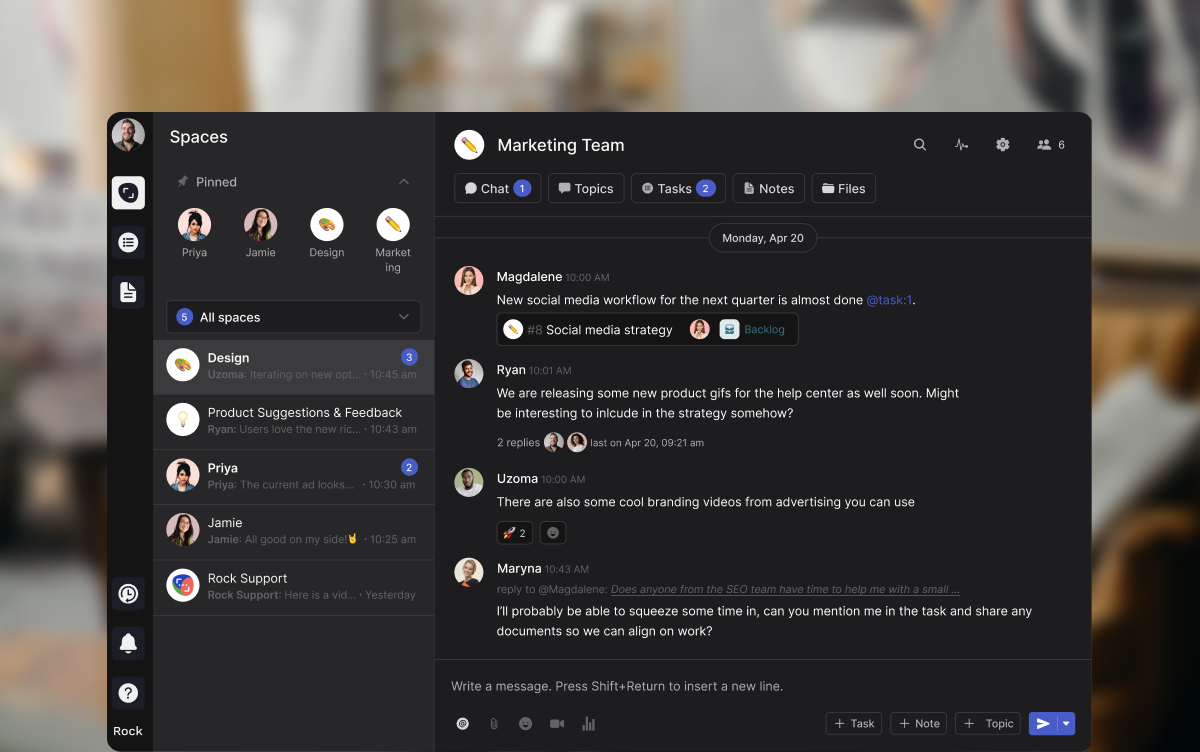
At Rock we run social plans inside the same workspace where the marketing team works. The plan lives as a pinned note in the marketing space. The pillars and audience personas live as separate notes the team re-reads quarterly. The editorial calendar is a board where each card is a post in production. Replies and inbound DMs live in chat next to the post, not in a separate inbox tab.
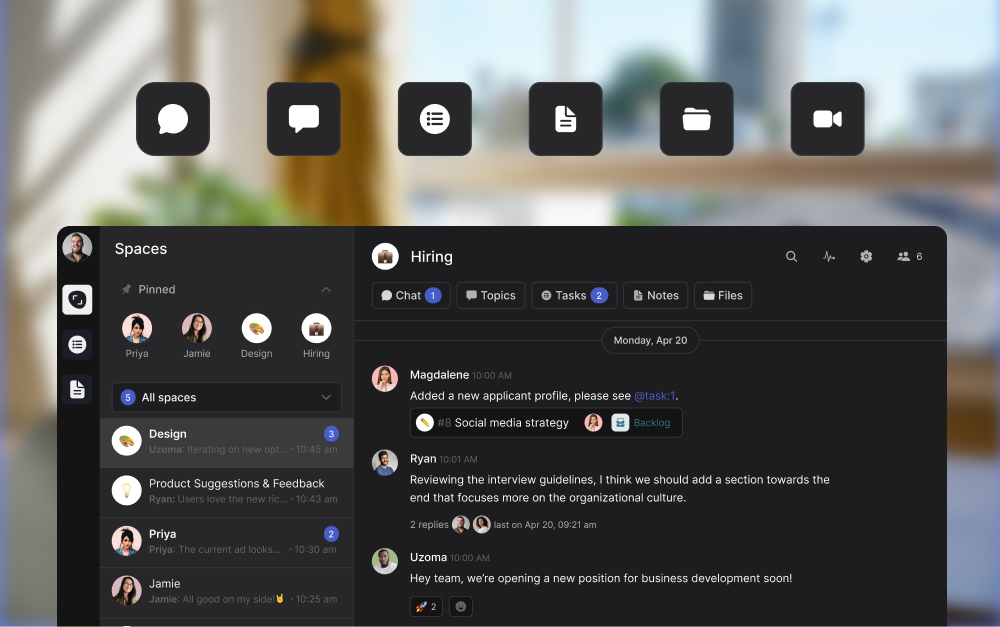
For agencies running social on retainer, the plan structure is reusable across clients. The six sections, the production pipeline, the community management rules, the KPI framework, the pitfalls list are the same. Only the audience definition, the specific pillars, and the platform mix change per client. Build the social plan template once, then duplicate the space per client. The compounding gain across a portfolio comes from this reuse, not from any single tactic.
Three adjacent disciplines tie the social plan into the broader operating model. Marketing operations runs the day-to-day execution. Capacity planning tells you how much social work the team can carry without quality dropping; social is one of the easiest channels to over-promise on and under-deliver. Agency KPIs close the loop on the operating side.
The broader marketing system fits together cleanly. The pillar marketing plan sits upstream as the artifact this social plan inherits its goals from. The content marketing plan handles the wider content system that social distribution sits inside. Campaign management handles the one-campaign-at-a-time view when a social push needs paid or content support. Each piece does one job; the plan is what connects them.
How to start your social plan this quarter
If your current social activity is unplanned (most teams are), do not try to write a perfect 12-month plan. Run a 90-day plan against the framework above and use the retrospective at day 90 to plan the next quarter. The first 90 days are about getting the system working, not winning every channel.
Three moves to start this week. Pick the channels: two or three platforms where the audience actually is, no more. Set the cadence honestly: a frequency the team can hold past month two, not the aspirational version. Set the community-management rules: response time targets, brand voice doc, escalation path. The other sections fill in over the first 30 days.
Run the social plan inside the same workspace as the work. Rock combines chat, tasks, and notes in one workspace. One flat price, unlimited users. Get started for free.