Marketing Campaign Management: A Practical Guide
According to the 2023 State of Creative Workflow Report from Ziflow and the AMA, 70% of creative team members work on more than seven different projects or campaigns each week. Most of those campaigns share the same patient stakeholders, the same approval bottleneck, and the same retro that never happens. The upstream layer that makes a campaign worth running is the creative strategy; without it, campaign management is throughput without direction. Campaign performance reads cleanest against a stage-by-stage marketing funnel diagnostic. For multi-channel digital campaigns, the integration logic and budget rollup live in the digital marketing plan. When a campaign leans on social channels, the cadence and community workflow sit inside a social media marketing plan. For content-driven campaigns, the editorial system lives in a content marketing plan. When the campaign is search-led, the SEO marketing plan is the upstream document. Campaigns roll up to the broader annual marketing plan. Campaigns sit inside marketing operations. Marketing campaign management is the workflow that turns that chaos into something the team can ship on time.
This guide covers how to run a single marketing campaign brief-to-retrospective. If you are looking for the system-level discipline that runs all your marketing work, that is marketing project management. This piece is the per-campaign workflow that lives inside it: seven phases, channel-level approval gates, and the mistakes that quietly derail launches.

What Is Marketing Campaign Management?
Marketing campaign management is the practice of planning, running, and measuring a single campaign end to end. It owns the brief, the channel mix, the production schedule, the approvals, the launch, and the retrospective. The output is a campaign that ships on the date promised and produces measurable results, not a campaign that exists in slides.
It is narrower than the broader marketing program (that is the system level) and broader than a single asset (an email, a social post). The dedicated role here, the campaign manager or marketing manager, owns the campaign from intake until the retrospective is filed.
"In the last few years, marketing seems to be devolving into a tactical pursuit, devoid of strategic thinking." - Mark Ritson, Marketing Week
Ritson is right, and campaign management is where this devolution shows up first. A campaign without a sharp goal becomes a list of tactics looking for a reason. The brief, run well, prevents that.
Marketing Project Mgmt vs Campaign Mgmt
The two terms get confused, and the confusion costs teams in tooling and process choices. The table below disambiguates them so you know which one you are reading and which one you actually need.
| Dimension | Marketing project management | Marketing campaign management |
|---|---|---|
| Reader question | How do I run marketing as a system? | How do I run THIS campaign well? |
| Time horizon | Continuous, quarter over quarter | One campaign, brief to retrospective |
| Owns | Workflow, capacity, planning cadence | Campaign brief, channel mix, launch, results |
| Typical role | Marketing project manager or ops lead | Marketing manager or campaign lead |
| Frameworks used | Kanban, Scrum, hybrid | Lifecycle phases and approval gates |
Marketing project management runs the system. Marketing campaign management runs the campaign. They are siblings inside the same operation and they cite each other.
The Campaign Lifecycle: 7 Phases
Most campaigns move through seven phases. Names vary across teams, the sequence does not. These phases run inside the broader marketing project management system that handles capacity and planning cadence across all your campaigns at once.
| Phase | What happens | How we run it in Rock | |
|---|---|---|---|
| 1 | Intake | A request lands from a client, the strategy lead, or a webform on the campaign landing page. Define what was actually requested before producing anything. | Webform turns site responses into tasks in a designated space with the channel label already attached |
| 2 | Brief | Define goal, audience, channels, success metrics, and the named approver. The locked agreement everyone refers to when scope drifts later. | @mention reviewers; convert the chat discussion into a task and a note in one click |
| 3 | Plan | Break the brief into channel-specific tasks, assign owners, schedule dependencies. The plan covers the campaign duration, not just week one. | 2-week Sprint as the campaign cadence; Rock's docs point Sprints explicitly at marketing and design teams |
| 4 | Produce | Copy, design, dev, video, paid setup. Production is where one slow channel quietly delays the rest of the campaign. | Per-channel WIP limits in the column names keep parallel channels honest |
| 5 | Review | Internal QA first, then channel-specific approval. The bottleneck almost every other bottleneck flows through. | One Topic per approval, the named reviewer added as follower, draft attached, SLA in the title |
| 6 | Launch | Coordinated release across channels. The pre-launch checklist matters more than the launch itself: links tested, UTM tags set, tracking pixels live, escalation contact named. | Custom field "launch-status" per channel; a checklist task with the named pre-launch owner |
| 7 | Measure & retro | Track results against the brief's named success metric, not whatever each channel reports. Book the retrospective at day 14 or 30, while the data is fresh. | A note for the retro, a recurring task for the day-14 checkpoint, results pinned to the space |
"The root cause of failure in most digital marketing campaigns is not the lack of creativity in the banner ad or TV spot or the sexiness of the website. It is quite simply the lack of structured thinking about what the real purpose of the campaign is and a lack of an objective set of measures with which to identify success or failure." - Avinash Kaushik, Web Analytics 2.0
Kaushik's point is the one most campaign managers know and avoid. The hardest 30 minutes of any campaign is naming the success metric before launch and accepting what it actually measures. Skip that step and the retro becomes an exercise in rationalization.

Multi-Channel Coordination
According to HubSpot's 2026 State of Marketing report, most brands use five to eight channels to connect with customers. A modern campaign is rarely a single asset; it is email plus social plus content plus paid running in parallel under one banner. Coordinating those channels is where most campaign managers actually spend their week.
The honest reality from the 2024 State of Marketing Collaboration from Meltwater and Asana: only 39% of marketers feel confident their goals are aligned with the business, and 27% feel disconnected from the rest of the organization.
That misalignment shows up in campaigns as channel teams optimizing local KPIs while the campaign-level goal slips. The fix is one shared campaign space, one campaign-level metric, and explicit channel-by-channel approval gates that run async.
"It tends to be better to have some of your campaign focused on long-term brand building and some of your campaign primarily focused on short-term activation. These two things enhance the other, so there's synergy between them." - Les Binet, IPA
Binet's point is why channel mix is a strategy decision, not a tactical one. Brand-building channels and activation channels do different jobs at different speeds; treating them as interchangeable is how campaigns end up over-indexed on whichever channel reports the cleanest data.
Channel Approval Gates That Hold
Every channel has a different reviewer set, different things to check, and a different SLA the team can actually live with. The table below lays out a starting point and how each runs in Rock if you want a concrete setup, not just a principle.
| Channel | Reviewers | What they check | Typical SLA | How we run it in Rock |
|---|---|---|---|---|
| Brand, copy editor, sometimes legal or CAN-SPAM | Subject line, claims, links, unsubscribe | 24 to 48 hours | One Topic per email, the reviewer added as follower, draft attached | |
| Social | Brand, creative, community manager | Voice, visual, hashtags, mention rules | 4 to 24 hours | Custom field "social-status" on the task plus a Topic for revisions |
| Content (blog, landing) | SEO, brand, copy editor | Keyword fit, accuracy, on-page CTAs | 48 to 72 hours | Note for the draft, comments per reviewer, task with the @mentioned reviewer |
| Paid (PPC, social ads) | Performance lead, brand, finance | Targeting, budget cap, claims | 24 hours | Custom field "approval-status" with the budget cap as a value |
The pattern that holds across all four channels: one Topic per approval, the named reviewer added as a follower, draft attached, SLA written into the title. Topics are designed for exactly this; the help center calls them "structured discussions that prevent notification overload."
The reviewer reads async, comments inline, and marks the gate cleared. Add a Custom Field on each task for "approval-status" so the campaign manager can scan the board and see what is gated where.
Common Campaign Management Mistakes
Five patterns show up every time a campaign quietly misses its goal. They are different from the system-level bottlenecks that derail marketing operations as a whole; these are campaign-specific.
- Skipping the brief sign-off A brief that nobody formally approved becomes the brief everyone interprets differently in week two. The brief is not the kickoff doc; it is the locked agreement on goal, audience, channels, and what counts as done. Get the named approver to sign off in writing before any production starts.
- Treating launch as the finish line Launch is the start of measurement, not the end of the campaign. Teams that close the project space the day after launch lose the data window where you can actually tell whether the campaign worked. Keep the space open through the measurement window and book a retrospective on day 14 or 30.
- Optimizing one channel and ignoring blended attribution Email opens spike. Paid clicks land. Social impressions roll in. Each channel team reports green and the campaign goal still misses. Single-channel KPIs without a blended attribution view hide the real picture. Decide on the campaign-level success metric before the channels start reporting their own.
- Reusing last campaign's KPIs by default A product launch and a brand awareness push are not the same campaign type and should not share the same scorecard. Pick KPIs that fit the goal of THIS campaign, not the metrics that happened to be in the last template. The wrong KPI silently makes the team optimize for the wrong thing.
- Skipping the campaign retrospective Without a retro, every campaign starts from zero. The brief misses the lessons from last quarter. The new team makes the same approval mistake. A 30-minute campaign retro at the end of the measurement window is the cheapest compounding investment in marketing operations.
If your team hits more than two of these on the last campaign, that is the lesson the next retrospective should center on. Trying to fix all five at once is how campaign teams over-index on process and under-deliver on the actual work.
Tools and Templates
The tooling for a marketing campaign is the same shape as for any project: a board for the work in flight, a way to discuss it next to the work, a place for the brief and the retro, and a way to bring clients and freelancers in without paying per seat.
For the broader category comparison see our task management tools guide. Stack-fit matters more than feature count; a campaign team that updates a simple board beats one that ignores a powerful one.
Campaign Management at Rock
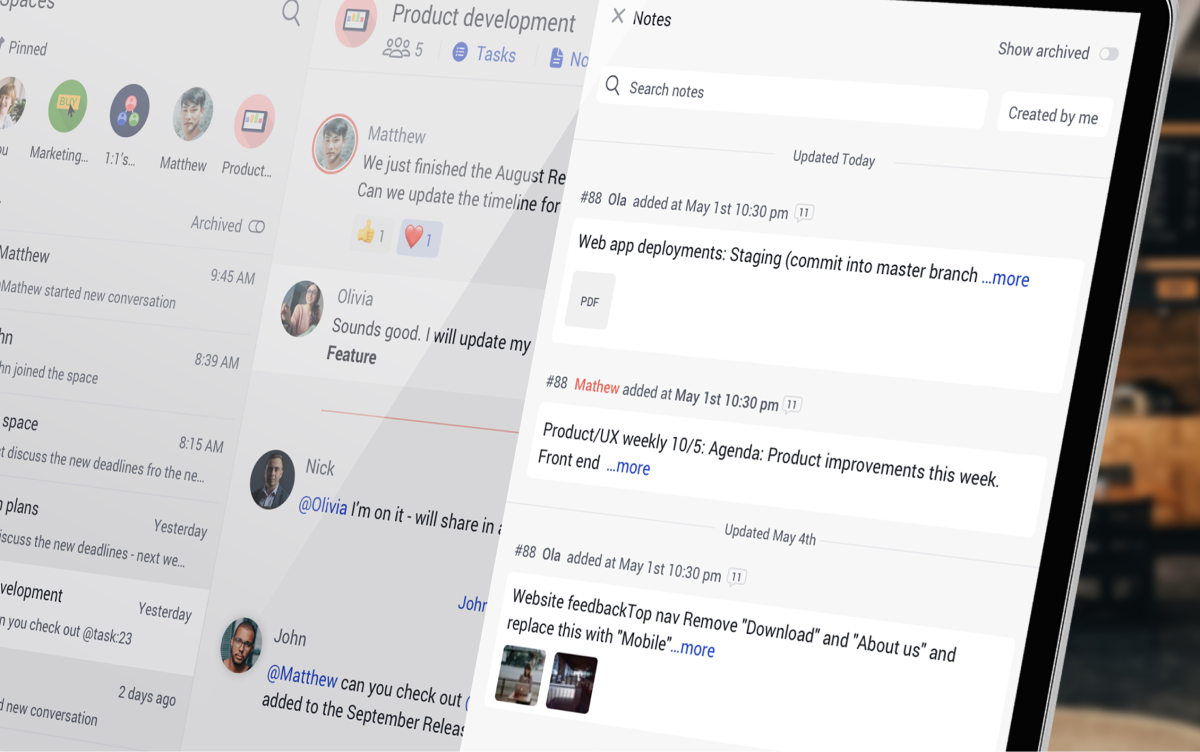
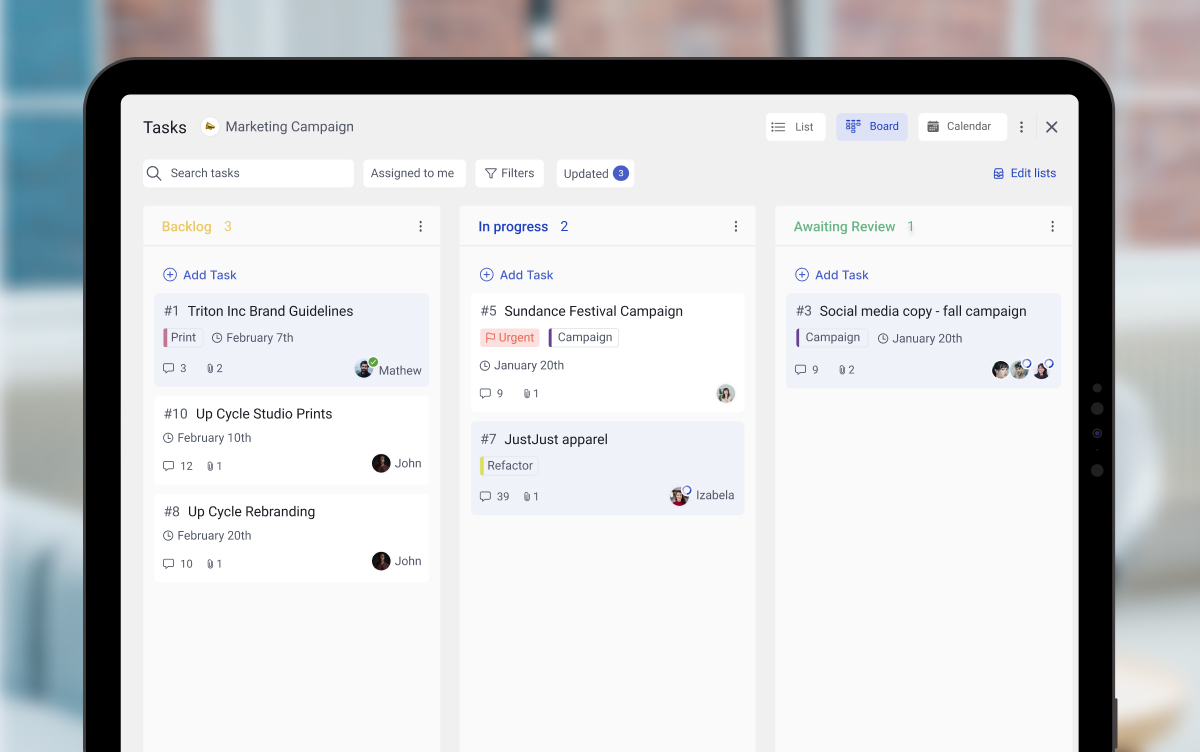
We run our own campaigns in a single space per campaign with chat, the Board view, the brief, and the assets all in one place. Channel labels live in the column names ("Email · In Review (max 3)") so capacity is visible without a separate spreadsheet. Sprints set the production cadence, Topics carry the per-channel approvals.
Two patterns we lean on hard. First, we use Tap to Organize to pull a campaign idea straight out of chat into a task or a note in one click — most of our briefs start as a Slack-style discussion that becomes a structured task. Second, on every client campaign, cross-org sharing brings the client into the same space at no per-seat cost. They see the live board, comment on cards, and sign off without a status email or a separate client portal.
What We Recommend
We run a 30-minute retrospective at the end of every campaign, including the ones that went well. We capture three observations and one experiment for the next campaign in a Note pinned to the space. The teams that learn fastest are not the ones running the most campaigns; they are the ones treating each campaign as a unit of compounding learning.
We are deliberate about notifications too. Rock's help docs put it well: "pick and choose your notifications." On a campaign, only the named approver follows the approval Topic, only the campaign manager gets pinged on every status change, and everyone else opts in by interest. It cuts noise enough that the team trusts the alerts that do come through.

The honest limitation: Rock's campaign management is light on heavy planning features compared to a dedicated marketing operations platform. Custom Fields are on the Unlimited plan; on free, a label does the same job for binary scope-in or scope-out cases.
For agencies under 30 people running fewer than ten campaigns at once, the lightweight stack is enough. Above that scale, a dedicated MOps tool starts to pay back. Pair the workflow with the right marketing KPIs so each campaign can be measured against goals that fit it, not the metrics that happened to be in last quarter's template.
Final Thoughts
Marketing campaign management rarely fails because the team lacked talent or tools. It fails because the brief was vague, the approval gates were sequential, and the launch was treated as the finish line. Get the brief sharp, run the gates async, and book the retrospective before launch day so the team knows it is coming.
The teams that ship better campaigns are not the ones running the most experiments. They are the ones running the same workflow well enough that each campaign teaches the next one something specific. That is the compounding advantage of disciplined campaign management.
Run your marketing campaigns in one place. Rock combines chat, tasks, and notes in one workspace. One flat price, unlimited users including clients and freelancers. Get started for free.