Marketing Operations: A Complete Guide for Modern Teams
Most agencies do not lose money on bad work. They lose it on missed handoffs, briefs that arrive without context, reports rebuilt from scratch every month, and the same fire-drill on a different client every Thursday. Marketing operations is the discipline that turns those one-off heroics into a system that runs the same way for every client without the chaos.
This guide covers what marketing operations actually means, the four pillars under it, and how the function looks different in an agency than inside a single brand. It also walks through the operating loop, the maturity model, and where to start if your ops sit between Ad-hoc and Defined. Run the maturity check below first to see where your team lands before reading on.

Marketing Ops Maturity Check
Five questions, one minute. Pick the answer that best matches how your team runs today, not how you wish it ran. The result tells you which level your operations sit at and what to fix next.
What is marketing operations?
Marketing operations is the system of process, people, technology, and data that runs marketing as a repeatable practice rather than a series of campaigns held together by individual effort. It is the operating model underneath the work: how requests come in, how briefs get written, how production moves, and how the team learns from what shipped. Strong marketing operations make the same machine work twelve times in parallel without twelve sets of fires.
The function is often confused with two adjacent disciplines. Marketing project management covers how a single piece of work moves from brief to delivery. Campaign management covers one campaign end to end across channels. Marketing operations is the meta-layer that contains both, plus the tech, the data, and the team structure.
| Dimension | Marketing Operations | Marketing Project Management | Campaign Management |
|---|---|---|---|
| Scope | The full operating model: process, people, tech, data | How a single piece of work moves from brief to delivery | One campaign end to end across channels |
| Time horizon | Quarterly to annual | Project lifecycle (days to months) | Campaign window (weeks to a quarter) |
| Question it answers | Does the system run reliably at scale? | Will this project ship on time and on brief? | Did this campaign hit its goal? |
| Owner | Ops lead, agency partner | PM or producer | Campaign manager or strategist |
| Output | SOPs, KPIs, capacity plans, retainer rhythms | Briefs, task boards, status updates | Creative assets, channel plans, performance reports |
| Sits inside | The agency itself | Marketing operations | Marketing operations and project management |
"Marketing ops is the art and science of executing great marketing or bringing a CMO strategy to life." - Darrell Alfonso, author of The Martech Handbook
Alfonso's framing is the cleanest one-liner for the role. Strategy comes from leadership; operations is what turns strategy into shipped work without burning the team out. The art is reading the situation; the science is the repeatable system that runs underneath.
In-house vs. agency marketing operations
Most marketing operations writing assumes a single in-house team running marketing for one company, usually a B2B SaaS shop with a Marketo or HubSpot stack. Agency marketing operations is structurally different in eight ways, and the differences shape every decision about process, hiring, and tooling.

An in-house team runs one operations loop with multiple campaigns flowing through it. An agency runs one loop per client account, in parallel, with shared production capacity behind them. The center of gravity moves from martech administration toward the production pipeline and the handoffs between strategy, creative strategy, media, and reporting.
| Dimension | In-house marketing ops | Agency marketing ops |
|---|---|---|
| Number of ops loops | One, running multiple campaigns | One per client, running in parallel |
| Center of gravity | Martech admin and demand-gen ops | Production pipeline and client handoffs |
| Cadence | Quarterly demand-gen waves | Monthly retainer cycles |
| Cost discipline | Internal headcount and software ROI | Billable hours and write-off rate |
| Reporting artifact | Internal dashboards for the marketing team | Client-facing decks tied to contracted KPIs |
| Tool stack | Heavy: Marketo, HubSpot, Salesforce, attribution | Lean: shared workspace, briefs, approvals, analytics |
| Hiring trigger | Marketo admin or demand-gen specialist | Ops lead or senior producer |
| Biggest failure mode | Tech stack outpaces process | One chaos client breaks team capacity |
The cost discipline is also different. In-house ops measures itself on internal headcount efficiency and software ROI. Agency ops measures itself on billable hours and write-off rate; every operations choice eventually shows up in utilization or margin.
The Gartner 2025 CMO Spend Survey found marketing budgets flatlined at 7.7% of company revenue, with 39% of CMOs planning to cut agency spend. The takeaway for service shops is direct: agencies need leaner, more measurable operations to defend their share of a budget that is no longer growing.
The four pillars of marketing operations
Most frameworks settle on the same four pillars. The labels vary; the substance does not. Each pillar has a different question it answers, a different owner, and a different failure mode when it breaks.
Process. The repeatable workflow that runs from intake to delivery. Brief format, task structure, review cadence, approval flow, retrospective. Process is what separates a Defined-level shop from a Repeatable one. Owner: ops lead or senior PM. Fails when it lives only in one person's head.
People. The team that runs the work and the structure that connects them. Roles, accountabilities, capacity, hiring triggers. People is where most agencies make the wrong call, hiring an ops person to fix what is actually a process gap. Owner: agency owner or partner. Fails when capacity is treated as a spreadsheet exercise rather than a planning discipline.
Technology. The stack that supports the work. Workspace, briefs, production tools, analytics, automation. For agencies this layer should stay deliberately lean; the failure mode is buying tools that promise to fix process problems and end up adding three more logins. Owner: ops lead. Fails when the stack outpaces the process.
Data and measurement. The numbers that tell the team whether the system is working. Operations KPIs (utilization, on-time delivery, write-off rate) plus marketing KPIs that ladder up to client outcomes. Owner: ops lead with finance partnership. Fails when reports are built for show rather than decisions. See our deep dive on marketing KPIs for the full set.

The four pillars are interdependent. Better technology without better process produces faster chaos. Better process without measurement produces a system you cannot improve. Better measurement without people accountable to it produces dashboards no one reads. Treat the pillars as one system, not four projects.
The marketing operations team
Inside a 5 to 50-person agency the marketing operations team rarely looks like the org charts you see in B2B SaaS articles. There is no Marketo admin, no demand-gen ops manager, no separate analytics lead. The function is usually one ops lead plus a senior producer, with the rest of the team contributing operations work part-time alongside their delivery role.
Ops lead or head of operations. Owns the operating model: process, capacity, measurement, improvement. At smaller shops this is the agency owner or a senior partner; the dedicated hire usually lands around 15 to 20 FTE.
Senior producer or traffic manager. Runs day-to-day flow: intake routing, capacity allocation, schedule defense. The role exists in agencies long before anyone calls it operations.
Project managers or producers. Run individual client accounts or projects. They live inside the operations system but are not responsible for designing it.
Specialist contributors. Senior strategists, finance leads, and tech-savvy team members who own one piece of the operating model (templates, reporting, integrations) without it being their full job.
The hiring trigger most agencies miss is when partners spend more time coordinating internally than working with clients. By that point the team has absorbed a year of bad habits that will take longer to undo than the operating model takes to build. Capacity planning as a discipline tends to surface this signal earlier than gut feel.
"The real maturity gap is not whether you care, or whether your team is talented. It is whether your operating model can function without heroics." - Karl Sakas, Sakas & Company
Sakas's framing is the right test for whether to hire an ops lead. If the agency runs on the founders' nights and weekends, no operating model exists yet; the hire is not the answer until the model is at least sketched. If the team is talented but consistently late or over budget, that is the signal that the model needs an owner.
An operations framework for running marketing
Behind every well-run agency is a repeatable loop that runs whether the work is a one-off project or a monthly retainer. The loop is the same; what changes is the cadence and the depth of each step. For a retainer the loop runs monthly with light planning. For a project it runs once with hard milestones at every step.
- Intake Work enters the system. New retainer scope, ad-hoc client request, internal initiative. The intake step turns the request into a defined unit of work with a brief, an owner, and a deadline. Skipping intake is the most common cause of work that arrives without context and ships late.
- Brief and plan The brief gets written or pulled from a template. Strategy, creative, and production align on scope and deliverables. Tasks get broken down, owners assigned, dependencies mapped. For retainers this is light and continuous; for projects it is a hard milestone.
- Production The work happens. Copy, design, dev, video, paid setup, content. This is where most billable hours sit and where context-switching across clients quietly destroys utilization. Production runs through tasks, hand-offs, and shared files inside the client workspace.
- Internal QA Before anything goes to the client, someone other than the maker reviews it. Brand consistency, factual accuracy, technical checks. This step is what separates Defined-level operations from Repeatable; agencies that skip internal QA send revisions to clients that should never have left the building.
- Client review and approval The deliverable goes to the client for approval. Comments come back, revisions cycle, the work ships. Speed of approvals is the single biggest variable in retainer profitability and the most under-managed step in agency ops.
- Launch and report The work goes live. Performance gets measured against the contracted KPIs, not whatever the dashboard tool surfaces by default. The report is a deliverable in itself, with team commentary that explains what the numbers mean for next month.
- Retro and improve Once a quarter, the team walks through what worked, what broke, what slowed the loop down. Notes feed into next quarter's brief template, capacity model, or staffing plan. Operations that skip the retro stay stuck at Defined and never reach Managed.
The seven steps above describe the canonical loop. Most agencies have all of them in some form, but two are routinely skipped or done badly. Internal QA gets cut when timelines tighten, which is exactly when it is most needed. The retro gets cut every quarter for two years and then the team wonders why the same problems keep returning.
For agencies running campaigns inside this loop, the campaign management piece runs as a sub-loop inside steps 2 through 6. For broader project work that touches design, dev, or strategy beyond marketing, marketing project management covers the tactical layer of how the work moves day to day.
Cross-functional handoffs are the hardest part
Most marketing operations failures are handoff failures. Strategy passes a brief to creative; creative passes assets to media; media passes a launch to reporting; reporting closes the loop back to strategy. Every transition is a chance for context to drop and quality to slip.
The numbers on cross-functional collaboration are bleak. Behnam Tabrizi's Harvard Business Review study of 95 teams across 25 corporations found 75% are dysfunctional. They fail on at least three of five measures: budget, schedule, specifications, customer expectations, and goal alignment.
For an agency this is harder still because the handoffs cross client boundaries too. Account management hands off to strategy, strategy to production, production to client review, client review back to account management. A single weak link in that chain produces a missed deadline that the client sees, not just the team. RACI as a discipline helps clarify who is responsible for which transition; without it the handoffs default to whoever shouted last.
"Centralize everything you can. Automate everything you can. Decentralize everything you can. Humanize everything you can. Embrace continuous change." - Scott Brinker, Chief Martec
Brinker's rules look contradictory at first glance. They are not. Centralize the things that should be consistent (brief format, KPI definitions, client reporting). Decentralize the things that benefit from local judgment (creative direction, client relationship). Automate the predictable. Humanize everything that touches a client. The rules are tensions to manage, not steps to execute in order.
Marketing operations maturity model
Most agencies move through five maturity levels as they grow. The widget at the top of this article scores you against the model. The descriptions below explain what each level looks like in agency life and what the jump to the next level requires.
Level 1: Ad-hoc. Operations are improvised. Things ship because of heroics, not systems. Common at year one or two, or after a fast growth spurt where systems did not keep up. The next move is documenting one workflow, usually intake or weekly reporting.
Level 2: Repeatable. Some workflows are documented but each client still feels custom. The brief format varies by client, the reporting template varies by week, the meeting cadence varies by project lead. The next move is standardizing one of those across all clients; the variation should be in the answers, not the structure.
Level 3: Defined. Most ops loops are documented and the team follows them. Quality holds across clients. This is where most healthy agencies sit. The next move is measurement: pick three to five operations KPIs and make the system observable.
Level 4: Managed. Operations are measured. Issues surface in metrics before they hit clients. Sales sees real capacity before committing kickoff dates. Reports loop back into next month's plan. The next move is continuous improvement: a quarterly retro that produces actual changes, not just notes.
Level 5: Optimized. Operations adapt continuously. The system improves itself with low overhead. Most agencies do not need to reach Level 5; the gain from Level 3 to Level 4 is much larger than from Level 4 to Level 5.
The MarketingOps.com 2024 State of the Marketing Operations Professional research found only 7% of organizations reach the highest digital maturity level, with most teams stuck at Repeatable or Defined. That distribution mirrors what we see across agency clients on Rock; the meaningful gains come from cleaning up Level 2 to Level 3, not chasing Level 5.
Tools for marketing operations
Agency marketing operations tooling splits into five layers. The trap most teams fall into is buying a Level 4 tool to fix a Level 2 process problem, which adds cost without solving anything.
| Layer | What it does | Lean agency stack | Stack-heavy enterprise stack |
|---|---|---|---|
| Workspace | Chat, tasks, notes, files in one place per client | Rock, Basecamp, ClickUp | Slack plus Asana plus Notion plus Drive |
| Production | Briefs, creative reviews, approvals, version history | Workspace plus Figma plus Loom | Workfront, Wrike, Adobe Workfront Fusion |
| Measurement | Channel analytics, campaign reporting, dashboards | GA4, Looker Studio, native channel dashboards | Tableau, Domo, Marketo Measure, attribution tools |
| Automation | Email, lead routing, drip sequences | Mailchimp, ActiveCampaign per client | Marketo, HubSpot Enterprise, Pardot |
| Documentation | SOPs, brand books, process libraries | Notes inside the workspace | Confluence, Notion at company scale |
For a 5 to 50-person agency the lean stack on the left is almost always the right answer. The enterprise stack on the right makes sense for an in-house team running a hundred-million-dollar pipeline; for an agency the per-client cost would destroy retainer margins. Project management software for agencies covers the tradeoffs in the workspace layer specifically.
What we recommend
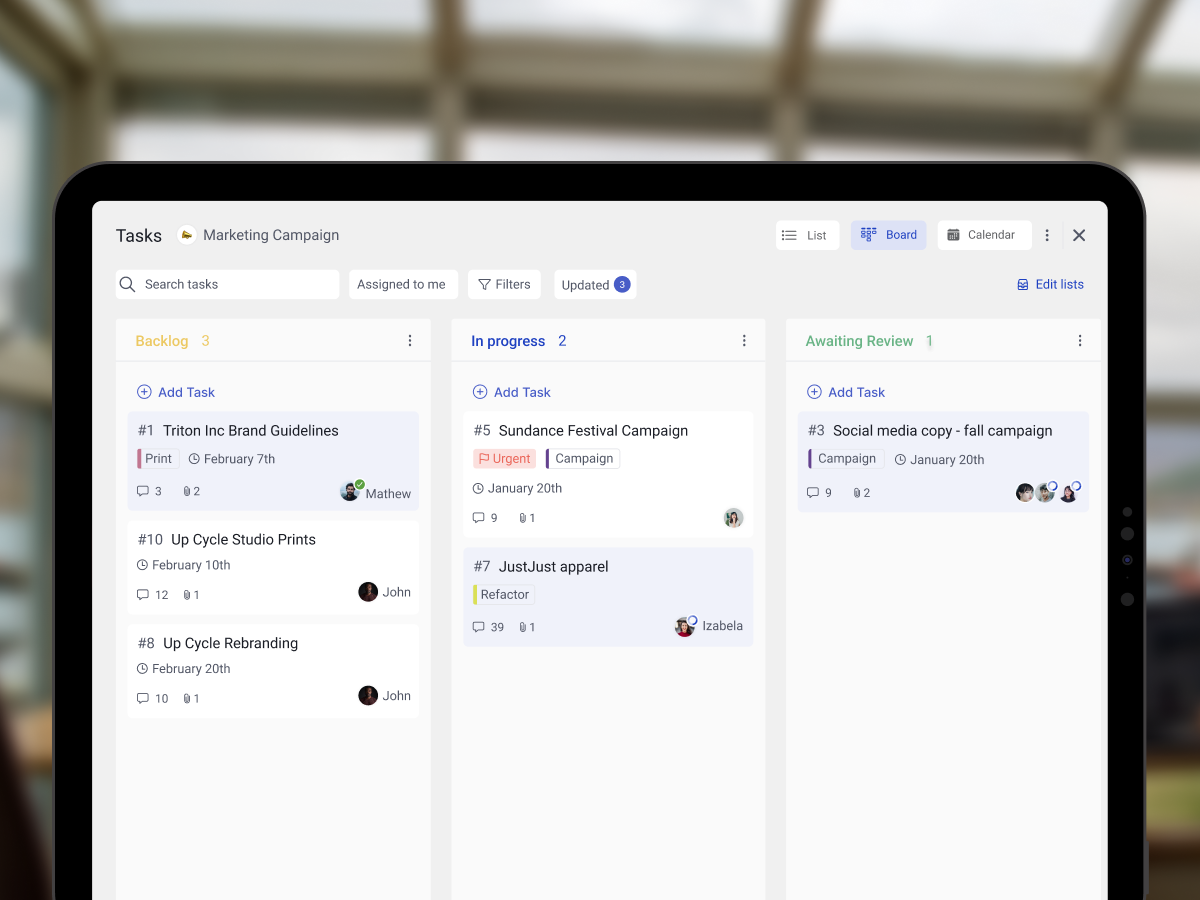
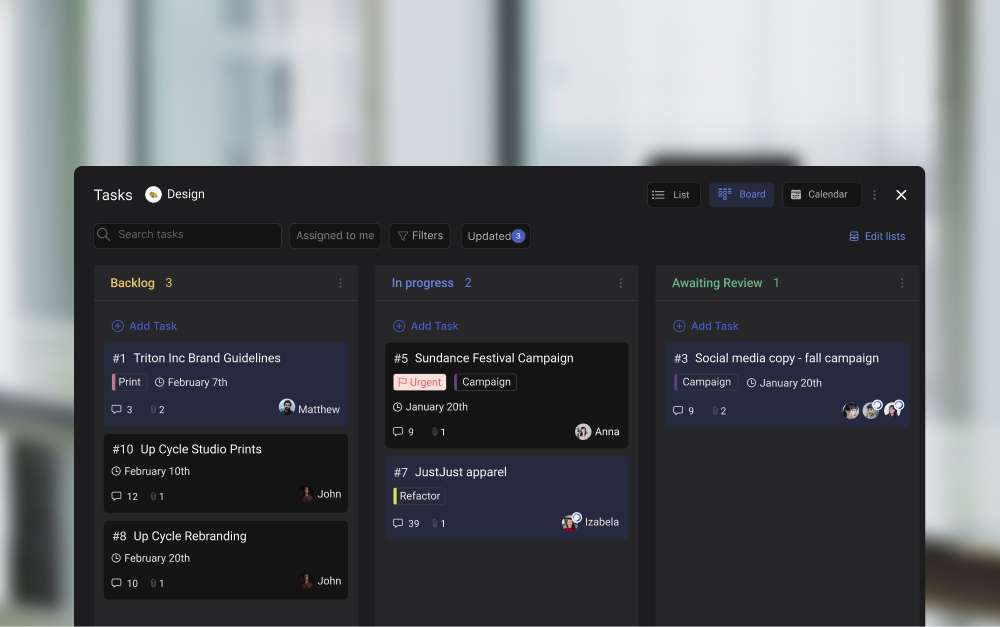
At Rock we run agency operations on the principle that the operating layer should sit where the team already works, not in a separate ops platform. Each client gets one space with chat, tasks, notes, and files together. The brief lives as a note. The production work lives as tasks. The handoffs happen in topics that thread the conversation by phase rather than by message timeline. The monthly report lives in the same space the work lives in.
This is honest about what Rock does and does not do. Rock is the workspace layer; it does not run paid media, it does not do attribution modeling, and it does not replace a real analytics tool for performance reporting. What it does is keep the work, the team, and the client conversation in one place so the operations layer is observable rather than scattered across five tools nobody syncs.
The broader operating model fits together with adjacent disciplines. Marketing project management handles the day-to-day movement of work. Campaign management handles the one-campaign-at-a-time view. Agency KPIs and marketing KPIs together produce the operating dashboard. Capacity planning and billable hours close the loop on the financial side. Operations is the spine that connects these into one functioning system. The marketing funnel is the diagnostic lens operations teams use to find where execution is leaking volume. Multi-channel digital execution rolls up to the digital marketing plan. Resource allocation handles how capacity gets distributed across the work the operations layer runs. Channel-specific plans like an SEO marketing plan inherit from operations and ladder back up at the quarterly review. The annual marketing plan is the artifact that tells operations what to execute against. Channel-specific plans like a content marketing plan and social media marketing plan branch off from there.
Common pitfalls
The mistakes below show up across agencies that intend to build real operations and slowly drift back to firefighting. Most are pattern recognition failures, not analytical ones.
- Buying the stack before defining the process A new tool feels like progress and is easier to expense than a process review. The result is an agency running three project-management apps and four document tools, none of which match how the team actually works. Define the loop on a whiteboard first; the stack falls out of the process, not the other way around.
- Hiring the ops lead too late Most agencies wait until the partners are drowning in admin to hire an ops lead, by which point the team has already absorbed a year of bad habits. The signal to hire is around 15 to 20 FTE or when the founders spend more time on internal coordination than on client work. Hiring earlier is cheaper than rebuilding the operating model later.
- Letting the ops lead become a martech babysitter An ops lead who spends the week fixing HubSpot integrations is not running operations. The role is process, capacity, measurement, and improvement. If the senior ops hire is the only person who can save a Mailchimp campaign, the agency has built a single point of failure dressed up as a leadership role.
- No standard onboarding loop for new clients Each new client is different in scope but the onboarding mechanics should not be. Without a standard loop, every kickoff reinvents the brief format, the tool setup, the meeting cadence, and the reporting template. The team burns 20 hours per onboarding that a defined loop would cut to five.
- Treating retainer scope creep as ops chaos When a retainer feels chaotic, the partners assume operations are broken. Often the operations are fine; the scope is leaking. Three free deliverables a month for the same client is a commercial problem, not an ops problem. Fix the scope agreement before redesigning the workflow.
The biggest of the five is the first one. Agencies that buy the stack before defining the process end up running three project tools, four document tools, and a deeply held grievance about software. The cure is one whiteboard session before any new tool gets evaluated; the loop comes first, the stack falls out of it.
How to start marketing operations this quarter
If your operations sit at Ad-hoc or Repeatable, do not try to jump to Managed in a quarter. The gain from Level 1 to Level 3 is the largest one available, and it is achievable in 90 days with three moves.
Pick one workflow and document it. Intake is usually the highest-leverage starting point because every other workflow downstream depends on a clean intake. Write the steps, name the owner, define the inputs and outputs. Pin it in the workspace.
Move client work into one shared space. If the work, the chat, the tasks, and the files live in five different tools, the operations layer is invisible. One space per client is the lightest possible structure that still shows the team who is doing what.
Standardize the brief format and the report format across clients. The variation should be in the answers, not the structure. Two templates done well move more shops from Level 2 to Level 3 than any tool purchase.
Operations is not a quarterly initiative; it is an ongoing discipline. But the first 90 days of deliberate work usually take an agency further than the next 90 days of incremental improvements ever will. Pick the workflow, pick the workspace, pick the templates. The rest follows.
Run client work and operations in the same place. Rock combines chat, tasks, and notes in one workspace. One flat price, unlimited users. Get started for free.