How to Build a Content Marketing Plan (With Template and Examples)
A content marketing plan is the content-specific layer of your broader marketing plan. Most teams confuse it with a content calendar; the calendar is the production schedule that comes out the other end. The plan says who you are writing for, what you are writing about, and how the work moves from idea to published to measured.
This guide covers what goes into a content marketing plan and how to define content pillars that ladder up to your audience. It walks through the production pipeline so the calendar does not slip every month, and where the plan should live so it survives the first quarter. Read on if your team is shipping pieces but cannot tell you whether they are compounding.
What is a content marketing plan?
A content marketing plan is the document that says who your content is for, what you will publish, where it will live, and who owns each piece. It sits inside your broader marketing plan and inherits its goals. The plan is not a content calendar, though it produces one; it is not a strategy document, though it inherits from one. It is the operational layer between strategy and production.
A good plan answers six questions. Who exactly is the audience and what do they care about? What content pillars will we own this year? What formats will we ship in each pillar? Where will we publish and how will we distribute? Who owns each step from brief to publish to measure? How will we know whether any of this worked?
"Nobody cares about your products or services. Why you exist is not your product. Your why is the problem your product solves." - Joe Pulizzi, founder of Content Marketing Institute
Pulizzi's frame is the cleanest test for whether a plan starts in the right place. If the first three pages of your plan are about your products, the plan will read as marketing collateral and the audience will treat it that way. If they are about the problem the audience is trying to solve, the plan has a chance.
What goes in a content marketing plan
The plan is shorter than most teams expect. Five to seven sections, each one tight enough that the team will actually re-read it. The structure below works for in-house marketing teams, agencies running content for clients, and founders writing the brand themselves.
| Section | What it answers | Common mistake |
|---|---|---|
| Audience and segments | Who exactly are we writing for, and what do they care about? | Generic personas like "B2B decision makers" produce generic content |
| Content pillars | What three or four big themes will we own this year? | Random topic lists with no compounding effect |
| Format mix | What forms does the content take inside each pillar? | Picking formats before pillars; channels before audience |
| Editorial calendar | When does each piece ship, and around what milestones? | Calendar built around the team's spare hours, not the audience cadence |
| Production pipeline | How does each piece move from brief to published? | Briefs that are too vague, no named owner per step |
| Distribution and repurposing | Where does the content go after it ships, and how is it reused? | Treating distribution as a residual, not a budgeted layer |
| Measurement | How do we know whether any of this is working? | Measuring everything the analytics tool shows, not what changes the next plan |
Define your audience and content pillars
The audience comes first. Two or three personas, written in enough detail that a new writer could pick up the document and write to the right reader without asking. The mistake teams make is treating personas as a stock taxonomy exercise; the personas that work for content are operational, not theoretical. They name the job, the pain, the trigger, and the channel where the audience pays attention.

Once the audience is named, content pillars are the structural choice that compounds the rest of the plan. Three or four pillars, each one mapped to a stage of the audience's journey. The four pillars below are a worked example for a B2B agency planning its own brand content; the same structure applies to in-house marketing teams.
| Pillar | Audience need it answers | Format mix | Cadence |
|---|---|---|---|
| Educate | Help readers understand a problem they barely know how to name | Long-form blog, explainer video, glossary entries | 2 to 4 pieces per month |
| Decide | Help readers compare options and make a confident choice | Comparison articles, head-to-heads, listicles, calculators | 1 to 2 pieces per month |
| Apply | Help readers take the action they have decided on | How-to guides, templates, checklists, walkthroughs | 2 to 3 pieces per month |
| Trust | Show readers other people like them got the outcome they want | Case studies, customer interviews, social proof posts | 1 piece per month |
The pillar structure is what turns a list of topics into a system. Each pillar has a job, a format mix, and a publishing cadence. Topics inherit from pillars; pillars inherit from audience needs; audience needs inherit from the strategy upstream. Nielsen Norman Group's content strategy framework makes the same case from a UX angle: strategy informs structure, structure informs content, content informs the user experience. Skip the structural layer and the plan defaults to whichever topic the loudest team member liked that week.
Free resource: download our marketing plan template to get the strategy notes, annual roadmap, and execution board structure ready to copy into your workspace.
Build the calendar and production pipeline
The editorial calendar is the schedule of what ships when. The production pipeline is the workflow that gets each piece from brief to published. Most teams confuse the two; a calendar without a pipeline is wishful thinking, and a pipeline without a calendar is improvisation.
The seven-step pipeline below is the canonical sequence. Skip a step and the work shows it. Most teams drop step 6 (distribute) and step 7 (measure) because they have no client-visible deliverable. The cost shows up three months later when the team is publishing more and growing less.
- Brief A request becomes a defined piece of work. Topic, audience, format, target keyword, length, owner, deadline, success metric. The brief is where the plan meets the work; if a brief is vague, every step downstream costs more. Most production problems trace back to a brief that should have been rewritten.
- Draft The writer turns the brief into a first draft. Inside an agency, this often happens in parallel across several pieces; capacity is the constraint, not creativity. The draft step is also where research happens. Skip the research and the editing step turns into ghost-writing.
- Edit A second pair of eyes runs the draft against the brief, the brand voice, and the structural checks. An edit is not a polish; it is a structural review. Editors are the cheapest insurance against work that ships and quietly underperforms because the brief got watered down somewhere between request and publish.
- Approve Final sign-off from the person whose name is on the brief. For agency work, this is the client. For internal content, this is the marketing lead. Long approval cycles are the single biggest cause of slipping editorial calendars; a 24-hour approval window built into the brief saves more time than any production tool.
- Publish The piece goes live. Format-specific work happens here: SEO checks for blog posts, design QA for visual content, technical review for video. Publish is a checklist, not a creative strategy step; treat it like one and the team stops re-litigating decisions made in step 1.
- Distribute Push the piece into the channels where the audience pays attention. Email, social, paid amplification, syndication, internal sales enablement. Most teams ship and forget; the discipline of distribution is what turns one piece into ten touchpoints. Distribution is part of production, not a separate workflow.
- Measure and iterate Pull the numbers from the success metric named in the brief. Compare against target, document what worked and what did not, feed the learnings back into the next brief. Most teams skip this step and the same mistakes repeat for two years. The retro is what turns the production line into a learning system.
"Content marketing is resilient and effective, but not easy. Producing and promoting content is a big job and a long-term commitment." - Andy Crestodina, co-founder of Orbit Media
Crestodina's annual blogger survey is the single best dataset on what content production actually costs. The 12th edition found the average article runs 1,333 words and takes around 3.5 hours to write. Multiply that out across the calendar and the staffing math gets honest fast; most teams plan a calendar that requires twice the production hours they have. Capacity planning is the corrective.
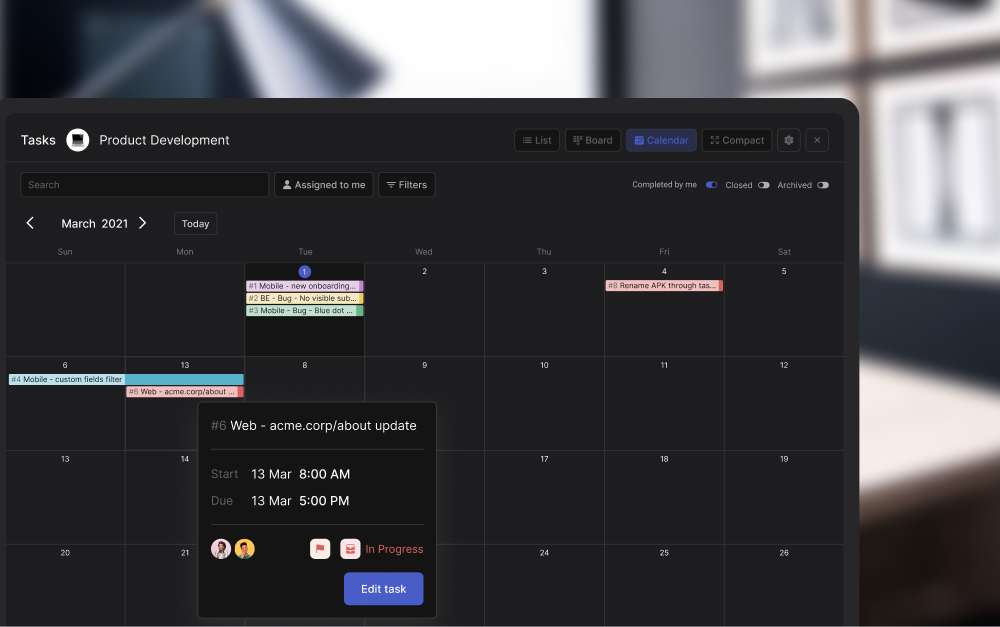
The production pipeline lives inside whatever workspace the team uses every day. Briefs as notes, drafts as task cards, edits as comments, approvals as task transitions, publish as a checklist. Run it as a project, not a doc. RACI is useful for assigning ownership at each step. Kanban is the natural board format for a production line where multiple pieces are at different stages.
Distribute, repurpose, syndicate
Most content plans budget for production and treat distribution as a residual. The compounding gain comes from the opposite split: production gets you the asset, distribution gets you the audience. A 2,000-word article that ships and gets one tweet is content production, not content marketing.
| Channel | Job in the plan | Cadence | Owner |
|---|---|---|---|
| Organic search | Compounding pull, long lifespan | Always-on, 2 to 4 pieces per month | SEO and content lead |
| Email newsletter | Direct relationship with the audience you already have | Weekly or bi-weekly | Content lead |
| Professional reach, decision-maker visibility | 3 to 5 posts per week per author | Founder, executive team, plus content lead | |
| Industry communities | Trusted voices in spaces buyers already trust | Active participation, not posting | Subject-matter expert |
| Syndication and guest posts | Borrowed authority, link acquisition | 1 to 2 placements per quarter | Content lead with PR or partnerships |
| Paid amplification | Reach the long tail of the audience the algorithm hides | Per-campaign, behind the best-performing pieces | Paid lead |
| Sales enablement | Turn content into deals by arming the sales team | Per-campaign and per-piece on flagship content | Content lead with sales |
The distribution table above is the channel layer. Each piece in the calendar should hit at least three channels in the first 72 hours after publish, and one or two long-tail channels in the weeks after. Repurposing extends the same piece across formats: a long article becomes three LinkedIn posts, an email, a sales-enablement deck, and a snippet for the next podcast.
Distribution channels are also where the content plan meets the rest of marketing. For the umbrella plan that ties content into SEO, social, email, and paid, see the digital marketing plan. Platform-specific social distribution sits inside its own social media marketing plan. Search-driven distribution belongs to your SEO marketing plan; campaign-led pushes belong to campaign management. The content plan names the channels and the cadence; the channel-specific plans handle the tactics.
"We all know that any company with a website is a publisher, but only recently have we begun to understand what that really means. It can take us deeper into unmapped territory, to help us flush out the richer story of our businesses, our purpose, our why." - Ann Handley, partner at MarketingProfs and author of Everybody Writes
Handley's framing is what flips the distribution conversation. The plan is not pushing content out to an audience; it is publishing on behalf of an audience that already exists. The shift is small in language and large in practice. Plans that start from broadcast feel like noise; plans that start from publishing build readers.
Measure what matters
Measurement on a content plan should be tight. Three to five numbers, each tied to a pillar or a goal in the broader marketing plan. The marketing funnel guide covers stage-by-stage benchmarks if you want a leak diagnostic. The temptation is to measure everything the analytics tool provides; the discipline is measuring only what changes next quarter's plan.

For the educate pillar, organic traffic and time on page are the leading indicators. For the decide pillar, comparison-page conversions and demo requests. For the apply pillar, template downloads and tutorial completions. For the trust pillar, branded search and direct traffic. Each pillar gets one or two numbers; the dashboard fits on a notecard, and the team actually opens it.
The cadence matters as much as the numbers. A 15-minute weekly check on the leading indicators, a 30-minute monthly readout against the full set, a quarterly retrospective that decides what changes in the next 90 days. Tie the content KPIs back to the broader marketing KPIs; an isolated content dashboard tends to underweight itself in the broader business conversation.
Common pitfalls
The mistakes below show up across content plans that intend to compound and slowly drift back into a publishing schedule with no system underneath. Most are pattern-recognition failures, not analytical ones.
- Planning by channel before audience Most content plans start with a list of channels: blog, LinkedIn, newsletter, podcast. The plan that ranks and converts starts with the audience and the questions they are actually asking. Channels are how you reach them; pillars and topics are why they read. Get the order wrong and the plan turns into a calendar of activity with no compounding effect.
- No production owner Briefs get written, drafts get assigned, edits float around in shared folders, publish dates slip. The fix is one named producer who owns the calendar end to end. Without that role, every step is a negotiation and the calendar is wallpaper. Production accountability is more important than any tool choice.
- Agency-brand content losing to client work For agencies, the cleanest signal that the content plan is broken is when the team is shipping for clients but the agency's own thought leadership has not been updated in three months. The team that writes for clients is the team that writes for the brand; capacity is finite. Bake the brand-content hours into the staffing model or expect the brand calendar to slip every time client work tightens.
- No distribution layer A 2,000-word article that ships and gets one tweet is content production, not content marketing. Distribution is part of the plan, not a residual; budget the time for it in the brief, name the channels in the calendar, and assign the owner. The compounding gain comes from distribution discipline, not from publishing more.
- Measurement that does not change behavior Reports get pulled, decks get built, the meeting happens, and nothing changes. The fix is naming the success metric in the brief at step one, then writing the retrospective in the same workspace where the next brief gets written. If the measurement does not change next month's plan, the measurement is wallpaper.
The biggest of the five is the third one for agencies, the second for in-house teams. Agency-brand content losing to client work is the single most common reason agencies cannot tell a credible content story about themselves. The fix is not motivation; it is staffing. Bake the brand-content hours into the model or expect the calendar to slip every quarter.
What we recommend
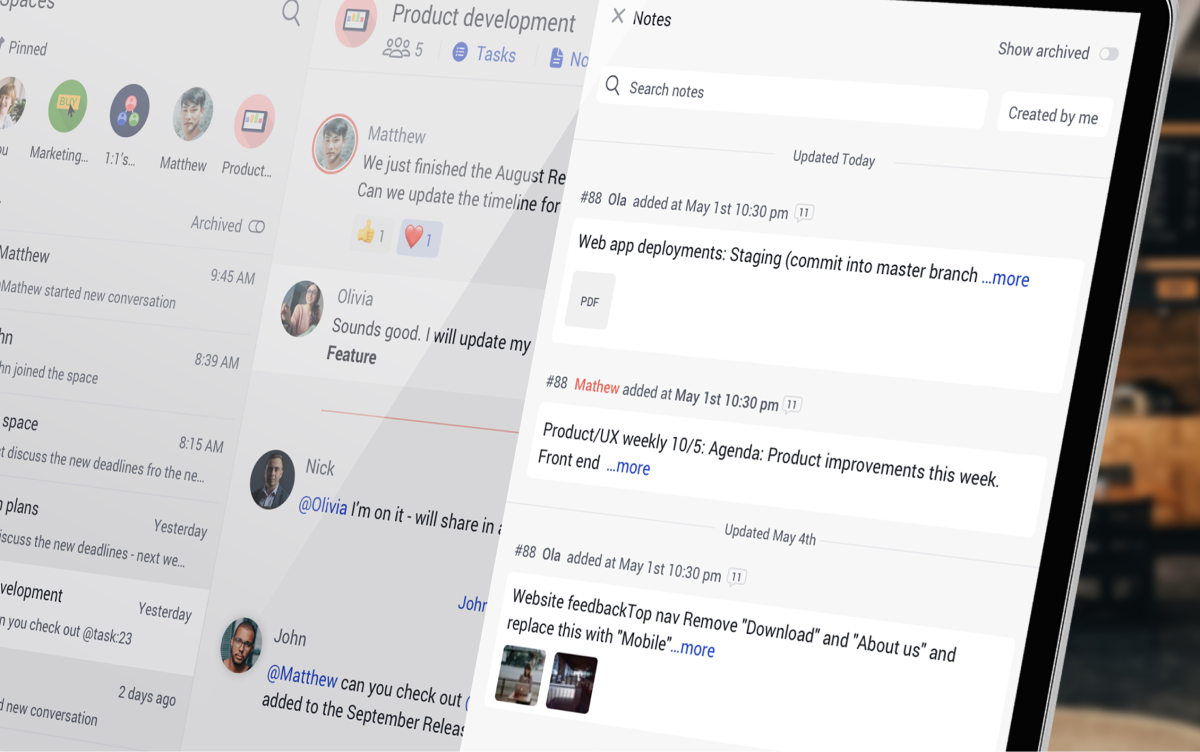
At Rock we run content plans inside the same workspace where the marketing team works. The plan lives as a pinned note in the marketing space. The pillars and audience personas live as separate notes the team re-reads quarterly. The editorial calendar is a board where each card is a piece in production. Distribution checklists live as task templates. Status updates happen in chat next to the work, not in a separate weekly meeting.

For agencies running content on retainer, the plan structure is reusable across clients. The pillar framework, the production pipeline, the distribution channels, and the measurement structure stay the same. Only the audience definition, the specific pillars, and the topical content change per client. Build the content plan template once, then duplicate the space per client. The compounding gain comes from this reuse, not from any single tactic.
Three adjacent disciplines tie the content plan into the broader operating model. Marketing operations runs the day-to-day execution layer underneath the plan. Billable hours ties the plan to the financial side; agency-brand content that runs over its allocated hours quietly is the most common source of margin erosion. Agency KPIs close the loop on the operating side, sitting underneath the per-client content KPIs.
The Content Marketing Institute's 2026 B2B Content and Marketing Trends Report surveyed more than 1,000 B2B marketers. It found that documented strategy is one of the strongest predictors of perceived content effectiveness. Most teams know they need a plan; the gap is between knowing and writing it down.
How to start your content plan this quarter
If your current content output is unplanned (most teams), do not try to write a perfect 12-month plan in the first week. Run a 90-day plan against the framework above and use the retrospective at day 90 to plan the next quarter. The first 90 days are about getting the system working, not winning every pillar.
Three moves to start this week. Define the audience: two personas at most, written tight enough that the team can say no to the wrong topics. Pick the pillars: three or four themes, each tied to an audience need, with a format mix and cadence. Set the production pipeline: brief, draft, edit, approve, publish, distribute, measure, with a named owner at each step. The other sections fill in over the first 30 days.
Run the content plan inside the same workspace as the work. Rock combines chat, tasks, and notes in one workspace. One flat price, unlimited users. Get started for free.