Basecamp vs Notion 2026: Opinionated PM or Doc Workspace?
Basecamp and Notion solve project work in opposite directions. Basecamp is a finished product. The opinions are baked in. To-dos, schedules, message boards, Hill Charts, and Campfire chat all live in one calm workspace, and you adjust your team to the tool. Notion is the opposite. It is building material. Pages, databases, and views give you the components, and you assemble your own project management system on top of them.
That single difference shapes everything else. This Basecamp vs Notion guide compares them honestly, axis by axis, and runs the real cost at 5, 15, and 30 seats. Some teams should pick Basecamp. Some should pick Notion. And some should pick neither because the chat-first workspace closer to how your team actually communicates lives somewhere else. Run the recommender below for a starting point.
Basecamp or Notion? Or neither?
Answer 4 questions for an honest pick.
1. What does your team need most?
2. How important is AI in the tool?
3. How many people will use it?
4. Do clients or freelancers need access?
Start over
Quick answer. Basecamp is opinionated project management with built-in messaging. Notion is a flexible workspace built around the page. Pick Basecamp if you want a calm, structured PM hub with chat included and minimal setup. Pick Notion if you want to build a real knowledge base and assemble your own task system on top. Pick neither if you want chat-first agency work with clients in the same space.

Want chat with your tasks and notes?
Rock combines all three in one workspace. One flat price, unlimited users.
What Basecamp is built for
Basecamp has been around since 2004 and has stayed close to one idea: project management should be calm. Each project gets a message board, to-do lists, a schedule, a chat room (Campfire), real-time pings, file storage, and Hill Charts for visualizing progress. The features are deliberately limited. There is no Gantt chart with cross-task dependencies, no time tracking on the base plan, and no AI.
That last point is intentional. 37signals, the company behind Basecamp, has been openly skeptical of bolting AI features onto every product. In late 2025, founder DHH wrote about Basecamp becoming agent-accessible. The reframe was direct. Instead of baking AI features in, 37signals revamped the API and added a CLI so external agents can drive Basecamp. The bet is that users will want to choose their own AI rather than have one chosen for them.
"Perfection is achieved, not when there is nothing more to add, but when there is nothing left to take away." - Antoine de Saint-Exupéry, Author of Wind, Sand and Stars
That quote captures Basecamp's product philosophy. The features are subtractive. Card Tables (lightweight Kanban) shipped in 2024. Hilltop View, which aggregates Hill Charts across projects, shipped in 2025. Each release adds one or two things and stays within the calm framework. Teams that want to onboard freelancers and clients without training appreciate that finished-product feel. Teams that want to build their own bespoke system find it limiting.
For the wider field, see our Basecamp alternatives breakdown. The async-first philosophy Basecamp embodies fits some teams better than others.
What Notion is built for
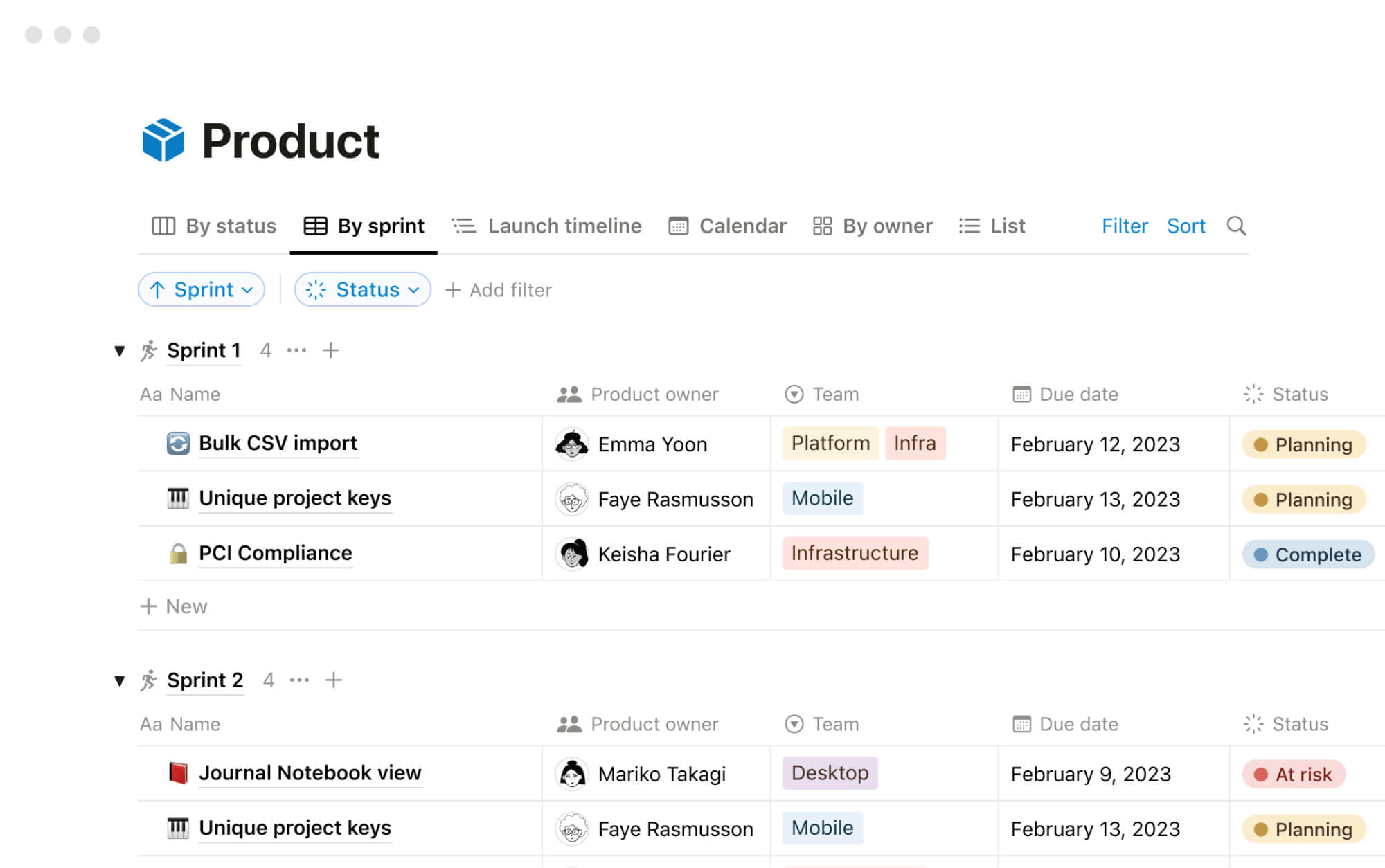
Notion takes the opposite approach. Every page is a flexible block-based document. Any page can become a database. Tables, kanban boards, calendars, and galleries are all views over the same data. The trade-off is that nothing comes pre-built. You decide what your project tracker looks like, what fields a task has, how docs are organized, and how teams navigate the workspace.
Product specs, engineering wikis, content calendars, OKR trackers, customer research libraries, and onboarding handbooks live well in Notion. The free plan is generous for individuals and small teams. Notion AI was bundled into the Business plan in May 2025, which means teams paying $20 per user per month or more get a writing assistant, summarization, action-item extraction, and Q&A across the workspace at no extra cost.
"We are stuck with technology when what we really want is just stuff that works." - Douglas Adams, Author of The Salmon of Doubt
Adams's line frames the trade-off well. Notion's flexibility is the product. The cost is that teams have to build a system before they can use it, and many teams build elaborate Notion workspaces that nobody but the original architect understands. For the broader field of options, see our Notion alternatives guide. For deeper PM-side comparisons, see Asana vs Notion, Asana vs Basecamp, Basecamp vs Monday, or Notion vs ClickUp head-to-head.

Basecamp vs Notion side-by-side
Five axes matter when picking between these tools. Philosophy, tasks and PM, docs and wiki, AI in 2026, and pricing. Here is how each one stacks up.
| Feature | Basecamp | Notion |
|---|---|---|
| Philosophy | Opinionated, finished product | Flexible, building material |
| Best for | Async PM with built-in messaging | Knowledge bases, wikis, docs that do tasks |
| Tasks and PM | To-dos, schedules, Hill Charts, Card Tables | Light: tables and kanban via databases |
| Docs and wiki | Message boards and docs (basic) | Best in class for nested pages |
| Built-in chat | Yes (Campfire and Pings) | Comments only |
| AI in 2026 | None native (deliberate). API-accessible to external agents | Notion AI bundled in Business plan (May 2025) |
| Free plan | 1 project, 3 users, 1GB | Unlimited blocks, 7-day history |
| Paid from | Plus $15/user/mo, Pro Unlimited $299/mo flat | Plus $10/user/mo, Business $20/user/mo (annual) |
| Client access | Built-in client view | Guests on paid plans |
| Mobile | Strong | Functional, slower than desktop |
| Learning curve | Minimal | Steep |
Philosophy: finished product vs building material
This is the spine of the Basecamp vs Notion comparison. Basecamp arrives with opinions. The features are decided, the layout is fixed, and the workflow is on rails. New teammates open it and know where to write a status update, where to add a to-do, where to start a chat. Onboarding takes minutes.
Notion arrives with components. Pages, databases, properties, views, relations, formulas. The team architect decides what a project tracker looks like, what a meeting note template includes, how the wiki nests. Onboarding takes longer because every workspace looks different. The flexibility is real and the trade-off is real.
For agency owners onboarding freelancers across time zones, the finished-product model wins. For founders who want to shape the workspace to match exactly how they think, the building-material model wins.
Tasks and project management
Basecamp ships with To-dos, Schedules, Card Tables (lightweight Kanban added in 2024), and Hill Charts for visualizing progress along uphill and downhill phases of work. The set is small and focused. There is no native Gantt chart, no resource workload view, and no time tracking on the standard tier.
Notion has no native PM features at all. Tasks are a database of pages with date and status fields. Teams build their own kanban or list views. Templates from the community fill some gaps, but the result is always a mimicry of dedicated PM tools rather than the real thing. For teams that need formal project management, Notion will frustrate within months.
If your work needs Gantt charts and dependencies, look at our ClickUp alternatives roundup or the Notion vs ClickUp comparison instead. Neither Basecamp nor Notion handles that well.
Docs and wiki
Notion wins decisively. The block-based editor, nested page hierarchy, linked databases, and synced blocks make Notion the strongest knowledge tool in the comparison. Teams that build wikis, product specs, and meeting note systems in Notion rarely move away because the doc experience itself is the product.
Basecamp's message boards and docs cover the basics. They handle short docs, decisions, and announcements well. They are not the place to build a 500-page wiki or a customer support knowledge base. Teams that want both async PM and a deep wiki end up running Basecamp plus Notion or Basecamp plus Confluence.
AI in 2026
This is the cleanest wedge between the two products. Notion went all-in on AI. Notion AI is bundled into the Business plan as part of the base subscription. Writing assistance, summarization, action-item extraction, Q&A across the workspace, and the Notion Agent feature are all included for teams paying $20 per user per month.
Basecamp went the opposite direction. 37signals deliberately ships no native AI features. The company has stated that they experimented with AI internally and chose not to ship most of what they built because it was not actually useful. Their public bet is on agent-accessibility instead: a revamped API and CLI so external agents (Claude, ChatGPT, Cursor, others) can drive Basecamp from the outside. Users bring their own AI rather than have one chosen for them.
This is a real philosophical split, and most ranking comparison articles have not caught up. If AI is part of how your team works, Notion's bundled approach is the smoother experience. If you want to choose your own AI tools or pay for none, Basecamp's stance is more aligned with how you operate.
Pricing model
Basecamp uses two pricing models. The Plus plan is $15 per user per month, which favors small teams. The Pro Unlimited plan is a flat $299 per month (annual billing) or $349 per month (monthly billing) for unlimited users, which favors teams above 20 people. Pricing details on basecamp.com/pricing.
Notion uses a per-user model. Plus is $10 per user per month on annual billing. Business is $20 per user per month with Notion AI bundled. Pricing details on notion.com/pricing.
The headline math depends on team size. We model that next.
Real cost at 5, 15, and 30 seats
Most comparison articles model 10 seats and stop. Below is the verified annual cost at 5, 15, 30, and 50 seats using 2026 list prices on annual billing. Rock is included as a flat-rate reference because the math gets interesting at the larger sizes.
| Team size | Basecamp Plus | Basecamp Pro Unlimited | Notion Plus | Notion Business (incl. AI) | Rock Unlimited |
|---|---|---|---|---|---|
| 5 people | $900 | $3,588 | $600 | $1,200 | $899 |
| 15 people | $2,700 | $3,588 | $1,800 | $3,600 | $899 |
| 30 people | $5,400 | $3,588 | $3,600 | $7,200 | $899 |
| 50 people | $9,000 | $3,588 | $6,000 | $12,000 | $899 |
Three things stand out. First, Notion Plus is the cheapest paid option below 12 people, and Basecamp Plus is the most expensive. Second, Basecamp Pro Unlimited at $3,588 per year stays flat regardless of team size, which makes it cheaper than Basecamp Plus once you cross 20 people. Third, Rock at $899 per year on annual billing is cheaper than every option in this table at every team size from 5 to 50.
The breakeven math: at 5 people, Notion Plus ($600) beats Rock ($899) and both beat Basecamp options. Past 9 people on Notion Plus or 7 people on Basecamp Plus, Rock costs less. Past 20 people, Basecamp Pro Unlimited becomes the better Basecamp option but is still 4× the cost of Rock.
None of this matters if the wrong tool is wrong for the work. Pricing alone is a bad reason to switch. But the Notion vs Basecamp pricing question combined with which philosophy fits your team shapes the decision. For more cost-modeling against the broader category, see our Notion vs Trello and task management apps guides.
When to pick Basecamp
Basecamp is the right pick for teams that want calm, opinionated project management with chat included. Some specific cases.
Async-first agencies and consultancies. The message board format encourages thoughtful written updates instead of rapid-fire chat. Hill Charts give a sense of progress without daily status meetings. The whole product is shaped around how async teams actually work.
Teams that bring clients into projects. Basecamp's client-access mode hides internal threads and gives clients a curated view of project progress. The flow is built in, not bolted on. For agencies that ran into Notion's guest-seat fees or Trello's permission complexity, Basecamp is a relief.
Teams that prefer no AI. If you want a tool that does not push you to use AI features, Basecamp is rare in the modern PM market. The 37signals stance on AI is genuine, not marketing.
Teams larger than 20 with a flat-rate preference. Pro Unlimited at $3,588 per year covers any number of users. Compared with Notion Plus at 30 people ($3,600), Basecamp Pro Unlimited matches the cost and adds built-in messaging.
Skip Basecamp if. You need formal project management with Gantt charts and dependencies. You write more than you ship and need a deep wiki. Or you want native AI as part of the daily flow.
When to pick Notion
Notion is the right pick for teams that lead with writing and want to build a system. Some specific cases.
Doc-heavy product and content teams. Product specs, engineering wikis, editorial calendars, content briefs, and customer research libraries fit Notion's flexibility. The page-and-database model handles these out of the box. See communication strategies for how doc-led teams structure async work.
Teams that want native AI bundled into the price. Since May 2025, Notion AI is included in the Business plan at no extra cost. For teams that will use AI heavily, this is meaningfully cheaper than ClickUp Brain or other AI add-ons.
Solo founders and small teams that want one tool. Notion can be a personal CRM, a project tracker, a journal, and a wiki at the same time. Few tools can. Below 10 people the per-seat cost is reasonable.
Knowledge bases that get heavy daily use. Customer support docs, internal HR handbooks, onboarding wikis, and policy libraries earn back the setup time within weeks.
Skip Notion if. You want a tool running today without configuration. You need formal project management. Your team will not invest the time to build a system before using it. Or you have outgrown the per-seat pricing model.
That third option, simply.
Rock pairs chat with tasks and notes. Built for client work, free for small teams.
When you should not pick either
Basecamp and Rock are closer to each other than most pairs in this comparison cluster. Both are flat-priced at scale. Both bundle messaging, tasks, and notes. Both target async-leaning teams. So this section starts with honesty.
Where Basecamp wins over Rock. Hill Charts as a unique progress visualization. The Shape Up methodology coupling for product teams. A 25-year track record and brand trust that matters to some clients. A built-in client-access flow that hides internal threads with one toggle. Campfire chat plus Pings come included.
Where Rock wins over Basecamp. Flat pricing of $899 per year on annual billing versus Basecamp Pro Unlimited at $3,588 per year. Modern threaded chat closer to dedicated tools like the Slack-tier messengers than Basecamp's Campfire. Task view flexibility (Kanban, list, sprint, calendar) versus Basecamp's smaller view set. Stronger fit for the SEA, Latam, and Africa connectivity profile because of Rock's mobile and offline behavior. Clients and freelancers join spaces directly without per-seat fees, which Basecamp also handles but at the higher price tier.
Where they are similar enough that brand preference decides. Both are flat-priced at scale. Both treat messaging as a first-class feature. Both deliberately limit AI: Basecamp ships none natively, Rock supports any AI through a custom API. Both work for async-first agency teams.
"There are only two ways to make money in business: bundling and unbundling." - Jim Barksdale, Former CEO of Netscape
The honest read is straightforward. For a 5-person agency, Basecamp Plus at $75 per month and Rock at $89 per month are close enough on price. Brand trust and client-access flow may legitimately tip toward Basecamp at that size. For a 15-person agency, Rock at $899 per year against Basecamp Pro Unlimited at $3,588 per year is a different conversation. The same is true at 30 people, where the math gap funds a part-time role.
Rock is also not the right tool for everyone in this comparison. If your work depends on Notion-style relational databases or deeply nested wiki pages, Notion remains the right pick. If your work depends on Hill Charts and Shape Up, Basecamp does that and Rock does not. The Notion vs Basecamp question is real for a real subset of teams, and Rock fits a different subset that wants chat-first work without the per-seat tax.
If you want to test the chat-first model on real work, the free plan covers 3 group spaces with 5 members each. That is enough to run a project end to end with the team. Compare against your current Basecamp or Notion plus a chat tool monthly cost. See our instant messaging apps guide for the broader chat-first context.
FAQ
Is Basecamp better than Notion? Neither is universally better. They are built around opposite philosophies. Basecamp is opinionated project management with messaging, schedules, and Hill Charts baked in. Notion is a flexible workspace where you build your own system. Pick Basecamp for calm async PM with low setup. Pick Notion for knowledge bases and doc-heavy work.
Can Notion replace Basecamp? For small doc-heavy teams that want everything in one workspace, yes. Notion has database-driven task views, comments, and a board view. The trade-off is setup time and the absence of native chat. Basecamp gives you Campfire, Pings, schedules, and Hill Charts out of the box. Notion gives you a blank canvas and templates. For teams that value finished workflows over flexibility, Basecamp stays simpler.
Does Basecamp have AI? Not natively, by design. 37signals has been publicly skeptical of AI as a baked-in feature and chose to make Basecamp agent-accessible instead. The company shipped a revamped API and CLI in late 2025 and early 2026 so external AI agents can drive Basecamp without features being added inside the product. Notion went the other direction and bundled Notion AI into the Business plan in May 2025.
Is Basecamp worth it in 2026? Yes for teams that match the calm, async, opinionated philosophy. The product is actively maintained, with Card Tables added in 2024 and Hilltop View in 2025. The 25-year track record matters for client trust. The flat $299 per month Pro Unlimited tier remains one of the cleanest pricing models in the category. Worth it depends on whether the philosophy fits, not whether the product is alive.
What are Hill Charts? Hill Charts are a Basecamp-specific way of visualizing project progress. Each task or piece of work is a dot on a hill. The uphill side represents figuring out what to do, the downhill side represents executing on that plan. The chart updates over time as the team moves dots, which gives stakeholders a sense of momentum that traditional Gantt charts miss. Hill Charts are unique to Basecamp and are part of why some teams stay even after trying alternatives.
Want one workspace where chat, tasks, and notes live together? Rock combines all three with flat pricing for unlimited users. Get started for free.