Client Kickoff Meeting Agenda + Script (Free Template)
Most client kickoff meetings fail the same way. They turn into information-gathering sessions, the agenda is a generic "project kickoff" template that does not match the engagement, and they end without a signed plan. Nobody calls it a failure because it was friendly and nobody pushed back. Then week three arrives, and the disconnect surfaces.
This guide covers the 8-section kickoff agenda, a script for what to say at each moment, and how to size the meeting to your engagement. Build your agenda with the widget below first, then read the detail on the sections that matter most.
Build Your Agenda
Before the template, a quick tailored agenda. Three answers and the widget outputs minute-by-minute timing scaled to your meeting length and stakeholder setup.
Build your kickoff agenda
Three questions. Get a minute-by-minute agenda tailored to your meeting length and stakeholders.
Quick answer. A client kickoff meeting agenda has 8 sections: welcome, onboarding recap, goals and success metrics, timeline, roles and communication plan, risks, next steps, and Q&A. The meeting runs 60 to 120 minutes depending on project complexity, with the 90-minute version the default for most agency engagements. Its purpose is alignment, not discovery, since discovery should have happened during the onboarding questionnaire. Weight the time toward goals and roles, not introductions, and protect the Q&A section. Hold the kickoff in week one or two, send the agenda 24 to 48 hours ahead, and close with a signed plan rather than a vague promise.
The 8-Section Kickoff Agenda
Every kickoff meeting, regardless of engagement size, covers the same 8 sections. The timing scales, but the structure does not. The table below shows minute allocations for a 90-minute meeting. Scale proportionally for 60-minute or 120-minute versions.
| Section | 90-min share | Purpose | Owner |
|---|---|---|---|
| 1. Welcome and introductions | 9 min | Warm up the room, confirm names, and establish who is in the session. | Account lead |
| 2. Onboarding recap | 9 min | Reflect back what the questionnaire surfaced. Show the client you listened. | Account lead |
| 3. Goals and success metrics | 18 min | Confirm the one business outcome that matters most. Lock the success number. | Account lead + client lead |
| 4. Timeline and milestones | 13 min | Walk through the 90-day plan as a shared roadmap. Highlight dependencies. | Project manager |
| 5. Roles and communication plan | 13 min | Agree on who does what, which channel for what, and the weekly cadence. For the full set of operational rules (response times, revision counts, change orders), see our client working agreement template. | Project manager |
| 6. Risks and mitigations | 9 min | Name the top 2 risks. Agree on the early-warning signals for each. | Account lead |
| 7. Next steps and decisions | 9 min | Close with a one-page plan both sides sign. No vague promises. | Account lead |
| 8. Q&A and open conversation | 9 min | Protected space for the client to raise anything unsaid. Do not skip. | Client lead |
The most common mistake in agenda design is over-weighting sections 1 and 2 (welcome, recap) and under-weighting sections 3 and 5 (goals, roles). A kickoff that spends 20 minutes on introductions and 8 minutes on the communication plan will feel friendly and decide nothing. Flip the ratio. For more on meeting structure broadly, see our meeting agenda examples guide.
Section 3 (goals and success metrics) is where most engagements either lock in or quietly drift. Twenty percent of the meeting feels like a lot until you realize this is the one section where the client has to commit to a specific number. Without that commitment, every later conversation becomes negotiable. Budget the time, do not rush it, and do not accept "a few KPIs" as an answer. One primary metric. Everything else is secondary.
Section 8 (Q&A) is the one agencies try to skip when time runs short. That is exactly backwards. The open conversation at the end is where clients surface the concern they did not want to ask during the structured sections. Cut time from section 1 or 4 before you cut time from Q&A. Our check-in questions guide has good prompts for the Q&A section when silence creeps in.
The Kickoff Script (What to Actually Say)
An agenda tells you what to cover. A script tells you how to say it. The lines below are tested openings for the moments that most kickoffs fumble. Copy them, adjust to your voice, keep the structure.
| Moment | What to actually say |
|---|---|
| Opening | "Thanks for making time today. Goal for the next 90 minutes is to align on three things: what success looks like, how we will work together, and what the next 30 days look like. We have a tight agenda, but I want to leave room at the end for anything on your mind. Sound good?" |
| Introducing the team | "Quick round: I'm [name], I'll be your main point of contact day to day. [PM name] is running delivery and timelines. [Specialist name] is leading [specific workstream]. On your side, it looks like [primary client contact] is the main decision-maker, and [others] will be in the weekly updates. Anyone missing from the key decision group?" |
| Recapping the questionnaire | "Before we talk plan, I want to reflect back what I heard from your questionnaire. Your top outcome is [specific metric], your main concern is [risk they flagged], and the internal stakeholder who cares most about this is [name]. Did I get any of that wrong or incomplete?" |
| Locking the success metric | "Let's put a number on success. By day 90, what is the metric that tells you this engagement is working? I want one number, not a list. If there are multiple, we pick the one that matters most and treat the others as secondary." |
| Setting the communication rhythm | "Our default cadence is a written update every Friday in the shared space, a live call every two weeks, and immediate escalation through [channel] for anything urgent. Does that rhythm work for how you like to be kept informed?" |
| Raising risks without scaring the client | "Every project has two or three things that could go sideways. Better to name them now than discover them in week six. On our side, [specific risk]. On yours, [specific risk]. What are we missing?" |
| Closing with commitment | "To recap what we agreed: the success metric is [number], the cadence is [rhythm], the biggest risk to watch is [risk]. I'll send a written summary of this call in the shared space within 24 hours, with a link to the 90-day plan for your sign-off. Anything we should adjust before we wrap?" |
The closing line matters more than the opening. "I'll send a written summary of this call in the shared space within 24 hours, with a link to the 90-day plan for your sign-off" turns a good meeting into a contracted one. Without that closure, the agreements from the kickoff drift, and by week three everyone remembers the conversation differently.
The opening script is worth memorizing. The first two minutes of a kickoff set the tone for the whole engagement. A confident opener that frames the purpose of the meeting, explicitly invites client input at the end, and puts a number on the duration signals a serious operation. A rambling opener that thanks everyone repeatedly, apologizes for the scheduling, and hopes "we will cover a few things" signals a meeting that will run long and decide little. The script is short on purpose. Read it once, make it yours, and use it every time.
"The quality of the first hour sets the ceiling for the relationship. Kickoffs that end with a signed plan produce engagements that renew. Kickoffs that end with 'great chat, let's circle back' produce engagements that quietly end at month four." - Nicolaas Spijker, Marketing Expert
How to Size the Meeting to the Engagement
One-size-fits-all kickoff agendas do not actually fit. Three rules for sizing the meeting.
60-minute kickoff. Simple one-off projects with a single client contact. Tight scope, clear deliverable, established trust. Compress the welcome section, skip the risks section only if genuinely nothing is at stake, and keep the Q&A.
90-minute kickoff. The default for most agency engagements. Retainers, standard project work, small client teams. This is where the 8-section agenda fits cleanly without feeling rushed.
120-minute kickoff. Complex engagements, enterprise clients, or multi-phase programs. Stakeholder mapping alone can eat 20 minutes when five client-side people need clear roles. Budget more time on roles and communication plan, and consider splitting into two meetings if it runs longer than two hours.
Longer than two hours is a warning sign. A kickoff that needs three hours probably needs two kickoffs: one strategic (goals, scope, risks) and one operational (roles, tools, cadence). Trying to do both in one session produces cognitive fatigue and decisions you regret.
Freelancers running solo engagements should not skip the kickoff just because "it is just me." A 45-minute version of the 8-section agenda with a single client contact still produces the alignment you need. Our freelance client management guide covers the solo-operator version of the same pattern.
When to Hold the Kickoff
The kickoff happens after the onboarding questionnaire is in and accounts are prepared. Usually week one or week two of the engagement. Earlier than that and you lack the context to present a real plan. Later than that and momentum has drifted.
Schedule the kickoff at the same time as the sales contract is countersigned. The client is most engaged in week one. Every day that slips before kickoff costs you a little engagement, a little urgency, and a little of the trust you built during sales. By day ten without a kickoff, something else has already taken priority in the client's head.
If the client wants to delay the kickoff by more than a week, take it seriously. A client who cannot find 90 minutes in week one is signaling something about their priorities or their internal readiness. Often the right move is a shorter 30-minute check-in to understand what is holding them up, then scheduling the full kickoff once that blocker is addressed. Pushing ahead with a kickoff the client is distracted during creates alignment you cannot trust.
Send the agenda at least 24 hours before the meeting. Better: 48 hours. Ask the client if anything is missing. A pre-read creates the space for client-side questions to surface before the meeting, which means the meeting itself stays focused on decisions rather than clarifications.
Common Kickoff Mistakes
Five patterns that sink otherwise solid kickoffs.
Treating the kickoff as discovery. By kickoff day, you should know the client's goals, stakeholders, and context from the questionnaire and sales handoff (captured in the client brief). If creative work is part of the engagement, a creative brief should also be drafted before the kickoff. If you are running the kickoff over video, our videoconferencing applications guide covers which tool fits which meeting shape so the creative team can start work right after sign-off. If you are asking "what does your business do" in the kickoff, the onboarding upstream failed. Kickoff is alignment, not first contact.
No written follow-up within 24 hours. Verbal agreements drift. The memory of what was decided diverges across participants within a week. A written summary in the shared space, with the 90-day plan attached, is the forcing function that makes the kickoff real.
Skipping the risks section to keep the mood positive. Skipping risks does not remove them, it just guarantees they surface later as surprises. Naming two or three risks in the kickoff normalizes honest conversation for the rest of the engagement.
Letting the meeting run over. A kickoff that slides from 90 to 120 minutes because "there is more to cover" is a sign the agenda was wrong or the scope is larger than estimated. Stop at time, book a focused follow-up, and protect the client's calendar.
No client homework between kickoff and delivery. If the client leaves the kickoff without a clear action item of their own (approve the plan, grant the access, share the asset), they become a passive observer. Engagements with one client action item after kickoff produce more engaged clients through week four.
Recording the meeting without telling the client it is being recorded. Seems small, but it breaks trust instantly when a client discovers a recording after the fact. Always ask explicit permission at the top of the call. Clients almost always say yes. What they do not appreciate is finding out later.
Using the kickoff to present rather than align. If you are talking for 70 percent of the meeting, you are pitching, not running a kickoff. A healthy kickoff has the client talking closer to half the time, especially in sections 3, 5, and 8 where their input is the point. If the client leaves saying "that was a great presentation," the meeting failed at its real job.
What We See on Rock
Rock is a product, not an agency, so we do not run client kickoff meetings ourselves. What we see, across the agencies that use Rock, is that the teams with the highest-retention clients treat the kickoff as a document as much as a conversation.
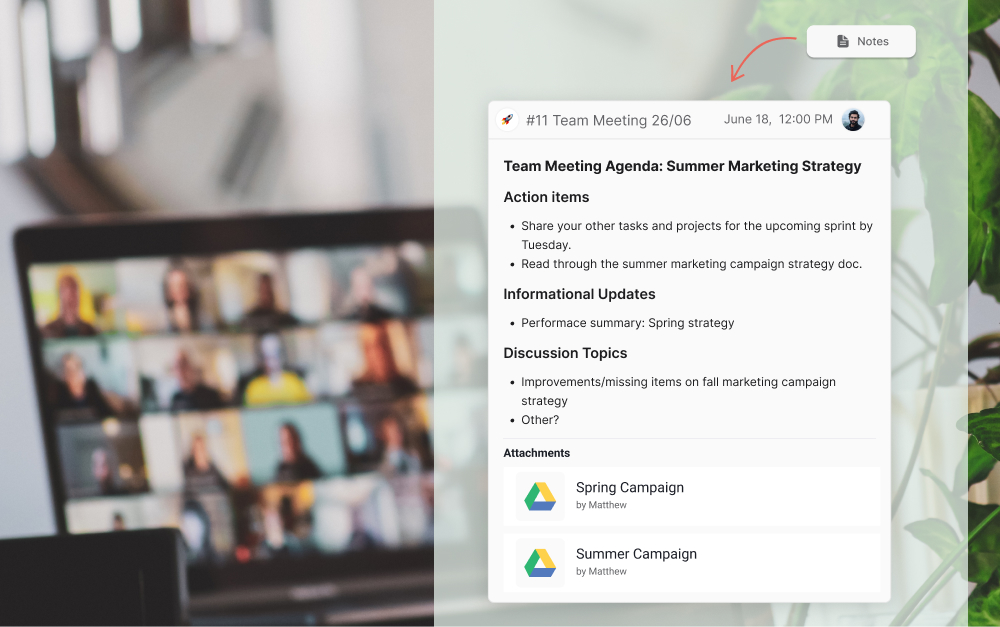
The pattern looks like this: the agenda sits as a pinned task in the shared client space, sent 48 hours before the call. Each section of the agenda has its own subtask so the discussion is scannable in real time. The account lead takes notes directly in the task comments, visible to the client, so the written summary is basically already drafted by the end of the call. The 90-day plan is a linked note in the same space, signed off as the final action in the meeting.
Agencies that run this pattern rarely need a follow-up meeting to clarify what was decided. The agencies that still run kickoffs in a generic calendar invite with notes in a private doc tend to spend the first half of week two reconstructing agreements. The difference is not the quality of the meeting. It is where the meeting lives.
For the full 7-stage onboarding process this kickoff sits inside, see our onboarding process walkthrough. For the questionnaire that feeds the kickoff, our client onboarding questionnaire covers the 15 questions to send before the meeting. For the retainer-based tier framework, see our client onboarding checklist.
The economics are the same as every other onboarding decision. HBR's research on client retention still holds: a 5 percent lift in retention raises profits by 25 to 95 percent. The kickoff is one of the first moments that lift happens, or does not. Clients who leave the kickoff with a signed plan renew far more often than clients who leave with good vibes.
A great kickoff ends with a signed plan, not a warm feeling. Rock combines chat, tasks, and notes in one workspace so the agenda, the discussion, and the follow-up all live together. One flat price, clients join free. Get started for free.