Project Manager Job Description: Template, Skills, Salary
Most project manager job descriptions read the same. Five to ten generic responsibilities, a list of skills any office worker would claim, a salary band hidden at the bottom or omitted entirely. The result: confused candidates, slow hires, and postings that do not reflect what the role actually does at the seniority you need.
This guide covers what a project manager actually does, with a JD builder that outputs a tailored description by seniority and industry, real 2026 salary ranges from BLS and Robert Half data, and a clean comparison with the three roles people most often confuse with project manager. The goal is a JD you can post that brings in the right candidates the first time.
Quick answer: what a project manager does
A project manager owns delivery: scope, schedule, budget, stakeholder communication, risk, team coordination, and closeout for a defined project. The role plans the work, runs the team execution, surfaces risks early, and reports progress to sponsors. The job description structure is consistent across industries; the responsibilities and salary band shift meaningfully by seniority level and by sector (IT, marketing, healthcare, construction, generic knowledge work).
The role is distinct from Scrum Master, Product Manager, and Program Manager. Each owns a different question, even though the day-to-day skills overlap. Most JD writing failures trace back to mixing two of these roles into one posting.
The builder above generates a JD by seniority and industry. The remaining sections cover the structural pieces in detail: core responsibilities, the seniority breakdown, the industry breakdown, the role comparison, salary data, and certifications.
Project manager core responsibilities
The category-standard pattern across the top JD templates is five to seven core responsibilities. Indeed extends to seven; Workable, Glassdoor, and BambooHR sit at five. The fuller seven-point version below maps cleanly to the PMI Process Groups (Initiating, Planning, Executing, Monitoring/Controlling, Closing) and is the version we recommend for postings.
Plan project scope, milestones, and deliverables. Before kickoff, document what the project will and will not do. Get sign-off from stakeholders. Most schedule problems trace back to scope problems that were never resolved before work started.
Build and maintain the project schedule. Sequence tasks, identify dependencies, mark the critical path, set milestones with realistic buffers. The schedule survives reality only when the PM updates it weekly, not annually.
Manage budget and forecast. Track actual spend against forecast, surface variance early, escalate when the band is at risk. Junior PMs report variance; senior PMs negotiate the trade-offs that resolve it.
Coordinate cross-functional team execution. Get designers, engineers, marketers, and ops aligned on the same plan and shipping to it. This is the hardest skill in the role and no certification teaches it.
Communicate progress, risks, and trade-offs. Sponsors, clients, and team members each need a different communication cadence and format. Senior PMs match the message to the audience without rewriting the underlying truth.
Identify and mitigate risks early. Maintain a risk register; score each risk by impact and likelihood; act on the ones above threshold. Risk management separates strong PMs from process administrators.
Run project closeout. Final delivery, retrospective, handoff documentation, lessons learned. Skipping closeout is the most common quiet failure of the role; it turns each project into a one-time event instead of compounding capability.
"Project management is the planning, organizing, directing, and controlling of company resources for a relatively short-term objective that has been established to complete specific goals and objectives." - Harold Kerzner, in Project Management: A Systems Approach to Planning, Scheduling, and Controlling
JD by seniority level
Most JD templates online ignore seniority. A "Project Manager" posting that mixes coordinator-level tasks with director-level tasks pulls in candidates from every band and confuses the interview process. The five-tier breakdown below is the realistic shape of the career path.
| Level | Years | Owns | 2026 US salary range |
|---|---|---|---|
| Project Coordinator | 0 to 2 | Documentation, scheduling, status tracking, meeting prep. Supports a senior PM; rarely owns a full project end-to-end. | $50K to $70K |
| Junior Project Manager | 1 to 3 | One workstream within a larger project, or one small standalone project under supervision. Tracks risks and dependencies; escalates upward. | $70K to $95K |
| Project Manager (Mid) | 3 to 7 | End-to-end delivery of mid-complexity projects, independently. Coaches Junior PMs and Coordinators on practice. Most "Project Manager" job postings target this level. | $95K to $125K |
| Senior Project Manager | 7 to 12 | Multiple concurrent projects or a program-level initiative. Owns the senior client relationship; negotiates scope and trade-offs at executive level. | $125K to $165K |
| Director / Head of PMO | 12+ | The project management function across the organization. Hires and develops PMs, sets delivery standards, owns delivery metrics for the company. | $165K to $230K+ |
The Mid Project Manager band is what most "Project Manager" job postings target. If you are hiring for it, write the JD to that band cleanly. Coordinator and Junior bands need different titles, simpler responsibility lists, and different interview rubrics; Senior and Director bands need explicit scope and stakeholder language that signals the elevation.
JD by industry
Industry shapes the JD more than most templates admit. The seven core responsibilities stay; one or two industry-specific responsibilities replace generic ones, the certifications change, and the salary band shifts.
| Industry | Industry-specific responsibilities | What changes in the JD |
|---|---|---|
| IT / Software | Coordinate engineering sprint planning, release management, technical dependencies, and DevOps cycles | Add agile delivery framework knowledge; familiarity with software development lifecycle, CI/CD, and engineering ceremonies. Highest salary band of the five. |
| Marketing / Creative | Run campaign timelines across creative, content, paid media, and lifecycle teams; manage creative review and approval cycles | Add campaign analytics, creative workflow tools, and review-cycle management. Often heavier client-facing component for agency PMs. |
| Healthcare | Ensure project work meets HIPAA, regulatory, and clinical compliance standards; coordinate with clinical staff on workflow changes | Add HIPAA awareness, clinical workflow understanding, regulatory documentation. Compliance-heavy; risk management weighs more. |
| Construction | Manage subcontractors, permits, inspections, on-site safety, and material logistics across the build cycle | Add OSHA awareness, blueprint reading, contract administration, on-site coordination. PMP common; PMI-CP construction credential a plus. |
| General / Knowledge Work | Adapt the delivery framework (agile, hybrid, or waterfall) to project type; cross-functional coordination across operations, finance, HR | Generalist version. Lower industry-premium but often more flexible across project types. |
The construction PM band is one of the highest-paying because the role layers safety compliance, contract administration, and physical-world scheduling on top of the standard PM work. The IT PM band is similarly elevated by the agile delivery and engineering-cycle knowledge requirements. Marketing and healthcare PMs sit closer to the generic knowledge-work band but with their own compliance or workflow specializations.
PM vs Scrum Master, Product, and Program Mgr
The single most common JD writing failure is hiring two roles in one posting. The four roles overlap in skills (facilitation, coordination, communication) but answer different questions.
| Role | Owns | Time horizon | Common confusion |
|---|---|---|---|
| Project Manager | Delivery: scope, schedule, budget, stakeholders, risk for one project | Project lifecycle (weeks to a year) | Confused with all three roles below; the PM is the "did we ship" owner |
| Scrum Master | Process effectiveness and team agility for one Scrum team | Sprint and continuous coaching cycle | Often combined with PM in small teams; the SM does not own delivery dates |
| Product Manager | The product backlog, product goal, and value the product delivers to users | Quarterly to annual | The PdM owns "what to build and why"; the PM owns "did we ship the agreed scope on time" |
| Program Manager | A portfolio of related projects, dependencies across them, program-level outcomes | Multi-quarter to multi-year | A senior version of PM scope, plus cross-project coordination; not a "manager of PMs" by definition |
The Project Manager owns "did we ship the agreed scope on time and on budget." The Scrum Master owns "is the team getting better at how they work."
The Product Manager owns "what should we build and why." The Program Manager owns a portfolio of related projects and the dependencies across them. JD postings that ask one person to do all four end up with mediocre coverage on each.
"Most of the work of project management is correctly prioritizing things and leading the team in carrying them out." - Scott Berkun, in Making Things Happen: Mastering Project Management
Skills that actually matter
Most skills sections read as generic communication advice. The honest list is shorter and more specific.
| Skill area | What it actually means in the role |
|---|---|
| Planning and scheduling | Building a realistic schedule (Gantt, sprint board, hybrid) that survives reality. Includes estimating, sequencing, and identifying critical path. The skill is judgment about uncertainty, not Microsoft Project mastery. |
| Risk management | Spotting risks early, scoring them by impact and likelihood, and acting on the ones above threshold. Junior PMs log risks; senior PMs reduce them. |
| Stakeholder communication | Translating between technical and business audiences, managing expectations on scope and trade-offs, running client conversations without flinching from bad news. |
| Budget tracking | Owning the project P&L: forecast vs actual, burn rate, variance analysis. The honest version is knowing when to surface a budget problem and how to negotiate the trade-offs. |
| Cross-functional coordination | Getting designers, engineers, marketers, and ops to agree on the same plan and ship to it. The hardest skill; no certification teaches it. |
| Decision discipline | Making the call when the team is split. Senior PMs add value here; junior PMs typically default to escalation. The career inflection point is when escalation becomes the exception, not the default. |
The career inflection point for most PMs is moving from escalation as the default to decision as the default. Junior PMs surface decisions to senior PMs; mid PMs make most calls themselves; senior PMs hold the authority to negotiate trade-offs without asking permission. Writing the JD to match the level of decision discipline you actually need is more important than listing every soft skill in the dictionary.
Salary ranges (2026)
Project manager compensation varies by seniority, industry, and region. The grounded numbers come from two sources: the US Bureau of Labor Statistics and Robert Half's annual salary guide. Both are updated regularly and free to access.
Per the US Bureau of Labor Statistics (May 2024 data), Project Management Specialists earn a median annual wage of $100,750 in the US. The role is projected to grow 6% from 2024 to 2034, with approximately 78,200 openings per year on average. This is faster than the average for all occupations and reflects the structural shift toward project-based work.
Robert Half's 2026 Salary Guide breaks the role out further. General Project Managers fall in the $69,500 to $100,000 band. IT Project Managers run $103,500 to $147,000, with senior IT PMs reaching $147,000 and above. Construction PMs and senior Healthcare PMs sit at the higher end. The seniority table above and the JD builder both reflect these figures.
The PMP certification carries a notable salary premium: industry sources cite roughly a 33% lift versus uncertified peers at comparable seniority. The lift is most pronounced at the mid-level transition; it narrows at senior and director levels where track record matters more than credentials.
Career path and certifications
Three credentials dominate the field at the entry and mid level. Each is a reasonable signal; none is a substitute for actual project delivery experience.
PMP (Project Management Professional) from PMI is the most widely recognized certification globally. It requires 36 months of project leadership experience plus a 35-hour education prerequisite, and renewal every 3 years. PMP carries the highest salary premium of the three and is the de facto standard for mid-career PMs in the US.
PRINCE2 originated in the UK government and dominates Europe and the Commonwealth. The Foundation level covers methodology basics; Practitioner is the next tier. PRINCE2 maps to a specific structured methodology and is most valuable in organizations that have adopted PRINCE2 explicitly.
CAPM (Certified Associate in Project Management) from PMI is the entry-level credential, often pursued by Project Coordinators or Junior PMs before they have the experience hours for full PMP. It signals discipline and methodology grounding to hiring managers.
For PMs whose role intersects with Scrum work, CSM (Certified Scrum Master) or PSM (Professional Scrum Master) add agile-specific signaling. For construction PMs, the PMI-CP (Construction Professional) credential adds industry-specific weight. Beyond senior level, certifications matter less than demonstrated delivery and stakeholder management track record.
Where the role is going
The project management profession is in active demand and structural change at the same time. PMI's 2025 talent gap research projects the global economy will need 25 to 30 million new project professionals by 2030 to 2035 to keep pace with project-based work. The demand side is unambiguous.
The role configuration is shifting at the same time. AI tooling is absorbing routine PM tasks: status report generation, scheduling, risk logging, basic budget variance analysis. The administrative side of the role is being automated faster than the strategic side. JDs written for 2026 should weight the human-judgment work (stakeholder leadership, scope negotiation, decision-making under uncertainty) more heavily than the tracking work AI tooling now handles credibly.
"The shortage of project talent endangers global growth. Organizations that fail to invest in developing project professionals risk falling behind." - Project Management Institute, 2025 Talent Gap update
For someone hiring a PM today, the practical implication is to hire for judgment and stakeholder skill, then equip the role with modern tooling. A junior PM with strong communication and pattern-recognition skills, paired with AI-augmented status and risk tools, often outperforms a more credentialed PM running 2018-era processes manually.
What we recommend (template + workspace)
For most teams, the right move is not "post a generic JD" but "use a tailored JD that matches the band and industry you actually need, then run the role on a real workspace, not in a doc." Generic JDs attract generic candidates; targeted JDs attract the right band; the workspace is what determines whether the new hire succeeds in the first 90 days.
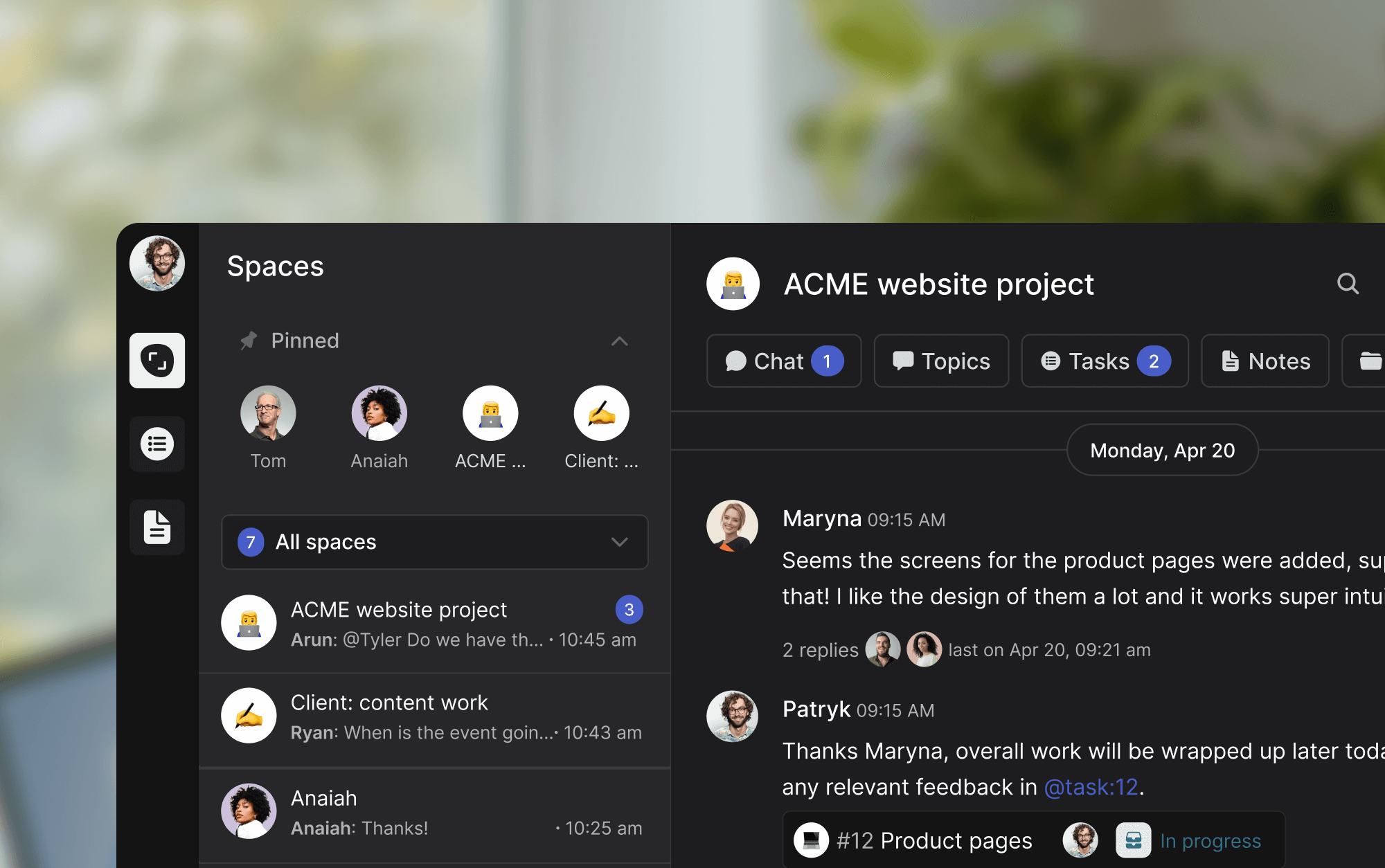
What we do at Rock: chat, tasks, and notes live in the same workspace. Project plans, risk logs, status updates, and stakeholder communications all sit next to the actual work, not scattered across email, a project tool, and a chat app. For a new project manager, this consolidation matters more than tooling sophistication; the role's leverage depends on visibility into the work, not on switching between five tools to assemble a status report.
Common pitfalls in JD writing
The predictable failure modes when writing or reviewing a project manager job description.
- Writing one JD for all seniority levels "Project Manager" postings that lump Coordinator-level tasks (note-taking, status reports) with Senior-level tasks (program ownership, client negotiation) attract candidates from every band and a confused interview process. Every JD should target one band cleanly.
- Listing 25 responsibilities Long responsibility lists feel comprehensive and read as nothing. The role has 5 to 7 core responsibilities. Anything more is either redundant or actually a different role you should not be hiring for. Cut to seven.
- Confusing PM, SM, PO, and Program Manager A JD that asks the candidate to "own product roadmap, run sprint ceremonies, and remove team impediments" is hiring three people in one job. The roles overlap in skills but answer different questions. Pick one and write the JD for that role; reference the comparison table above to verify.
- Salary band hidden or omitted JDs without salary ranges underperform on application volume and concentrate replies from underqualified candidates. Several US states now require salary disclosure on postings; even where not required, including a band saves both sides time. Use the JD builder above for current ranges.
- Overweighting certifications PMP, PRINCE2, CSM, and CAPM open doors at the entry and mid level; they do not predict senior performance. JDs that require PMP for a Junior PM role miss talented junior candidates; JDs that demand it for a Director role are signaling a cargo-cult hiring process.
Frequently asked questions
What is a project manager job description?
A project manager job description outlines the responsibilities, required skills, qualifications, and salary range for the role. The standard structure covers the role summary, 5 to 7 core responsibilities (scope, schedule, budget, team coordination, stakeholder communication, risk, quality), required skills, preferred certifications, and reporting relationships. The shape changes meaningfully by seniority level and industry.
What does a project manager actually do day to day?
A working project manager spends most of the day on coordination: clarifying scope, unblocking the team, communicating progress, and tracking risks against the plan. Roughly 60 to 70% of the time is communication-heavy work; the remaining 30 to 40% is analytical (planning, budget tracking, risk scoring, reporting). Junior PMs spend more time on documentation; senior PMs spend more time on stakeholder negotiation and decision-making.
What is the salary for a project manager in 2026?
Per the Bureau of Labor Statistics (May 2024 data, the most recent), Project Management Specialists in the US earn a median of $100,750 annually. Robert Half's 2026 Salary Guide pegs general PMs at $69,500 to $100,000 and IT PMs at $103,500 to $147,000+, with Senior IT PMs reaching $147,000 and above. Industry, region, and seniority all drive material variance. The JD builder above outputs ranges for each combination.
What qualifications does a project manager need?
For most mid-level PM roles: a bachelor's degree in a relevant field, 3 to 7 years of project delivery experience, and ideally one of PMP (Project Management Professional), PRINCE2, or CAPM (Certified Associate in Project Management). PMP is the most widely recognized; PRINCE2 dominates in the UK and parts of Europe; CSM applies if the role intersects with Scrum work. Certifications are useful but not predictive of senior performance.
What is the difference between a project manager and a scrum master?
A project manager owns delivery commitments: scope, schedule, budget, and stakeholder coordination for a defined project. A Scrum Master owns process effectiveness and team agility, but does not own the date the team ships. The two roles can be combined in small teams or agencies, but they answer different questions. The 4-role comparison table above details the distinction across PM, SM, Product Manager, and Program Manager.
Do project managers need a PMP certification?
No, not strictly. PMP is widely recognized and tends to come with a salary premium (industry sources cite around 33% lift), but many strong PMs do not have one. PMP is most valuable at the entry-to-mid transition, where it signals discipline and a baseline of methodology. At senior and director levels, demonstrated delivery track record matters more than the credential.
How is the project manager role evolving?
PMI's 2025 talent gap research projects 25 to 30 million new project professionals will be needed globally by 2030 to 2035 to keep pace with project-based work. At the same time, AI tooling is absorbing routine PM tasks (status report generation, scheduling, risk logging), shifting the role toward stakeholder leadership, judgment under uncertainty, and cross-functional negotiation. The administrative side is being automated; the human side is becoming more important.
How to use this guide
Run the JD builder above with the seniority and industry that match your hire. Copy the output, edit for company specifics (team size, sponsor name, reporting structure), and post. The structure aligns with what candidates expect and recruiters scan.
For ongoing PM operations, the guide pairs naturally with our project management framework, project charter template, and RACI matrix guides. The role is real; the discipline is teachable; the JD is the entry point.
Hiring a project manager? Run them on Rock from day one. Rock combines chat, tasks, and notes in one workspace. One flat price, unlimited users. Get started for free.