What Is a Scrum Master? Role, Skills, and Where It's Going
The Scrum Master is one of the most-explained and most-misunderstood roles in software work. Most articles describe it as servant leader, coach, facilitator, and impediment remover, in that order. The official Scrum Guide moved on from that framing in 2020, and the role itself has been quietly changing since.
This guide covers what a Scrum Master actually does in 2026, using the official 2020 Scrum Guide structure. It separates Scrum Master from Project Manager, Product Owner, and Tech Lead. It explains where the role flexes for small teams and dual-hat realities. And it covers honestly where the role is going as some companies eliminate dedicated Scrum Master positions while the work itself continues.
Quick answer: what is a Scrum Master
A Scrum Master is a role on a Scrum team accountable for the team's effectiveness, defined by the official 2020 Scrum Guide as a "true leader who serves the Scrum Team and the larger organization."
The role spans three services: serving the Scrum Team, serving the Product Owner, and serving the broader organization. The Scrum Master coaches, facilitates, removes impediments, and improves how Scrum is implemented, but does not own delivery commitments, scope, or what gets built.
The role is not a project manager, not a tech lead, and not a product owner, even when the same person sometimes holds multiple titles. The next sections cover what each service looks like in practice, how the role compares to adjacent roles, and where the realistic shape of the position has been changing.
The mapper above is calibrated for actual team contexts, not the textbook ideal. Use it before reading the rest; many readers discover their team needs a different shape of the role than they assumed.
What a Scrum Master actually does
The 2020 Scrum Guide is the authoritative source on what is a Scrum Master and what the role is accountable for. Sutherland and Schwaber, the framework's co-creators, deliberately rewrote the Scrum Master section that year to fix what they saw as the most common misread. Per the official 2020 Scrum Guide, the Scrum Master is "accountable for establishing Scrum as defined in the Scrum Guide" and "accountable for the Scrum Team's effectiveness."
The bigger 2020 change was deliberate: the long-standing phrase "servant leader" was replaced with "true leaders who serve." Schwaber explained the reasoning publicly. Many practitioners had read the original phrasing as a license for passive facilitation, treating the Scrum Master as someone who avoided hard conversations and accommodated the team rather than challenging it. The rewrite reasserts that the Scrum Master is a leader, not a facilitator emeritus.
Most popular Scrum Master explainers still parrot "servant leader." That is a small tell when you read role guides. The ones that quote the 2020 wording have done more recent homework than the ones that did not.
The 3 services: Team, Product Owner, Organization
The 2020 Scrum Guide structures the role as three services rather than four or five responsibilities. Most competing role guides default to a 4 or 5 item responsibilities list; the 3-services framing is canonical and underused.
| Serves | What that looks like in practice | The mistake to avoid |
|---|---|---|
| The Scrum Team | Coaching the team in self-management and cross-functionality, removing impediments to progress, ensuring all events happen and stay timeboxed and productive. | Becoming the team's secretary or note-taker. Facilitation is the work; documentation should belong to the team. |
| The Product Owner | Helping with effective product backlog management, communicating the product goal, coaching on empirical product planning in complex environments. | Shielding the team from the PO's priorities or stepping into product decisions. The SM coaches the PO; the SM does not replace the PO. |
| The Organization | Leading and coaching agile adoption beyond the team, planning Scrum implementations within the company, removing barriers between stakeholders and the Scrum Team. | Treating this as someone else's job. The organizational service is what separates a senior SM from a junior facilitator, and it is where the role contributes most strategic value. |
The third service is where most of the role's strategic value lives, and it is also the most-skipped. A Scrum Master who only serves the team produces a well-run team in a poorly run company. The organizational service requires uncomfortable conversations with managers above the team, which is why junior Scrum Masters tend to avoid it and senior Scrum Masters lean into it.
Daily, weekly, sprint-cycle work
The role does not look like a typical 9-to-5 role with a fixed schedule. The work clusters around ceremonies and impediments, with coaching woven through the rest of the time.
| Cadence | What the Scrum Master is doing | How long it actually takes |
|---|---|---|
| Daily | Facilitating the daily standup if needed, listening for impediments raised but not yet acted on, having one-on-ones, surfacing patterns to the PO, unblocking external dependencies. | 1 to 2 hours, mostly in 15-minute increments scattered through the day. |
| Within sprint | Refinement support, coaching individuals or pairs on agile practices, attending design or architecture discussions to listen for process drift, removing organizational blockers between sprints. | 4 to 8 hours per week, depending on team maturity. |
| Sprint boundary (planning + review + retro) | Facilitating sprint planning, the sprint review with stakeholders, and the retrospective. Ensuring action items from the retro actually land. | 4 to 6 hours per 2-week sprint, concentrated on the boundary days. |
| Quarterly / organizational | Coaching other SMs and managers, working on agile maturity beyond the team, addressing systemic blockers, contributing to release planning at scale. | 4 to 12 hours per quarter, more in transformation contexts. |
One detail surprises new Scrum Masters: the role can be done well part-time. Mountain Goat Software estimates a Scrum Master can effectively cover one team in roughly 20 to 30 hours per week.
Below 15 hours per week, the role becomes a facilitator title without enough time for real coaching. Above one full team for full-time, the depth of organizational service starts to compound, but there is no automatic justification for two teams unless both are in active transformation.
Scrum Master vs PM, PO, and Tech Lead
The most common confusion is between Scrum Master and Project Manager. The two roles overlap in skills (facilitation, coordination, problem-solving) but answer different questions. The PM owns "did we ship by the date." The SM owns "is the team getting better at how they work."
Most agencies that try to convert their PMs into SMs without changing the underlying expectations end up with PMs who run sprint ceremonies but do not coach. The job title changed; the day-to-day did not.
| Role | Owns | Cares about | Does not own |
|---|---|---|---|
| Scrum Master | Process effectiveness, team agility, ceremony quality | How the team works, blockers, coaching depth | What the team builds, deadlines, stakeholder commitments |
| Product Owner | The product backlog, product goal, value delivered | What gets built next and why | How the team works internally, ceremony format |
| Project Manager | Delivery commitments, scope, schedule, dependencies across teams | Did the team ship by the date, on budget | Coaching, agile practice maturity, internal team dynamics |
| Tech Lead / Engineering Manager | Technical direction, code quality, individual development | Architecture, hiring, growth conversations | Sprint ceremony facilitation, agile process discipline |
The Scrum Master and Product Owner overlap is more philosophical. The PO advocates for what to build; the SM coaches the team in how. The 2020 Scrum Guide explicitly notes the conflict that arises when one person tries to do both: priority advocacy and process coaching pull in different directions, and one usually crowds out the other.
"The Scrum Master is a team captain, coach, and servant leader, not a formal project manager. The Scrum Master guides the team, encourages it to continuously improve, and works to remove impediments that are reducing flow." - Jeff Sutherland, in Scrum: The Art of Doing Twice the Work in Half the Time (2014)
Where the role flexes for small teams
Most ranking role-explainer pages assume a 50-person engineering organization with a dedicated Scrum Master. That is not most teams. In practice the role flexes by team size, agile maturity, and time available.
For a team of 4 to 7 with 6 to 18 months of agile experience, a part-time Scrum Master (15 to 25 hours per week) is realistic. For an early-stage team just starting Scrum, a 3 to 6 month engagement with an external coach often beats promoting an internal person too soon.
For a mature team of 5 with 3 plus years of practice, rotating facilitation among team members and bringing in an external coach quarterly often outperforms a dedicated SM. The honest test is whether the work is getting done well, not whether the org chart shows a Scrum Master role.
The dual-hat reality is also normal. Many small businesses, agencies, and startups run an SM-plus-PM hybrid, an SM-plus-Engineering Manager hybrid, or rotate the SM role weekly. The trade-off is real: PM duties tend to crowd out coaching, and the team experiences the role mostly during ceremonies. Done deliberately the dual-hat works because the same person sees both the agile process and the broader project context. Done accidentally it produces a PM who runs retros.
Skills that actually matter
Most skills lists for the role read as generic communication advice. The honest list is shorter and more specific.
Reading a room. The single most predictive skill for ceremony quality. Knowing when to let silence sit, when to push, when to redirect, when to end early. This is learned by running ceremonies, not by reading about them.
Holding uncomfortable conversations. The organizational service requires escalating impediments to managers two levels up. It also requires telling a Product Owner their backlog refinement is failing the team, or telling a senior engineer their behavior is hurting the team's psychological safety. Avoiding these conversations is the most common failure mode of the role.
Coaching versus telling. The discipline of asking the question that helps the team see the answer, instead of giving the answer. Lyssa Adkins's Coaching Agile Teams remains the canonical text on this.
"If you have a problem and to solve it you need someone else to change, you do not understand your problem yet." - Lyssa Adkins, in Coaching Agile Teams (2010)
Pattern recognition across sprints. A Scrum Master sees the same team for many sprints. The work is noticing the patterns the team cannot see from the inside. Recurring impediments, conversations that keep getting deferred, architectural decisions that produce the same sprint pain.
Domain context, eventually. The senior version of the role requires enough understanding of the technical and product context to know what is realistic. Generic facilitation skill is necessary but not sufficient at the senior level.
Certifications: a neutral take
Two main entry-level certifications dominate the field. Both are reasonable as learning credentials, neither is a substitute for actual practice. The Professional Scrum Master (PSM) from Scrum.org is more rigorous at the entry level, does not expire, and is taken via online assessment. The Certified ScrumMaster (CSM) from Scrum Alliance requires a 2-day course, is more popular by enrollment, and renews every 2 years.
For someone entering the field, either is a defensible signal. PSM is harder to bluff through because it lacks the in-person course component; some hiring managers weight it more heavily. CSM is easier to schedule and includes structured learning. Both are dwarfed in importance by actual team-facing experience after the first 18 months in the role.
Do not buy the certification industry's salary uplift claims. The credential opens doors at the entry level and matters less the further into the role you go. Senior agile coaches often have one, often have neither. Advanced certifications (A-CSM, PSM II, PSM III) signal genuine expertise and are worth the investment for senior practitioners.
Where the role is going (2026 and beyond)
The dedicated Scrum Master role has been contracting at scale across 2024 and 2025. Three patterns are worth understanding because they change what new Scrum Masters should plan for.
Layoffs at scale. Capital One eliminated approximately 1,100 Scrum Master roles in 2024. Royal London cut roughly 90% of its Scrum Master positions. A UK bank eliminated around 1,000 SM and Agile Coach roles in the same period (data via Humanizing Work and Age of Product).
The training pipeline reflects the shift. Entry-level Scrum Master class enrollment fell from a 24% share in 2022 to under 5% in 2024. The work has not disappeared; the dedicated role has.
The Spotify-influenced "no Scrum Master" pattern. Spotify's 2012 Kniberg-Ivarsson whitepaper renamed the Scrum Master role to Agile Coach and made it optional. Spotify itself has since moved away from the model the whitepaper described. But the rebrand-or-eliminate pattern spread. Some organizations now run team-led facilitation with rotating responsibility, supplemented by part-time Agile Coaches who span multiple teams.
AI absorption of administrative work. Sprint metrics, blocker tracking, retro analysis from chat transcripts, and ceremony scheduling are increasingly handled by AI tooling. Both Scrum.org and Scrum Alliance launched AI-for-Scrum-Master content and microcredentials in 2024 and 2025, evidence the role is being reshaped, not preserved. The administrative side of the role is the side AI absorbs first; the coaching, organizational impediment work, and pattern-recognition pieces remain genuinely human.
"The biggest problem in Scrum is the word 'Servant Leadership.' Many people interpreted that as meaning they do not need to enable the team to improve." - Ken Schwaber, on the 2020 Scrum Guide rewrite (per ZenTao Scrum Guide 2020 commentary)
What this means for someone entering the role in 2026: optimize for the parts of the work that are not being absorbed. Coaching depth, organizational leverage, and pattern recognition across sprints. The career path increasingly runs Scrum Master to Agile Coach to Engineering Manager or Product Operations, rather than Scrum Master forever.
This is consistent with the Digital.ai State of Agile data showing Scrum still at 87% adoption among agile teams. The framework is healthy; the role configuration around it is evolving.
What we recommend
For most teams the practical answer is not "should we hire a Scrum Master" but "what shape of the role does our context need." For a small team or agency, the dual-hat or part-time version is realistic and effective when held deliberately.
For a team in early agile adoption, an external coach for 3 to 6 months often outperforms an internal hire. For a mature team, rotating facilitation supplemented by a part-time coach often beats a full-time SM.
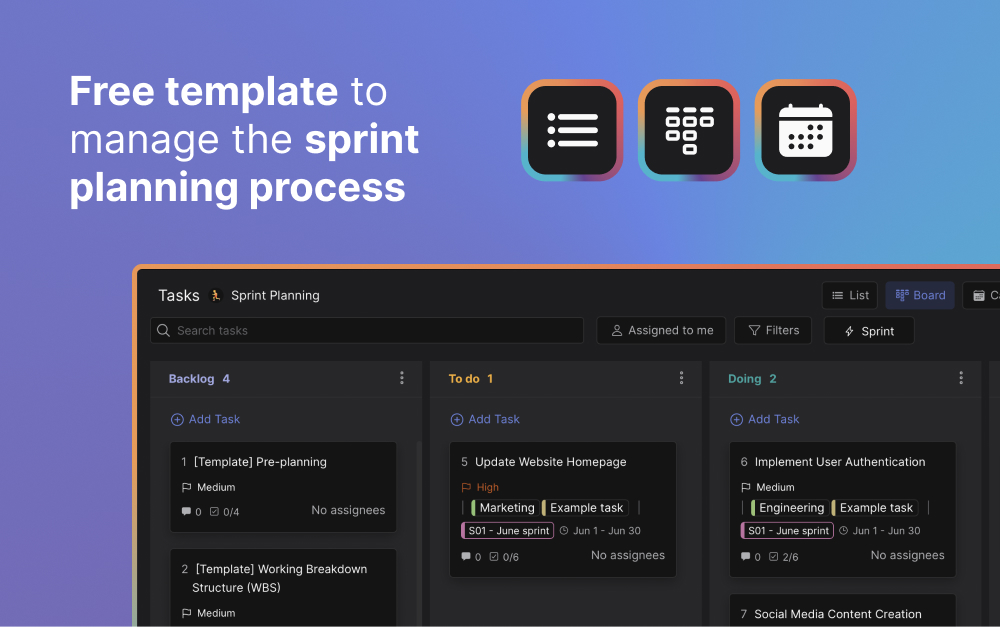
What we do at Rock: chat, tasks, and notes live in the same workspace, so sprint coordination, retro action items, and impediment tracking sit next to the work itself. Sprint planning, daily standups, and retrospectives all happen against the same task board the team is working from. For dual-hat or part-time SMs, this matters more than for full-time ones; the role's leverage depends on staying close to the actual work without adding tool overhead.
Common pitfalls
The predictable failure modes for the role, in order of frequency observed.
- Becoming the team's secretary Note-taking, calendar wrangling, and ticket housekeeping creep into the role until coaching disappears underneath. The team learns to depend on the SM for admin instead of owning their own process. Push administrative work back to the team; protect the calendar for coaching and impediment removal.
- Confusing servant leadership with passive facilitation The 2020 Scrum Guide explicitly moved from "servant leader" to "true leaders who serve" because too many SMs read the original phrasing as a license to avoid hard conversations. Schwaber himself flagged this. The SM is supposed to challenge the team and the organization, not just nod through retros.
- Owning impediments instead of removing them An impediment list with 30 open items and no movement is a sign the SM is logging blockers rather than escalating them. Removal often requires uncomfortable conversations with managers two levels up. That is the work.
- Defending Scrum dogmatically The framework is a means; team effectiveness is the end. SMs who treat estimation rituals, ceremony length, or every Scrum Guide line as immutable produce ceremony theater. Adapt the practice when the principle is preserved; remove it when neither holds.
- Skipping the organizational service The Scrum Guide names three services: serving the Team, the Product Owner, and the Organization. Most SMs only show up for the first. The third is where senior SMs add the most value: coaching managers, removing systemic blockers, working on agile maturity beyond their team. Skipping it is also why the role gets seen as ceremony-keeper rather than strategic contributor.
Frequently asked questions
What does a Scrum Master do?
Per the official 2020 Scrum Guide, the Scrum Master is accountable for the Scrum Team's effectiveness and serves three audiences: the Scrum Team, the Product Owner, and the wider Organization. In practice the role spans facilitation of ceremonies, coaching the team in agile practices, removing impediments, and improving how Scrum is implemented across the company.
Is a Scrum Master the same as a Project Manager?
No. A Project Manager owns delivery commitments such as scope, schedule, and dependencies across teams. A Scrum Master owns process effectiveness and team agility but does not own the date the team ships. The two roles can be combined in small teams, but they answer different questions: did we ship versus did we build the right way to keep shipping.
Does a small team need a dedicated Scrum Master?
Often no. Mountain Goat Software estimates a Scrum Master can effectively cover one team in roughly 20 to 30 hours per week, which means a dual-hat role (SM combined with PM, EM, or Tech Lead) is normal for teams under 8 people. The work itself is still real; it just does not require a full-time position.
Is the Scrum Master role declining?
In some organizations, yes. Capital One eliminated around 1,100 SM roles in 2024; Royal London cut roughly 90% of its Scrum Masters; entry-level SM training class share fell from 24% in 2022 to under 5% in 2024 (Humanizing Work data). The work has not disappeared; it is being absorbed by Engineering Managers, Agile Coaches, and team-led facilitation models. The dedicated SM role is contracting; the responsibilities are not.
Do you need a certification (CSM, PSM, A-CSM) to be a Scrum Master?
No, you do not need one to do the work. Many practitioners get one to enter the field; many senior SMs and agile coaches do not have one. PSM (Scrum.org) tends to be the more rigorous of the entry-level certifications; CSM (Scrum Alliance) is more popular by enrollment. Either is reasonable as a learning credential; neither is a substitute for actual coaching practice.
What is the difference between a Scrum Master and an Agile Coach?
A Scrum Master typically works with one team at a time on Scrum-specific practice. An Agile Coach typically works across multiple teams and the broader organization, often on agile maturity beyond a single framework. Career-wise, Agile Coach is the common next step from senior Scrum Master, especially as organizations consolidate roles.
Can the same person be Scrum Master and Product Owner?
Officially discouraged because the two roles answer different questions and create a conflict of interest. The PO advocates for what to build; the SM coaches the team in how. One person trying to do both tends to lose the coaching depth on the SM side and the strategic clarity on the PO side. In small teams the dual role appears anyway; treat it as a known compromise, not a sustainable design.
How to grow into a Scrum Master role
For someone who wants to enter or grow into the role from an adjacent position (developer, project manager, team lead), the path is more about deliberate practice than credentials.
- Read the Scrum Guide twice The 2020 version is roughly 13 pages and is the authoritative source on what the role accountabilities are. Read it once for orientation, then again with a highlighter for the specific phrasing on Scrum Master accountabilities. Most working SMs cannot quote the three services accurately; doing so is a small but meaningful credential.
- Volunteer to facilitate one ceremony for an existing team Retros are the easiest entry point because the format is well-defined and the stakes are low. Run one. Get feedback. Run another. Facilitation is muscle memory, not a personality trait, and the only way to build it is in front of real teams.
- Pick a coaching practice book and apply one chapter at a time Lyssa Adkins's Coaching Agile Teams is the most-cited entry. Read one chapter, try the practice with one teammate, repeat. Coaching is the part of the role that does not get better through certification courses; deliberate practice is the only path.
- Decide between PSM and CSM, then enroll PSM (Scrum.org) is more rigorous at the entry level and does not expire. CSM (Scrum Alliance) is more popular and includes a 2-day course. Either works as a learning credential. Skip the certification industry's marketing claims about salary uplift; the credential opens doors but does not do the work.
- Find a senior SM or Agile Coach to shadow Watching an experienced SM run a difficult retrospective or escalate a structural blocker teaches more in two sessions than 10 books. If your company does not have one, agile communities and conferences (Scrum Gathering, Agile Alliance) are the next best path.
- Pick up the third service early Most junior SMs default to serving the Team and avoid the Product Owner and the Organization. Pick at least one organizational coaching task in your first 90 days, even a small one (improving the cross-team dependency conversation, for instance). It signals you understand the full role and accelerates the path to senior SM or coach.
Whatever shape the Scrum Master role takes for your team, the work happens better when chat, tasks, and notes share a workspace. Rock combines them at one flat price for unlimited users. Get started for free.