What is Agile? A Practical Guide for Agency Teams
Agile was built for product teams. One product, one backlog, a dedicated crew, and a product owner who is available every day. Agencies are none of those things. You quote fixed prices. You run eight client projects at once. Your clients disappear for weeks. Your designer works on three brands in a single day. When you read generic Pomodoro Technique-style focus blocks pair naturally with Context switching is what sprints help reduce; agile guides, the advice sounds good but the math does not work.
This is agile for agencies. A practical translation of what agile actually is, which parts matter for agency work, and where to deviate from the textbook without pretending you invented something new.
What Is Agile?
Agile is an approach to project management that delivers work in short, repeated cycles instead of one big plan at the end. Teams ship small pieces, gather feedback, and adjust. The agile methodology was defined by the Agile Manifesto in 2001 by 17 software developers who were tired of heavy documentation and slow releases.
The Manifesto lists four values: individuals and interactions over processes and tools, working output over comprehensive documentation, customer collaboration over contract negotiation, and responding to change over following a plan. There are also 12 principles that expand on those values.
Agile is an umbrella. Under it sit specific frameworks: Scrum (time-boxed sprints), Kanban (continuous flow), Extreme Programming, and hybrids. For the full comparison with traditional project management, see our agile vs waterfall guide. For the most common agile framework in practice, see our Scrum for agencies guide, or our Kanban vs Scrum comparison if you are deciding between the two.
"For each desired change, make the change easy (warning: this may be hard), then make the easy change." - Kent Beck, Co-creator of Extreme Programming and Agile Manifesto signatory
That line captures what agile is really about. Not a prescribed process. A way of making change possible.
Why Agile Breaks at Agencies
Agile assumptions collide with agency reality. A McKinsey survey of marketing executives found that only 3% called the transition to agile with their agency partners "smooth." More than 80% called it filled with obstacles. That is not a communication problem. It is a structural problem.
Four structural gaps make textbook agile hard at most agencies.
| Structural gap | What it looks like at an agency |
|---|---|
| Fixed-price contracts do not flex | Clients pay a set amount for a defined list of deliverables. "Adjust scope based on what you learn" does not work when the scope is the contract. |
| Multiple clients share one team | Scrum assumes a dedicated team on one backlog. Your team serves five to ten clients. A dedicated sprint team barely exists. |
| Clients are not product owners | Agile expects someone available daily to prioritize, answer questions, and sign off. Agency clients run their own businesses. They miss reviews, drop changes at 11 PM Friday. |
| Teams do not ship "working software" | Agile's definition of a completed increment assumes software. Agency sprints produce draft copy, design concepts, campaign plans. Different definition of "done." |
None of this means agile is wrong for agencies. It means you need to adapt it. Pretending agile works out of the box at an agency is how you end up running the same broken process every two weeks.
The Agile Principles That Matter for Agencies
The Agile Manifesto lists 12 principles. Most are written for software teams. Five translate directly to agency work. Here is how they look once you strip out the software language.
| Principle | What it means at an agency |
|---|---|
| Deliver value early and often | Show the client something tangible every week or two. A wireframe, a draft concept, a sample section. Rough beats nothing every time. |
| Welcome changing requirements | Welcome changes within the agreed scope. Push back on changes outside it. A fifth logo round is a change order, not a sprint adjustment. |
| Build around motivated individuals | The PM steps back. The team picks tasks from the sprint board. Daily standups are for team coordination, not PM check-ins. |
| Reflect and adjust regularly | Never skip the retrospective. Ten minutes at the end of every sprint. What worked, what did not, what to try differently. |
| Simple trumps complex | Maximize the amount of work not done. A 3-column sprint board beats a 12-column one with custom fields nobody fills in. |
Skipping the retrospective is the most common mistake. Our retrospective guide covers the format if this is the first one you are running.
"An attitude has no boundaries, so we wouldn't ask 'can I use agile here', but rather 'how would I act in the agile way here?' or 'how agile can we be, here?'" - Alistair Cockburn, Agile Manifesto co-author

Pick a Framework by Project Type
Most agencies do not need one framework. You need different approaches for different project types. Here is a quick cheat sheet that matches the most common agency work to the agile framework that fits best.
| Project type | Best framework | Why it fits |
|---|---|---|
| Website builds and brand launches | Scrum + waterfall hybrid | Milestones give clients predictability, sprints give the team room to iterate. |
| Retainers and ongoing support | Kanban | Reactive work with no sprint boundary. Requests flow in, team pulls from the board. |
| Marketing campaigns | Hybrid (waterfall plan, agile execution) | Brief and channel mix fixed upfront. Content production adjusts based on performance. |
| Product or SaaS feature work | Match the client's process | If you are building inside their team, their rhythm wins. Scrum or Kanban as they use. |
| Short creative bursts | Named task with due date | One-off graphics, social posts, quick landing pages do not need a full sprint. |
Agile for marketing teams deserves a specific note. A 2025 AgileSherpas report found that hybrid marketing teams are 24% more likely to release work faster than teams running a single framework. The "plan in waterfall, execute in agile" pattern that fits campaigns also turns out to be the highest-performing pattern across marketing broadly.
For the practical Scrum setup, see our Scrum for agencies guide. For Kanban on retainer work, our task board guide covers the setup.
Common Agile Mistakes at Agencies
Five recurring failures when agencies try agile.
Imposing agile top-down. The PM reads a book, announces the team is now agile, and expects behavior change by Monday. It does not work.
"So I hope I've made clear that imposing agile methods is a very red flag." - Martin Fowler, Chief Scientist, ThoughtWorks
Fowler's point is simple. Agile is about how the team chooses to work. If leadership mandates it, the team will perform the ceremonies without adopting the mindset. That is worse than not doing agile at all.
Treating velocity as a performance metric. Velocity is a planning tool. Story points completed per sprint help the team estimate future work. For items still vague, t-shirt sizing handles the roadmap layer before story points enter the picture. The moment management uses velocity to compare teams or push for more output, teams inflate their estimates and the metric becomes meaningless.
Skipping the retrospective. The retrospective is where learning happens. Skip it and you are running the same broken process every sprint. A 2025 AgileSherpas survey found that 96% of marketers practicing agile report a positive experience. The ones who do not are usually the ones who dropped the retrospective first.
Locking scope, budget, and timeline at the same time. Scrum needs one variable to flex. If all three are fixed, you are running waterfall with sprint language on top. That is fine, just call it what it is.
Copying software-team agile wholesale. The Scrum Guide assumes software engineers. Your team has designers, copywriters, strategists. Adapt the language. Adapt the ceremonies. "Developers" in an agency context means anyone building the increment, not just engineers.
Agile for Remote Teams at Agencies
Agile for remote teams is a different problem than agile for a co-located crew. Generic guides assume a physical standup, a shared board on the wall, a kitchen for informal chats. For agencies in developing nations working with western clients, or for any distributed team, none of that applies. Agile for small teams spread across time zones needs a different playbook.
Three adjustments make agile work remotely.
Async standups. Three questions posted in a shared thread every morning. What did I do, what will I do, what is blocking me. The team reads at their convenience. This is how you run asynchronous work across time zones without losing coordination.
Written-first decisions. Every decision gets documented. Retrospectives happen in a shared note, not a video call. Sprint planning produces a written sprint goal. Remote teams cannot rely on hallway memory.
Overlapping hours for sync touchpoints. Identify two to three hours when most of the team is online. Schedule the few sync ceremonies that need live discussion in that window. Everything else is async.
What We Do at Rock
Our own team runs agile for agencies day to day. Here is what that looks like.
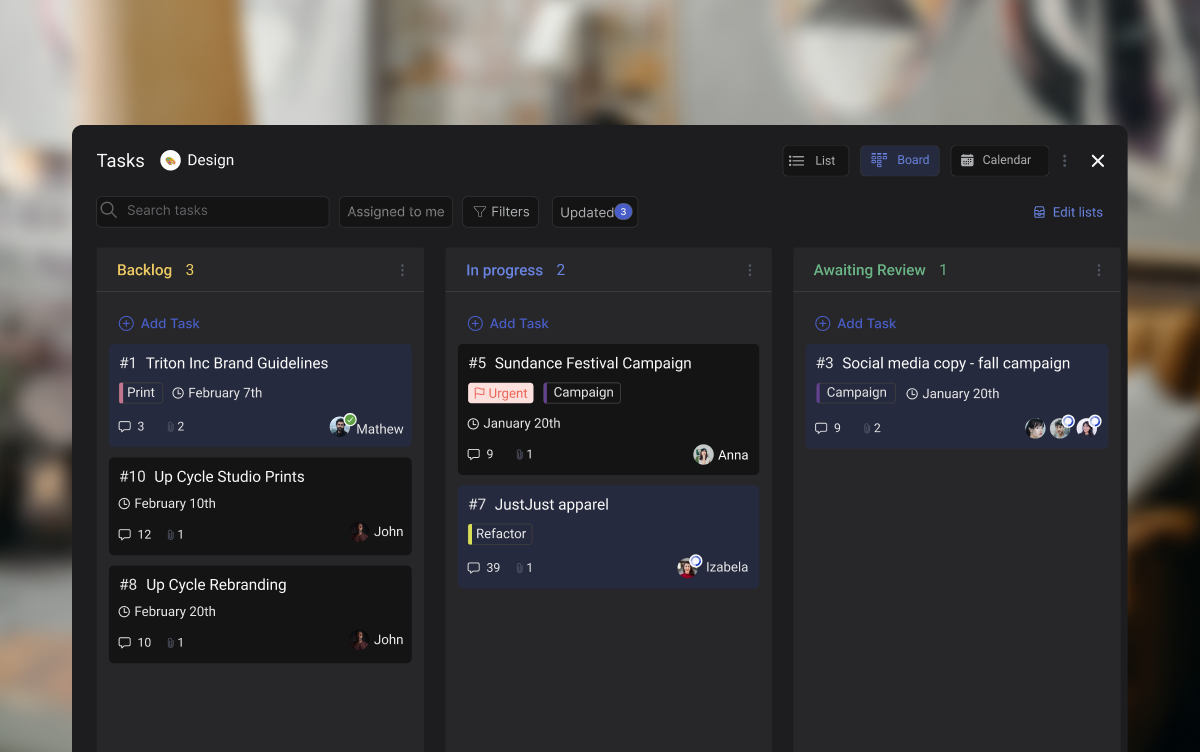
We use two-week sprints. Sprint start dates are staggered across projects so Monday mornings are not consumed by back-to-back planning meetings. Sprint planning is 20 minutes per project, not four hours. Daily standups are async in Topics because our team works across time zones. Retrospectives are a shared note with three columns. Each project space has a sprint board on the Unlimited plan with tasks rolling over automatically week to week.
We do not run pure Scrum. We mix Scrum for planned project work with Kanban for reactive support requests. It is not textbook agile. It ships work and keeps the team sane.
Getting Started with Agile at Your Agency
Do not start by rolling out agile across the whole agency. Start with one project. Preferably one that is actively in trouble.
Step 1. Pick one project. Choose a project with an engaged internal team and a reasonable client. Not your worst fire. Not your easiest job either. Somewhere in the middle.
Step 2. Set a sprint cadence. Two weeks is the default. Our sprint duration guide explains when to go shorter or longer.
Step 3. Define the sprint goal. One sentence. What will the client see at the end of this sprint.
Step 4. Break the work into tasks. Use the agile sprint planning template if you need a starting point. Each task needs a clear Definition of Done.
Step 5. Run the sprint. Async standups. Ship at the end. Review with the client. Retrospective with the team.
Step 6. Run 3-4 sprints before expanding. Most teams hate sprint one, tolerate sprint two, and start seeing value by sprint three. Give it time before deciding it does not work.
Step 7. Expand to the next project. Once one project runs agile cleanly, the team knows the rhythm. Add a second project. Then a third. The rhythm scales faster than the learning curve.
For a deeper look at why agile works when it is done right, read about the benefits of agile project management. For the broader landscape of methodologies, compare options in our project management methodologies guide.
Run agile for agencies without the Jira overhead. Rock combines chat, tasks, and notes in one workspace. One flat price, unlimited users. Get started for free.