What is Scrum? The Practical Guide for Agencies
You read about Scrum. You tried sprints. It half-worked. That is because most Scrum guides are written for software teams with one product, one backlog, and one dedicated set of engineers. Agencies do not have any of that. You run five to ten clients at once. Your designers float across three brands in a single day. Your clients vanish for a week, then drop changes at 11 PM on Friday.
This guide covers Scrum for agencies. What Scrum actually is, what the official framework says, and how agencies adapt it to work in practice. No purity tests. No jargon drops. Just the parts that matter when you are trying to run projects across multiple clients and keep the lights on.
What Is Scrum?
Scrum is a lightweight framework for managing work in short, fixed-length cycles called sprints. Created by Jeff Sutherland and Ken Schwaber in the early 1990s, it helps teams deliver working results in one to four weeks, then inspect and adapt before the next cycle. The official 2020 Scrum Guide is just 13 pages. The rules are deliberately minimal so teams can adapt the scrum framework to their context.
The Scrum Guide defines it as "a lightweight framework that helps people, teams and organizations generate value through adaptive solutions for complex problems." Three pillars hold it up: transparency (everyone sees the same thing), inspection (check progress often), and adaptation (change direction when the data says so).
"At its root, Scrum is based on a simple idea: whenever you start a project, why not regularly check in?" - Jeff Sutherland, Co-creator of Scrum
The scrum methodology sits under the broader agile umbrella. If you want to compare methodologies side by side, see our agile vs waterfall guide. For now, here is what matters: Scrum is the most popular team-level agile framework. According to the 17th State of Agile Report, 63% of agile teams use Scrum. It is the default starting point for most teams moving to agile.
The Three Scrum Roles (And What They Mean at an Agency)
The Scrum Guide 2020 calls these "accountabilities," not roles. The shift matters. You do not hire a Product Owner. You decide who holds that accountability on this project. Here is how the three scrum roles translate when you are running an agency.
Product Owner
The Product Owner owns the backlog. They set priorities, write user stories, and decide what the team builds next. In a software product team, this is often a full-time role.
In an agency, the Product Owner is your account manager or project lead. Not the client. Making the client your Product Owner is one of the most common mistakes agencies make. Clients will micromanage, freeze the backlog at the wrong moment, and push pet features that do not serve the project goal. The client is a stakeholder. Your account manager translates client input into a prioritized backlog.
Scrum Master
The Scrum Master facilitates the process, removes blockers, and coaches the team. They do not assign work. They do not manage people. Their job is to protect the team from distractions and help them improve over time.
Most agencies under 15 people cannot dedicate someone full-time to this. You have options. Rotate the role weekly so everyone learns the process. Have the senior PM hold it part-time alongside their other work. Or drop the role and treat the PM as sprint guardian. Purists will push back. It works anyway if someone is actively protecting the sprint from scope creep and client interruptions.
Developers (Not Just Engineers)
The Scrum Guide calls the team "Developers." That wording trips people up. It does not mean software engineers. It means the people who build the increment. The 2020 version of the Scrum Guide deliberately dropped software-specific language so the framework applies beyond engineering.
In a creative agency, the Developers are your designers, copywriters, strategists, and anyone else hands-on with the work. Scrum for marketing teams puts copywriters and campaign leads on the same sprint crew as designers. A sprint team for a brand launch looks nothing like a sprint team for a SaaS feature. Both are valid. The Scrum Guide recommends three to nine people. Scrum for small teams often means running sprints with three or four people and a shared Product Owner.
Build your agency's sprint setup
Answer 4 questions. Get a personalized Scrum setup in 30 seconds.
1. How many people on your team?
2. How many active client projects at once?
3. Where is your team located?
4. What does your work mostly look like?
Start over
The Five Scrum Events (And What to Keep vs Cut)
Scrum defines five events. Every event has a purpose. At an agency, some are essential and some can be trimmed. Here is the honest breakdown.
The Sprint
The Sprint is the container for everything else. One to four weeks, repeated. Most teams run two-week sprints. Our sprint duration guide covers how to pick the right length. For agencies, the key tip is to stagger sprint start dates across your client projects. If every sprint starts on the same Monday, your planning meetings will stack and nothing gets done before Wednesday.
Sprint Planning
The team selects backlog items for the sprint and defines a sprint goal. The Scrum Guide allows up to eight hours for a month-long sprint. For a two-week sprint, most guides say four hours.
At an agency with a small team, 20 to 30 minutes per project is usually enough. Do not force a ceremony if the work is straightforward. What matters is that everyone knows the sprint goal, the tasks are broken down, and there is a clear Definition of Done. Skip the velocity calculations and story point debates unless your team genuinely uses them.
Daily Scrum (Stand-up)
The daily scrum is 15 minutes at the same time every day. Team members cover three questions: what did I do yesterday, what will I do today, what is blocking me. It is for the team, not for the PM. It is not a status report.
"The problem that I frequently see crop up is that people treat Daily Stand-up as reporting." - Jeff Sutherland, Co-creator of Scrum
At an agency with people in different time zones or split across projects, the sync version rarely works. Switch to async scrum stand-ups. Each team member posts three short answers in a shared thread in the morning. Blockers get flagged, the PM responds, and the team moves on. This is how you run asynchronous work without losing the daily check-in.
Sprint Review
At the end of each sprint, the team shows the working increment to stakeholders and gathers feedback. The burndown chart is what most teams put on the screen to anchor that review. For an agency, this is the client review. Treat it as the formal checkpoint where deliverables get signed off.
The trap is running a sprint review only for the internal team while skipping the client. Without client sign-off at the sprint boundary, feedback piles up at the end of the project and turns into never-ending revisions. Build the client review into every sprint.
Sprint Retrospective
The team reflects on the sprint. What went well, what to improve, what to try next time. It is the learning engine. Our retrospective guide covers the format in detail.
This is the most commonly skipped event, especially at agencies juggling multiple projects. Do not skip it. Ten minutes at the end of each sprint is enough. Write down two things that worked, two things that did not, and one change for the next sprint. Over six months, these small improvements compound.
The Three Scrum Artifacts
Scrum has three artifacts. Each one represents work or value. Each has a commitment attached that keeps the team honest.
1. Product Backlog. The master list of everything the team might work on. Commitment: the Product Goal, a single long-term target the backlog serves. At an agency, the Product Backlog is your master task list for a client project. The Product Goal might be "launch the rebrand" or "ship the new site."
2. Sprint Backlog. The subset of backlog items the team commits to for this sprint, plus a plan for delivering them. Commitment: the Sprint Goal, the outcome the sprint aims for.
3. Increment. The working output of the sprint. Commitment: the Definition of Done, a shared checklist of what finished means. For agency work, the Definition of Done might be "reviewed internally, QA'd, approved by account manager, ready for client review."
Why Pure Scrum Breaks at Agencies
Scrum was designed for product teams with one product, one backlog, and a dedicated crew. That is not how agencies operate. Here are four places pure Scrum fails in agency work.
Multiple clients kill dedicated teams. Scrum assumes the team focuses on one backlog. Your designer works on three brands in a single day. Your developer switches between four codebases. A dedicated sprint team barely exists in most agencies.
Fixed-price contracts resist adaptation. Clients buy defined deliverables at a quoted price. Scrum's "adapt based on what we learn" clashes with "deliver exactly what I paid for." Pure agile breaks when scope is locked.
Clients disappear for weeks. The Product Owner role assumes daily availability for questions and reviews. Real agency clients are busy running their own businesses. They miss sprint reviews, then email changes at 11 PM Friday. This breaks the feedback loop.
Ceremony overhead does not scale down. A five-person agency running full Scrum ceremonies across eight clients drowns in meetings. If you spend 10 hours per week on planning and stand-ups, you lose a quarter of your delivery timeline capacity.
"The Scrum framework, as outlined herein, is immutable. While implementing only parts of Scrum is possible, the result is not Scrum." - Ken Schwaber and Jeff Sutherland, The Scrum Guide 2020
The Scrum Guide is clear: cherry-picking means you are not doing Scrum. Fine. Call it something else. Most agencies run a hybrid, and the AgileSherpas State of Agile Marketing Report found that 53% of marketers use hybrid frameworks rather than pure Scrum or Kanban. You are in good company. For a direct comparison of the two, see our Kanban vs Scrum guide.

Running sprints across a distributed team?
Rock's Sprints feature plus built-in chat keeps everyone aligned.
How to Actually Run Scrum at an Agency
Here is what works in practice. Six adaptations that keep the value of Scrum without the overhead that breaks small teams.
1. One sprint per client project, staggered starts. Instead of one company-wide sprint, each active project has its own sprint cycle. Start dates are staggered so your Monday mornings are not consumed by back-to-back planning meetings.
2. Lightweight ceremonies, not full-length. 20-minute planning, async stand-ups, 30-minute retrospective. Skip the formal sprint review if your client already reviews on their own cadence. The ceremonies exist to serve the work, not the other way around.
3. Account Manager owns the backlog. They own client communication, they own priorities, they write the sprint goal. The client is a stakeholder, not a Product Owner. This single shift fixes more problems than any tool change.
4. Async stand-ups in threaded messages. Three short answers posted in a shared chat thread every morning. Blockers get flagged, people respond, the team moves on. No more 15-minute video calls across six time zones.
5. Kanban for reactive work, Scrum for planned work. Retainers, support tickets, and ongoing requests fit Kanban. Fixed-scope projects (brand launches, website builds, campaigns) fit sprints. Run both in parallel.
6. Ship something every sprint, even if it is not the final deliverable. A mid-fidelity wireframe. A draft campaign concept. A code feature behind a flag. Clients lose trust when sprints end with nothing visible. Something beats nothing every time.
What we do at Rock: our team runs two-week sprints with staggered start dates across projects. Daily stand-ups are async in Topics because people work across time zones. Sprint planning is 20 minutes per project, not four hours. Retrospectives are a shared note with three columns. It is not pure Scrum. It works.

Common Scrum Mistakes at Agencies
Five ways small teams go wrong with Scrum, drawn from years of Scrum.org research and agency practice.
Backlog items too vague. "Design homepage" is not a task. It is a project. Break it into smaller items with clear Definition of Done before sprint planning, not during. If you cannot estimate it, you cannot plan it. A quick t-shirt sizing pass surfaces which stories need acceptance criteria before they can move forward.
Sprint ends with nothing shippable. Work carries over. Quality debt accumulates. Clients see no progress. Every sprint should produce something you could show someone, even if it is rough.
Treating Daily Stand-up as status reporting. If the PM is checking on people, it is not a stand-up. The stand-up is for the team to coordinate with each other. The PM listens for blockers.
Skipping retrospectives. You run the same broken process every two weeks. The AgileSherpas report also found that 43% of marketing departments cite insufficient training as the biggest agile obstacle. Retrospectives are how your team trains itself.
Fixing scope, budget, and timeline all at once. Pick two. Scrum needs one variable to flex. For agencies this usually means negotiating scope within a fixed budget and timeline. If the client wants all three locked, you are doing waterfall, not Scrum.

The Tools You Actually Need to Run Scrum
Forget Jira. A full agency Scrum setup needs five things:
- A backlog per project. A task list is fine.
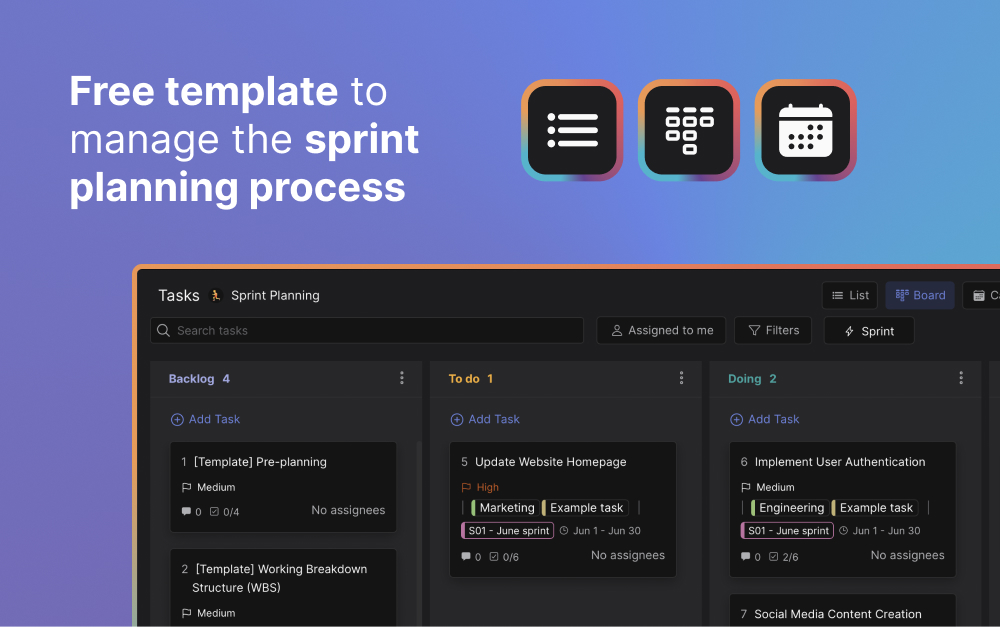
- A sprint board. Four columns: Backlog, To Do, Doing, Done.
- Async stand-ups. Threaded chat works.
- A place for retrospectives. Shared notes or a thread.
- Sprint cycles. Tasks roll over automatically week to week.
Rock gives you all five in one workspace, which is why it works as a lightweight home for Scrum for agencies. Sprints on the Unlimited plan roll tasks between cycles automatically. The Board view is your sprint board. Topics handle async stand-ups. Notes cover retrospectives. Cross-org spaces mean clients can see the parts of the backlog you choose to share, without buying their own seats. The agile sprint planning template gives you a full sprint setup in one click, with guide cards for each step.
If you want to go deeper on the agile side before committing, read about the benefits of agile project management or browse the broader project management framework guide to see how Scrum compares to other approaches.
Run scrum for agencies without the Jira overhead. Rock combines chat, tasks, and notes in one workspace. One flat price, unlimited users. Get started for free.