How to Run a Daily Standup Meeting
If your daily standup has quietly turned into a status meeting, you are not alone. Microsoft's 2025 Work Trend Index found that 30 percent of meetings now span multiple time zones, up eight points since 2021. People join half-awake from their living rooms and run through yesterday, today, and blockers while checking chat on the side. The ritual is still there, the point of it has gone missing.
A standup is meant to move work forward. Not to report up. Not to tell a manager how busy you have been. When it works, it catches blockers early and keeps the team pointed at the same goal. When it does not, it is a 15-minute tax on everyone's morning.
This guide covers how to run a daily standup meeting that actually does its job. Format options, how to avoid the status-report trap, and when to skip the meeting entirely. There is no single right way. There is a right way for your team.
Here is where I would push back on the usual advice. You might think faster tools mean less need for a standup. In some cases it is the opposite. When a team moves really fast, work can drift apart and quiet dependencies build up between people. A short, regular status check is how you catch that before it turns into rework. The point is not to read out tasks. It is to stay close enough that nobody is surprised.
What Is a Daily Standup?
It is a short, daily check-in where the team aligns on what is moving forward and what is blocking progress. The format came out of agile software development and is a core event in Scrum, where it is called the daily scrum. A stand-up meeting usually runs for 15 minutes or less. Everyone who is working on the same goal attends.
The purpose is not to report to a manager. It is for the team to coordinate with each other. Who is working on what, who needs help, what decisions need to happen today so work does not stall. That is the whole point of the standup, and the most common way it gets lost.
Teams run it differently. Some use the classic three questions as a fixed meeting agenda. Some walk the task board. Some skip the live meeting entirely and post written updates. Good standups do not all look the same. Agile as a whole, covered in our agile for agencies guide, leans on that adaptability on purpose.

Why Most Daily Standups Fail
Before we talk about how to run one, here are the four failure modes that kill most standups. If your current meeting has two or more of these, a format change will not save it. You need to redesign.
Reporting to the manager. When the manager is the one listening, the meeting becomes a status check. People say what sounds good, not what is actually blocking them. Atlassian's State of Teams 2025 survey of 12,000 knowledge workers found that high-performing teams use meetings to make decisions, not to give status updates. A standup run as a status meeting is training your team to work around it.
Timebox creep. A 15-minute meeting that consistently runs 25 is not a 15-minute meeting. It is a daily half-hour that nobody agreed to. Shopify's internal cost calculator, reported by Fortune in 2023, puts a 30-minute meeting with three people at $700 to $1,600 in real cost. Multiply that by a team of seven running five days a week and the math gets uncomfortable fast.
One person monologues. A senior voice talks for four minutes. The rest of the team zones out. Juniors stop preparing for the standup because they are not going to be heard anyway. The meeting is still happening. It stopped being useful last month.
Nobody raises blockers. People sense that flagging a blocker leads to more questions, not more help. So updates become polite fiction. Everyone says they are on track. Then Thursday afternoon the work slips, and it turns out three people knew on Monday.

Pick the Standup Format That Fits Your Team
Different teams need different formats. The picker below takes four questions about your team and recommends a daily standup format that fits, plus a template you can copy.
Which standup format fits your team?
Answer 4 questions. Get a format recommendation and a copy-ready template.
1. How many people on your team?
2. How spread out are you time-zone wise?
3. What does most of your day look like?
4. How does your team stay in sync today?
Start over
Walk the Board vs the Three Questions
The classic three-question format asks each person: what did you do yesterday, what will you do today, what is blocking you. For many teams this works fine. For others, it slowly turns into a status report. That is not a hypothetical risk. It is what the Scrum Guide authors themselves decided had happened.
In 2020, the Scrum Guide was revised. The new version described Scrum as aiming to be "a minimally sufficient framework by removing or softening prescriptive language." Among the changes, the three daily scrum questions were removed.
"Scrum 2020 aimed to be a minimally sufficient framework by removing or softening prescriptive language. e.g. removed Daily Scrum questions." - Schwaber and Sutherland, Scrum Guide 2020 Revisions
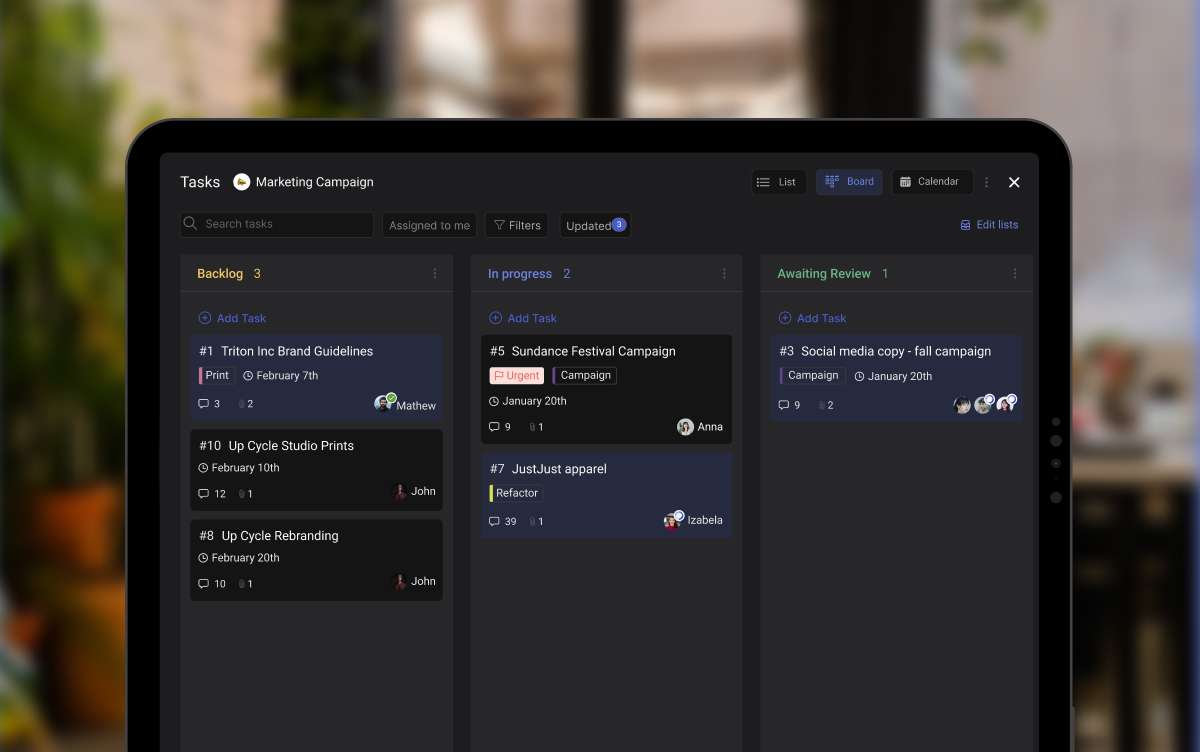
Schwaber and Sutherland, who wrote the guide, made the change because teams were treating the questions as a mechanical script instead of a live planning conversation. The alternative most teams drift toward is walking the task board. Instead of going person by person, the Scrum Master or account lead moves card by card through the In Progress column, starting with whatever is closest to Done. For each card, the owner says the next step and flags any blocker. The focus shifts from "what did I do" to "what is moving the work forward." That shift is exactly what Jason Yip, a ThoughtWorks consultant whose Patterns for Daily Standup Meetings is hosted on Martin Fowler's site, points to when he critiques the three questions format.
"The larger question is whether Yesterday Today Obstacles is creating too much of a focus on personal commitment versus paying attention to the right things." - Jason Yip, ThoughtWorks
Neither format is wrong. The standup format that fits your team depends on how your work moves, how people behave when the mic is on them, and what you need the meeting to actually do. If your team does not even have a shared task board yet, that is step zero. Our guide on why your team should use a task board covers the basics.
| Format | How it runs | Best for | Skip this if |
|---|---|---|---|
| Three questions | Each person answers: what I did, what I will do, what is blocking me. | Small co-located teams learning the rhythm. Easy to teach new joiners. | Your team started treating it like a manager check-in instead of peer sync. |
| Walk the board | Scrum Master moves card-by-card through In Progress, starting with items closest to Done. | Teams with a visible task board and a shared goal for the sprint. | There is no shared board, or work is mostly individual with no overlap. |
| Discussion-based | Team opens with the sprint goal and talks only about progress against it, no fixed format. | Senior teams who already self-organize well and want to skip the template. | Newer teams, or teams that drift off-topic without a format to anchor them. |
| Async written | Each person posts a short written update in a shared channel or topic once per working day. | Distributed teams across time zones, or any team where focus time is sacred. | The work is highly interdependent and needs live back-and-forth to unblock. |
Sync vs Async Standups
The second decision after format is whether the standup happens live or in writing. Same pattern: neither is better in all cases. It depends on the team.
A sync standup works when the team shares enough overlap that a live 15 minutes is cheap, and the work is interdependent enough that real-time back-and-forth is worth the interruption. A small team on a tight sprint goal. A product squad in one time zone. A client-facing team running a launch.
An async standup works when your time zones do not overlap enough to make a live meeting fair, or when the work is focus-sensitive and the cost of a midday interruption is high. Microsoft's Work Trend Index reports that employees now get interrupted every two minutes on average, 275 times a day. Adding a scheduled synchronous interruption to that pattern is not free. A remote standup in writing, posted once per working day in a shared thread, often gives the team more signal with less cost.
Mike Cohn, who has written about daily scrums for 20 years, puts it plainly when teams ask him person-by-person or story-by-story:
"Not all teams need to do it the same." - Mike Cohn, Mountain Goat Software
The same logic applies to sync vs async. It is a team-by-team call based on time zones, work type, and how well chat already covers coordination. The table below cuts through the common cases.
| Your situation | Sync or async | What it looks like |
|---|---|---|
| Same time zone, 4-8 people, shared sprint goal | Sync | Live 15 minutes, walk the board, hard stop. Longer discussions split off after. |
| 2-3 hour spread, mid-size team, client-facing work | Sync with some async | Sync 3 days a week during overlap. Async written update the other two days. |
| 4+ hour spread, any team size | Async | Everyone posts a written update before 11am local. Blockers get tagged in-thread. |
| Heads-down engineering work, focus-sensitive | Async | Written, not voice. Protect the maker schedule. Sync only when the sprint goal is at risk. |
| Solo freelancer or 2-3 person team | Skip it | Chat already does the job. Status lives in tasks. Revisit when you hit 5 people. |
How to Actually Run a 15-Minute Standup
Once you have picked a format, running the standup well is a small number of habits repeated. These are lifted from Yip's patterns and adapted for teams that are not pure software crews.
Same time, same place, every day. This is the simplest pattern to get wrong. A stand up meeting that moves around the calendar stops being a ritual. Pick a time. Honor it. If it is async, pick a daily post-by deadline and hold it.
Start on time. Stop on time. If the meeting is 9:00, start at 9:00. If two people are missing, start anyway. Hard stop at 9:15. If a topic is still open, that is what a side meeting is for.
Round robin, not volunteer order. When people volunteer, the same two extroverts go first and the meeting fills up before quieter teammates speak. Round robin in a fixed order solves that. Or walk the board by card, which removes the order question entirely.
Park the deep-dive. When two people start problem-solving live, the other five check out. "Let's park it, finish standup, then three of us stay on the call" is one of the highest-leverage phrases you can train into a team.
Focus on flow, not activity. The old model asks "what did you do." A better ask is "what is keeping the sprint goal at risk today." The first question generates a recap. The second generates a decision. If you want to go deeper on sprint goals, the sprint duration guide covers how to size a sprint so the standup has a meaningful anchor.
Common Standup Mistakes and How to Fix Them
Formats aside, most standups fail because of habits that sneak in over time. Here are the six mistakes we see most often in agency and small-team settings, and how to reset each one.
| Mistake | Why it fails | How to fix it |
|---|---|---|
| Reporting to the manager | People start answering for their boss, not their peers. The standup stops being a team sync. | Rotate who runs it. Manager stays quiet or skips entirely for two weeks to reset the tone. |
| Going over 15 minutes | Once it stretches to 25, half the team tunes out and the other half resents the time. | Hard stop at 15. Move the long discussion to a side meeting with just the people who care. |
| Nobody raises blockers | Teams sense that blockers will be punished, not solved. So updates become polite fiction. | The person running it asks "what decision do you need from this group?" Makes blockers welcome. |
| One person monologues | A senior voice fills the time. Juniors stop prepping because they are not going to be heard. | Timebox per person at 90 seconds. Round robin, not volunteer order. |
| Solving problems live | Two people get into it, everyone else stops listening. Fifteen minutes become thirty. | "Park it" rule. Note the problem, route to the right people, continue the standup. |
| Everyone joins remotely from the office | In-room people talk to each other, remote people miss the side chatter and disengage. | If one person is remote, everyone joins from their own laptop. Levels the playing field. |
What We Do at Rock
Honestly, we do not run a daily standup at Rock. Our team is small enough that updates already flow through chat and the task board during the day. A blocker becomes a task comment and the right person gets mentioned. Progress shows up as cards moving across the board. Threaded conversations happen in the Topics inside our team's space, on the messaging side.
We would add a lightweight async check-in if the team grew past eight people, or if we added more time zones than we have today. Right now, a standup would create more noise than it resolves. That is the honest answer, even if every agile article on the internet says we should run one. If you do need the structure, our agile sprint planning template is a solid starting point. A daily standup agenda fits naturally on top of it.

If your team is in a similar spot, do not schedule a meeting just because a framework says to. The standup is a tool. It solves a specific coordination problem. If the problem is not there, the tool is not needed.
When to Skip the Daily Standup Entirely
The small-team case is the obvious one. Below five people, chat usually does the job. Adding a meeting forces people to repeat what they already said during the day in a fixed 15-minute slot.
Solo freelancers do not need a standup. If it is just you, daily planning belongs in your own calendar or your own task list, not in a meeting with yourself.
Teams where chat is already rich often do not need a standup either. If every blocker gets raised, every decision gets made, and the board stays clean, a scheduled meeting will add overhead without adding information. The benefits of agile project management come from the habits, not the ceremony.
Retainer teams that run on Scrumban instead of Scrum often skip the daily meeting by design. The flow board is their synchronization artifact. A weekly check-in and a monthly retrospective, which we cover in how to run a retrospective, is usually enough. If you want more on which framework fits, the project management framework guide covers the picks.
The signal that you need a standup is not team size. It is whether blockers are sitting undiscovered for more than a day, or whether the team's work is pointing in subtly different directions. If either of those is happening, a short daily sync is worth trying. If neither is, you probably have better things to do at 9 AM.
A standup is only as good as the tools and habits that support it. Rock combines chat, tasks, and notes in one workspace. One flat price, unlimited users. Get started for free.