Client Management for Freelancers: 7 Rules, a Channel Map, and Client Fire Signs
Most freelance client problems are not really about the client. They are about the setup. For one freelancer's story of tightening that setup, see our Fosca case study. Late payers, scope creepers, unresponsive clients, last-minute changers: every one of them shows up less often when the first week of the engagement is structured well.
Freelancing is now a real career for about 72 million independent workers in the US alone. The tools have never been better. But most freelancers still lose hours each week to scattered email, half-finished Trello boards, and clients who text at 9pm on a Sunday.
This guide covers seven rules, a channel map, and a way to think about firing clients. Run the widget below first to get a channel setup recommendation for the client you are dealing with right now.

Pick the Right Setup for This Client
Before the seven rules, a quick recommendation for the specific client you have in front of you. Answer three questions and the widget gives you a channel setup that fits. No generic list.
Pick the right setup for this client
Three questions. Get a channel setup that fits the client, not a generic list.
Quick answer. Client management for a freelancer means running the relationship, the scope, and the communication so both your time and the client's outcome are protected. It is less about being friendly and more about being predictable. Most freelance client problems, late payers, scope creep, unresponsive clients, trace back to a loose setup, not a bad client. Seven rules do most of the work: one shared space per client, written scope from day one, response-time rules, protected weekends, documented decisions, early escalation of scope creep, and one weekly update. Pick the channel setup that fits the client at kickoff, not after three weeks of mess.
The 7 Rules of Freelance Client Management
These seven rules cover the setup that prevents most freelance client problems before they start. Each row has the rule, what it looks like in practice, and the common mistake that causes the problem in the first place.
| Rule | What it looks like in practice | Common mistake to avoid |
|---|---|---|
| 1. One shared space per client | All chat, tasks, and files live in one workspace. The client sees everything in one place. | Splitting the same client across email, WhatsApp, Trello, Drive, and Figma. Nobody can find anything three months in. |
| 2. Written scope from day one | Signed scope document with deliverables, revision limits, payment terms, and timelines. | Starting on a verbal "just do this quick." A 3-month project grows out of the gap. |
| 3. Set response-time rules upfront | "I reply within 4 business hours, Monday to Friday" pinned in the shared space. | No rules at all. The client expects instant replies and you feel guilty when you take a lunch break. |
| 4. Protect your weekends and evenings | Notifications off outside work hours. Auto-reply explains when you will respond. | Answering one weekend message "just this once." It becomes the pattern for the whole engagement. |
| 5. Document decisions in writing | Every agreement, scope change, or deadline shift written in notes or chat with the date. | Relying on memory. Three months later the client remembers it differently, and your invoice gets disputed. |
| 6. Raise scope creep early and politely | "This is outside the original scope. Here is a change order if you want me to include it." | Quietly absorbing small asks until you are doing 30 percent of the work for free. |
| 7. Send one proactive update every week | A short Friday summary: what shipped, what is next, what is blocked. Five lines max. | Only answering when the client asks. Silence feels like a problem, even when the work is going well. |
The pattern across every row is that clarity, written down, protects the relationship. Verbal agreements feel friendly. Written agreements let the friendly part actually work, because nobody is worried about being taken advantage of. For more on the communication side, our guide on communicating with clients covers the tone and messaging side.
The Channel Map
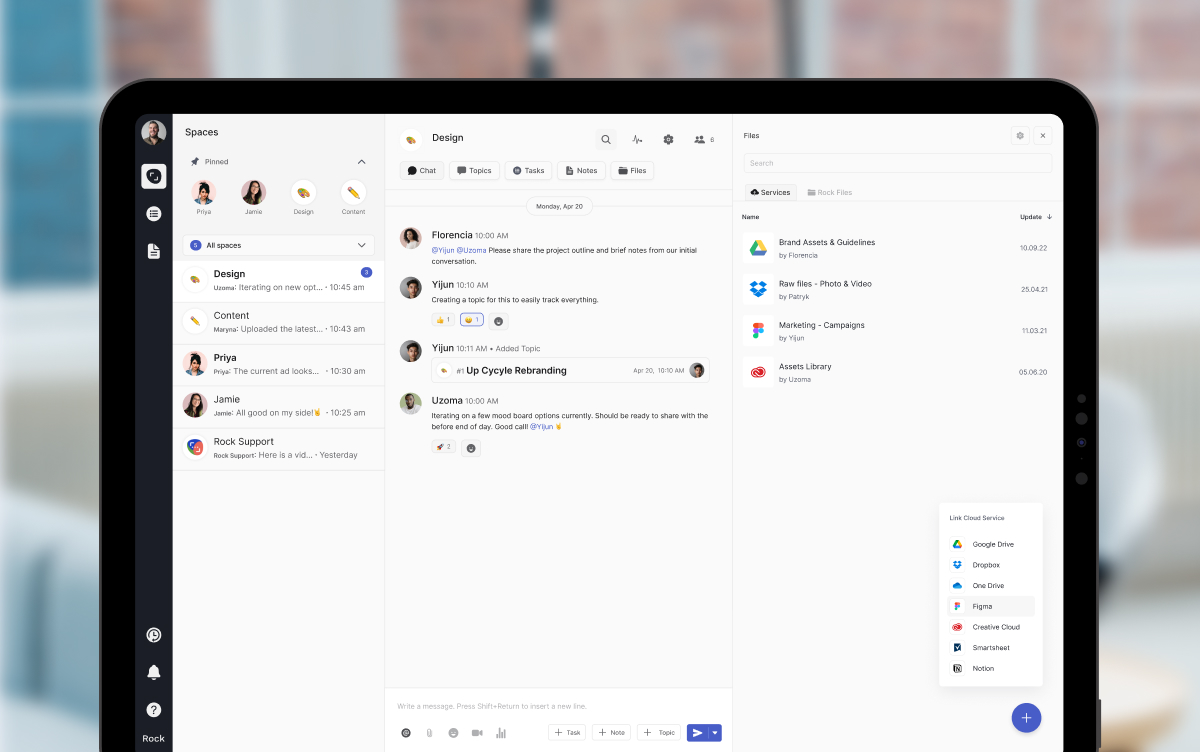
Channel choice depends on the client, not on your default preference. A one-off project does not need a workspace. A long retainer with a five-person team should not run in your email inbox. The table below maps client type to the setup that fits.
| Client type | Primary channel | Cadence | Boundaries |
|---|---|---|---|
| One-off project (under 2 weeks) | Email plus one shared document | Daily check for the duration | Response within 24 business hours |
| Short retainer (1 to 3 months) | Shared client space with chat plus weekly written update | Weekly summary, ad hoc chat during the week | Response within 4 business hours, silent weekends |
| Long retainer (3 months or more) | Full shared workspace: chat, tasks, notes, files | Weekly written summary plus biweekly live call | Same response rules, plus quarterly review to reset scope |
| High-maintenance client | Structured space with explicit rules pinned at the top | Daily light touch, weekly written summary | Escalation only through one agreed channel, not every tool at once |
| Multi-stakeholder client | Main group chat plus a private 1:1 thread with the decision-maker | Weekly group update, biweekly 1:1 with decision-maker | Group chat for discussion, 1:1 for decisions |
| Async-friendly client | Written updates plus recorded video walkthroughs | Weekly async update, no fixed call schedule | Live calls only when a decision genuinely needs real-time input |
Two things keep this simple. First, pick the setup at the start of the engagement, not after three weeks of mess. Second, pin the boundaries (response times, weekend rules, escalation path) somewhere the client actually sees them. A good client onboarding checklist covers both in the first week, which is why the first week matters so much.
The difference between a freelance relationship that grows and one that burns you out usually shows up in the first two weeks. Whatever you set up then is what you live with for the rest of the project.

The Four Most Common Client Problems
Four client types cause most freelance stress. Each one has a pattern, and each pattern can be interrupted by a specific move early in the engagement.
The late payer. Pays invoices 30, 45, or 60 days past due. The fix is in the scope document: clear payment terms, a defined late fee, and either a deposit upfront or billing in installments tied to delivery. Payment terms are not a conversation to have when the first invoice is three weeks overdue. They are a conversation to have before the first line of work.
The scope creeper. Keeps adding small asks that look reasonable individually but compound into 30 percent extra unpaid work. The fix is a written scope from day one and the habit of raising additions in writing the moment they come up. "Happy to add that. It is outside the original scope. Here is the change order." Short, polite, firm. Done in writing. Every time.
The unresponsive client. Disappears for weeks, then wants the project finished by Friday. The fix has two parts. First, a written check-in rhythm they agree to (even a weekly email is enough). Second, a clause in the scope that defines what happens when delays are on their side. If they miss a feedback deadline, the project timeline shifts. Not a threat, just a documented expectation everyone signed off on at the start.
The last-minute changer. Requests major changes the day before deadline. The fix is revision limits in the scope (two rounds, not unlimited) and a "design lock" date after which changes cost more. Good freelancers name this date in the kickoff, not when the panic request lands.

When to Fire a Client
Most freelance content skips this topic. It is the most important one.
Not every client deserves a seat on your roster. Three signs that a client is costing more than they pay.
They ignore the rules you already set. Response-time rules, weekend silence, revision limits. You set them, they acknowledged them, and they still cross them every week. That is not a miscommunication. That is a values mismatch.
They talk to you differently than they talk to their own team. If your calls feel tense and everyone internal to their company seems fine, you are not the problem. You are just the outside resource that makes it acceptable to vent.
The P and L does not work. If you calculate your effective hourly rate including all the unpaid admin time, follow-up emails, and unplanned "quick calls," and it is below what you would accept as a salary, the client is subsidized by your evenings. That is not sustainable.
Firing a client is a two-step conversation. First, raise the specific issue in writing and offer a fix. "Our current setup is not working. Here is what I need to continue: X and Y." If they accept and change, good. If they push back or go silent, send the 30-day notice to wind down, complete your contracted work cleanly, and move on. Do not burn the relationship. Most bad clients came from good referrals, and the referral chain heals faster than you think.
One more note on this. Firing a client does not feel good in the moment, but the freelancers who never do it tend to hit a ceiling. Your capacity is fixed. Every hour spent on a bad client is an hour you cannot spend on a better one. The math always works out in favor of protecting the top of your roster.
What We Do at Rock
Rock is built for freelancer-client collaboration, and a meaningful share of our users run exactly this kind of work. The pattern among the ones who have long, profitable relationships is consistent.
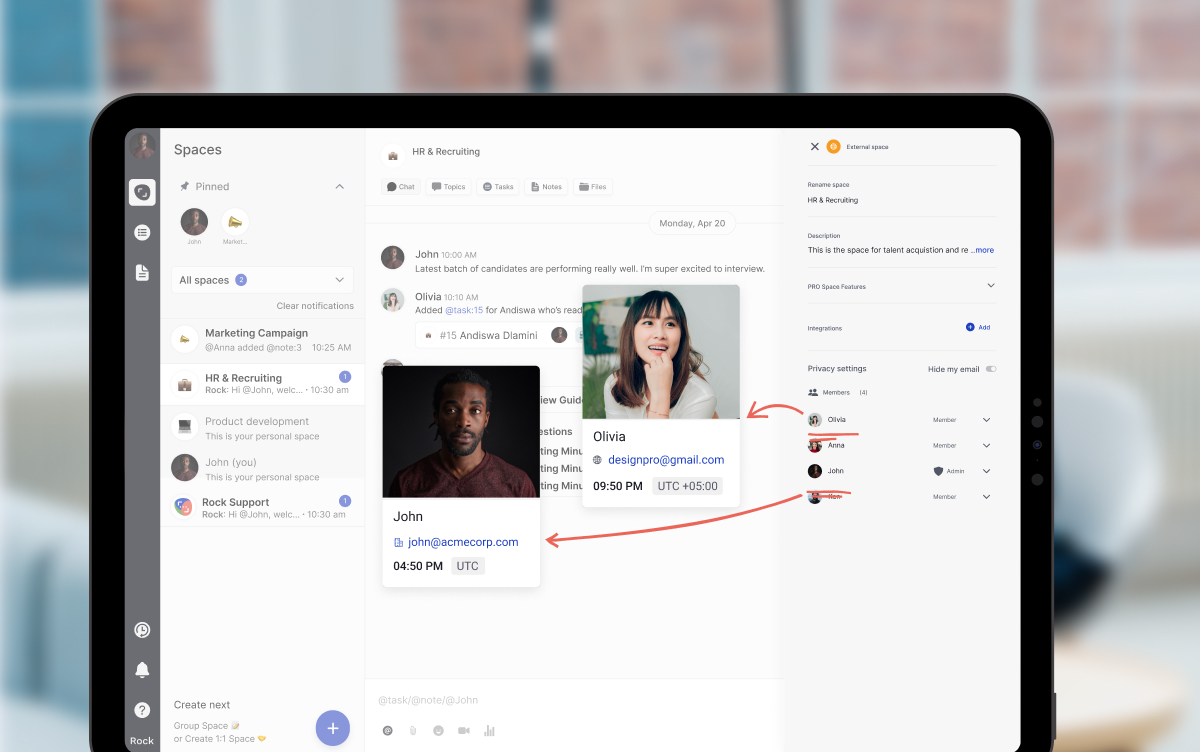
They run one shared space per client. Chat, tasks, notes, and files all live there. The client joins as a guest at no extra cost, which removes the friction of "which tool are we using this time?" for every new client. The scope document sits pinned at the top of the space. The weekly update is a pinned note. Response-time rules are the first thing a new client sees when they join.
The freelancers who struggle run the same client across email, WhatsApp, a Trello board, Google Drive, and Figma. Every update requires five tools. Every handoff loses context. By month three, nobody knows where anything is.
Harvard Business Review's research on client retention still holds: a 5 percent increase in retention can lift profits by 25 to 95 percent. For a freelancer, retention is everything, because client acquisition is the most expensive time you spend all year. One shared workspace where the relationship, the scope, and the work all live together is a retention tool disguised as a productivity tool.
The Short Version
Client management for a freelancer is not about being nicer. It is about being clearer, sooner, in writing. Seven rules do most of the work: one shared space per client, written scope from day one, response-time rules, protected weekends, documented decisions, early escalation of scope creep, and one proactive update every week.
Pick the channel setup that fits the client, not a default. Run the channel map at kickoff. Raise problems in writing the moment they start, not the month they blow up. And fire the clients who keep crossing lines you already agreed on.
For tool picks, see our roundup of the best client management software for freelancers. For related reading, see our guides on communicating with clients, client onboarding, scope of work templates, and the full client management playbook.
Freelance client management works best when every client has one shared space instead of five scattered tools. See how freelancers run client work on Rock across multiple retainers. Rock combines chat, tasks, and notes in one workspace. One flat price, clients join free. Get started for free.